Those of us who are baby boomers and grew up in evangelical churches in America experienced firsthand the birth of "contemporary Christian music" and the battles it has spawned. The cultural revolution of the 1960s affected every institution, including the church. For one of us, living in Southern California during the 1970s meant witnessing the culture shift brought to the church by the Jesus Movement, giving rise to Maranatha! Music and Christian rock bands playing every Saturday night for thousands of young people at the original Calvary Chapel, in Costa Mesa. On the other hand, it also meant being lectured by ex-rock-musicians-turned-Christians who warned Christian teenagers to stay away from rock music, even when it had Christian lyrics, because, as everyone knows, "volume plus pulsation equals manipulation."
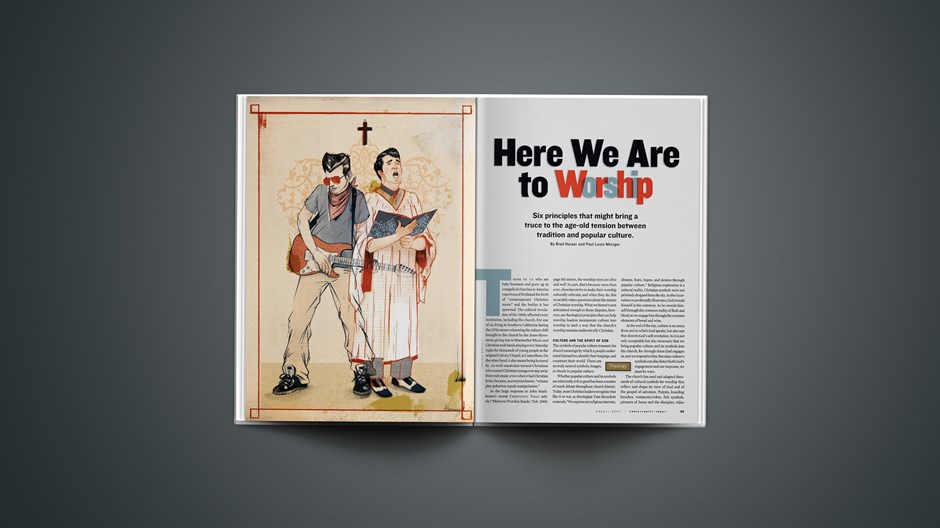
As the large response to John Stackhouse's recent Christianity Today article ("Memo to Worship Bands," Feb. 2009, page 50) attests, the worship wars are alive and well. In part, that's because more than ever, churches strive to make their worship culturally relevant, and when they do, this invariably raises questions about the nature of Christian worship. What we haven't seen articulated enough in these disputes, however, are theological principles that can help worship leaders incorporate culture into worship in such a way that the church's worship remains authentically Christian.
Culture and the Spirit of God
The symbols of popular culture transmit the shared meanings by which a people understand themselves, identify their longings, and construct their world. There are no truly neutral symbols, images, or rituals in popular culture.
Whether popular culture and its symbols are inherently evil or good has been a matter of much debate throughout church history. Today, most Christian leaders recognize that like it or not, as theologian Tom Beaudoin contends, "We express our religious interests, dreams, fears, hopes, and desires through popular culture." Religious expression is a cultural reality. Christian symbols were not pristinely dropped from the sky. As the Incarnation so profoundly illustrates, God reveals himself in the common. As he reveals himself through the common reality of flesh and blood, so we engage him through the common elements of bread and wine.
At the end of the day, culture is an arena from and to which God speaks, but also one that distorts God's self-revelation. So it is not only acceptable but also necessary that we bring popular culture and its symbols into the church, for through them God engages us, and we respond to him. But since culture's symbols can also distort both God's engagement and our response, we must be wary.
The church has used and adapted thousands of cultural symbols for worship that reflect and shape its view of God and of the gospel of salvation. Pulpits, kneeling benches, vestments/robes, fish symbols, pictures of Jesus and the disciples, video screens, incense, movie clips, and so on all affect the church's view of God and the communication of the gospel. The result has been a consistent tension in the church between form and function.
If the forms of worship are meant to communicate God and his message of salvation (the function), then as culture precipitates a change in forms, this change necessarily affects the function. The basic question the church must address is, Do changing worship forms adapted from popular culture facilitate an authentic encounter with God in Christ through the Holy Spirit as described by the Scriptures and understood by historic Christian orthodoxy?
To examine this question, we will build upon six affirmations for worship from John D. Witvliet in his book Worship Seeking Understanding:
(1) All liturgical action is culturally conditioned. Witvliet writes, "Liturgical enculturation best begins with an accurate description of existing cultural influences on liturgical celebration." Simply stated, since worship will necessarily involve elements of popular culture, the church must examine its worship forms, asking how contemporary culture has influenced its worship.
(2) The relationship between liturgy and culture is theologically framed by creation and the Incarnation. If creation provides the basis for human cultural activity, then Christian cultural engagement can be seen as containing great potential for good. Moreover, the Incarnation provides the model for the church's involvement with culture. Thus, if God, in taking on the form and identity of a creation/cultural reality in Jesus, facilitates the clearest image of who God is, then the church must recognize that popular culture symbols have the potential for a powerful and positive place in worship.
(3) Integrating liturgy and culture requires us to be critical of our own cultural context. Worship leaders need to critique the culturally generated worship forms they use, asking whether each form enhances or degrades authentic worship. Contemporary forms must be examined to see not only if they engage the church through commonly understandable symbols, but also if they are able to represent God and the gospel with integrity.
Article continues below
Few people, perhaps, would question that popular cultural worship forms can engage a broad spectrum of people. People who already identify with contemporary music and computer graphics will find themselves easily drawn into the worship experience when such forms are used. But thoughtful worship leaders and theologians have recognized that there can be a downside as well. As theologian Donald Bloesch has written,
Worship is not a means to tap into the creative powers within us rather than an occasion to bring before God our sacrifices of praise and thanksgiving. Hymns that retell the story of salvation as delineated in the Bible are being supplanted by praise choruses that are designed to transport the soul into a higher dimension of reality.
Worship is not about a search for meaning or experience, but an acknowledgment that meaning and salvation are found in God's incomparable act of redemption in Christ. Methodist pastor Craig Rice agrees: "As long as the church continues to confuse the hunger for God, extant in every human heart, with the same yearnings that drive a market culture and a consumerist society, its worship will remain irrelevant at best and an outright impediment at worst."
There is no question that authentic worship will meet people's needs. The problem occurs when worship forms are focused on meeting people's felt needs. Each week, the church is filled with people whose felt needs have been defined for them by a consumer culture that generally urges them to focus on self-fulfillment. The role of the church in worship is not to meet felt needs but to show people that their real needs go deeper.
Can contemporary worship forms address people's real needs? Certainly. But in choosing only forms that are comfortable and familiar, there is always the tendency to cater to what people want to hear and feel, rather than confronting them with God, whose presence is not always so comfortable. And a God made comfortable by market-driven worship is unlikely to confront sinners with their need for repentance or a gospel that is fundamentally about self-denial rather than self-fulfillment. Quoting Martin Marty, theologian Marva Dawn remarks that when worship is driven by the market, it "draws crowds, but it is so fully adapted to the not-yet-born-again 'that worship becomes measured by the aesthetics and experience of those who don't yet know why we should shudder.'"
Article continues below
(4) The extremes of either complete identification with or rejection of a given culture should be avoided. "In every instance of cultural engagement," says Witvliet, "there must be a yes and a no, a being in but not of, a continuity and a discontinuity with accepted cultural practices." Dawn agrees, suggesting that the Christian faith has always been odd, and that we must emphasize the importance of that dialectical pole.
However, when churches take this to the extreme—becoming completely alien to the culture in sticking to traditions or celebrating them in ways irrelevant to normal life—then Christians separate themselves from the world in a sectarianism, provincialism, or esoteric Gnosticism that prevents ministry to the culture. The best array of worship forms will illustrate that the church is both embedded in culture, speaking through its constantly changing forms, and also a countercultural community, one that represents transcendent values and truths that confront culture's fallenness.
(5) Worship must reflect common elements of the Christian tradition through the unique expressions of a particular cultural context. If we adapt the church's worship forms too fully to the unique forms of a particular culture or subculture, those outside that culture who come to the church may have no idea of the form's transcendent meaning and will not be able to connect it to God or the gospel. Moreover, the unchecked use of cultural forms for worship runs the risk of producing a national Christianity, or worse, a national (American) Jesus, or a Gen X, baby boomer, or postmodern Jesus, with the result that the church begins to bear witness to a God made in culture's own image.
One example: Many large churches try to solve worship-style frustrations by opting for both a traditional service and a contemporary service. To do this is necessarily to divide a local congregation into two congregations, based usually on the age of the worshipers, with the older worshipers attending the traditional service and the younger attending the contemporary one. Given that most American churches already divide into other smaller gatherings (e.g., adult Bible classes, youth groups), where then does the church come together as a multigenerational community to worship its Lord? Where do young people learn the riches of "ancient" worship symbols, and where do old Christians learn to worship the same God in new ways, helping them to continue engaging an ever-changing culture?
Article continues below
(6) The liturgical actions of the church—including proclamation of the Word, common prayer, baptism, and Eucharist—are among the "universal" or common factors in the Christian tradition. And these kinds of symbols should remain universal for at least two reasons.
First, the church is not only a multicultural community, but also a historical community, one that always finds its identity in the same God revealed in Jesus Christ. Thus, as there are theological and relational realities that unify the church through the ages, this unity should be reflected in a consistency of symbols.
Moreover, the use of historic forms of Christian worship allows a congregation to understand experientially that it is not merely a present community, in danger of passing away along with other fads of modernity, but a community in living union with believers of all time, coming to the same table to meet the same Jesus encountered by the disciples at the Last Supper 2,000 years ago. The church obsessed with constantly reinterpreting itself through ever-newer symbols is in danger of forgetting who it is and why it exists. Walter Brueggemann laments,
In a stupor of amnesia, a community may think there is only "now," and there is only "us." … People with amnesia are enormously open to suggestion, blind obedience, and easy administration.
But some might object, "Why do we have to retain ancient forms and symbols to remember who we are and who God is? Can't we represent enduring realities best in the language of contemporary culture?" In regard to certain symbols, the answer is definitely no, which leads us to the second reason to keep certain worship forms consistent despite a changing culture: Scripture sometimes ordains not only the function but also the form.
An obvious example is the Lord's Supper. To a certain extent, the form is the function here. During the early church era, the form of Eucharist was offensive to pagans, who thought it was a kind of cannibalism. But the church was unwilling to change the form because it was so closely connected to the message it represented.
Some have suggested that, since symbols like bread and wine do not have the same meaning in all cultures as they did in ancient Middle Eastern culture, the church should use "cultural equivalents," that is, symbols from each culture that have the same meaning. The problem is that cultural equivalents are never exact, and usually not even that close in their meaning. For example, some have suggested using rice instead of bread for the Eucharist in Asian cultures, since rice, like bread in other cultures, is the basic food source of daily life. The problem is that bread represents much more than this in the biblical narrative. It represents the presence of God, as illustrated by the showbread in the temple. Also, unlike rice, the ability of bread to be broken is of supreme importance to the image of the broken body of Christ. Similarly, one is unlikely to find a cultural equivalent for wine, which represents not only a basic meal drink in the biblical text, but also life, blood, and judgment.
Article continues below
Better simply to teach people the significance of the ancient signs and preserve them intact.
Yes and No
So what is the solution to the worship wars, to the battle over contemporary versus traditional worship forms? As suggested above, the answer must lie in a dialectical, yes-and-no approach. When contemporary forms draw a broad community of worshipers more effectively into authentic engagement with the Trinitarian God, yes. When they accurately represent the biblical gospel, yes.
When contemporary forms present an image of God or the gospel that lacks the fullness of or distorts the image given by historic Christian tradition and the biblical narrative, no. When they create unmitigated divisions in the local church, no. If the biblical image of the church is multiethnic, multigenerational, and multicultural, then the church should prize such diversities even in the midst of their difficulties, seeking always to bring the diverse elements of its community into unity through worship.
When it comes to the ongoing tension between worship and cultural engagement, Dawn has said it well: "The primary key for holding the two poles of this dialectic together is education—teaching the gifts of the faith tradition to those who do not yet know and understand them, and teaching those who love the heritage some new forms in which it can be presented to others."
Brad Harper is professor of theology at Multnomah University. Paul Louis Metzger is professor of theology and culture at Multnomah Biblical Seminary of Multnomah University. They are coauthors of Exploring Ecclesiology (Brazos Press, 2009), from which this article is excerpted and condensed. Download a Bible study for this article at ChristianBibleStudy.com.
















 While we pray for peace, we need moral clarity about this war.
 As my doubts about his teachings grew, so did a secret fascination with Jesus.
 After lobbying from fellow Southern Baptists and Christians affected by the war, the House speaker moves a package forward.






