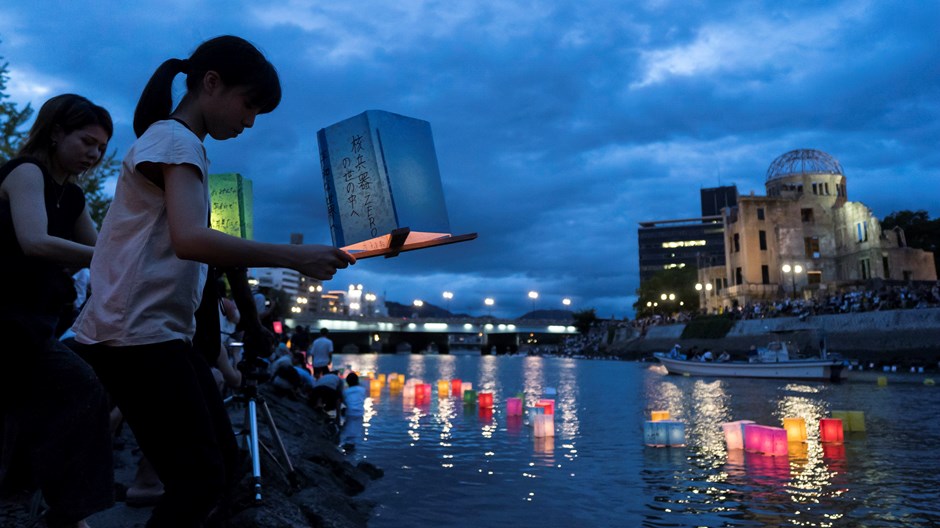
Sixty-four years ago today, the United States dropped a uranium bomb called "Little Boy" on the Japanese city of Hiroshima. It was the first use of nuclear weaponry in history. Three days later, the plutonium bomb known as "Fat Man" was dropped on Nagasaki. Six days after that, the Japanese surrendered, and World War II ended.
There's little disagreement about what the bombs did: The two blasts and their immediate aftermaths resulted in 150,000-246,000 deaths.
The historical impact of the bomb, however, is another matter. Most Americans believe—with reason—that the bombings forced Japan's surrender, thus averting a planned invasion of the islands that would have taken a grisly toll on both sides.
Others contend that Hiroshima and Nagasaki, coming on the heels of a six-month conventional firebombing campaign, had less to do ending the war than did the successful Soviet invasion of Japanese-held Manchuria on August 9.
The debate still generates considerable heat, all the more so with nuclear weapons roaring back into public discussion.
In recent years, an unlikely coalition of former Cold Warriors has urged movement toward the global abolition of nuclear weapons. This position, which would have been dismissed as fantasy even five years ago, now has the support of two-thirds of the former secretaries of state, defense, and national security advisers, was endorsed by both presidential candidates in the 2008 elections, and has been adopted as policy by the current administration.
Of course, not everyone agrees with this position—and the presumed effect of the Hiroshima and Nagasaki bombings is often cited as a reason to keep a sizable nuclear arsenal.
But—whatever the Bomb's role in ending the war—Hiroshima gives us no basis for rejecting current proposals for a nuclear weapons-free world.
Here are three reasons why:
(1) First of their kind vs. a proliferated world. The first nuclear weapons were unique, developed in utter secrecy. Former Secretary of State George Shultz, then a young Marine in the Pacific, recalls the news that an atomic bomb had been dropped, saying, "There wasn't anybody on the ship who had the foggiest idea what that was." This meant that retaliation in kind was literally unimaginable for the Japanese.
The same is not true today: nine nations possess a combined total of 20,000-plus nuclear weapons; more than three dozen countries are nuclear-capable; and the explosive devices that leveled Hiroshima and Nagasaki are the size of the triggers on some modern nuclear weapons, which are orders of magnitude more powerful. The use of a nuclear weapon today would almost certainly beget further use, sparking a chain reaction—the unpredictability of which would be exceeded only by its destructiveness.
(2) A world at war vs. absence of global conflict. The pictures of Hiroshima and Nagasaki managed to shock a world whose collective conscience had been callused by more than a half-decade of war. Yet the bombing was but one horror in an overall conflict that claimed 60 million lives.
That context matters. Despite the persistence of regional wars, we are now blessedly free of any global struggle—like the World Wars, or the Cold War—that would justify or even give meaning to such massive loss of life. There is no conflict today in which the use of a nuclear weapon could conceivably be justified as necessary or proportional.
(3) Wartime economies vs. a flat world. When the bombs were dropped on Hiroshima and Nagasaki, national economies were isolated and devastated by war. This meant that the bombs dropped on Hiroshima and Nagasaki, for all their destructiveness, had localized consequences.
Today, the current downturn notwithstanding, we live in a globalized economy characterized by financial interdependence. It is nearly impossible to overestimate the economic fallout from the use of even one nuclear weapon today: our system depends on the security of cities, reasonableness of investment, and a smoothly functioning global supply chain. A nuclear attack would strike at the heart of global prosperity, causing massive suffering far beyond the sphere of immediate nuclear conflict.
So, maybe Fat Man and Little Boy ended the war, and maybe they didn't. Either way, vested interests in interpreting Hiroshima and Nagasaki don't do us any good.
Those who use Hiroshima to defend nuclear weaponry are forced to adopt a sort of celebratory triumphalism about the massive, indiscriminate killing of civilians, which contravenes every principle of Christian just war theory. And those on the other side, who use Hiroshima to decry the Bomb, often find themselves in a position that seems to impose a false moral equivalency on both the cause and conduct of World War II-era Japan and America.
How much better it would be, instead, if we could remember Hiroshima and Nagasaki rightly: as two events involving massive suffering and loss of life, situated within the vast tapestry of suffering and death that was World War II.
Article continues below
Consider Shultz, who—if the bombings did prevent an invasion—is one of the lives that may have been saved. That fact hasn't kept him away from the forefront of the current push to do away with nuclear weapons altogether.
Whether the bombings averted further tragedy by shortening that conflict is a debate that historians can and should continue. But, in the interest of ensuring that Hiroshima and Nagasaki go down in history as the first and last uses of nuclear weapons in war—a goal we can all agree on—we'd do well to let our historical disagreements stay historical.
Tyler Wigg-Stevenson is the founder and director of the Two Futures Project. "Speaking Out" is Christianity Today's guest opinion column and (unlike an editorial) does not necessarily represent the opinion of the publication.












 While we pray for peace, we need moral clarity about this war.
 A Christian reconciliation group in Israel and Palestine warned that war would come. Now the war threatens their relevance.españolالعربيةFrançais
 Christians can disciple each other toward action, prayer, and hope.





