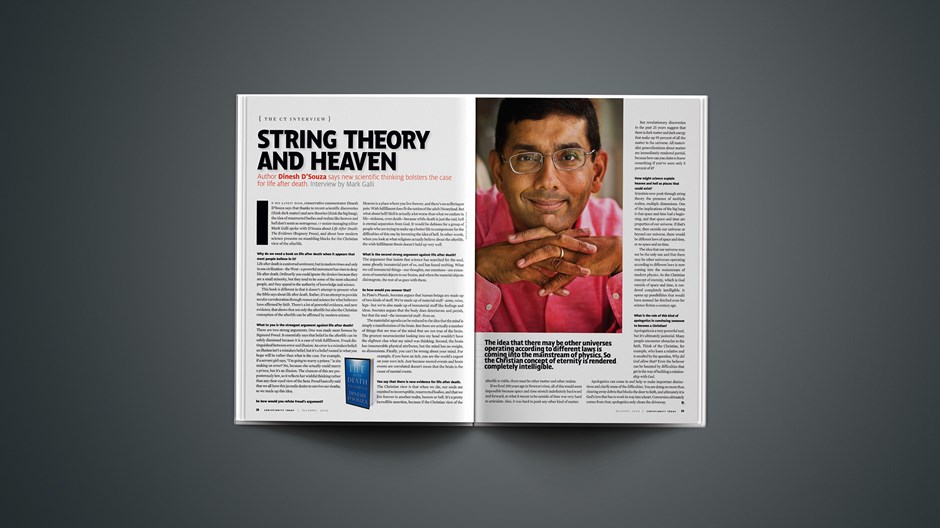
In his latest book, conservative commentator Dinesh D'Souza says that thanks to recent scientific discoveries (think dark matter) and new theories (think the big bang), the idea of resurrected bodies and realms like heaven and hell don't seem so outrageous. CT senior managing editor Mark Galli spoke with D'Souza about Life After Death: The Evidence (Regnery Press), and about how modern science presents no stumbling blocks for the Christian view of the afterlife.
Why do we need a book on life after death when it appears that most people believe in it?
Life after death is a universal sentiment, but in modern times and only in one civilization—the West—a powerful movement has risen to deny life after death. Ordinarily you could ignore the deniers because they are a small minority, but they tend to be some of the most educated people, and they appeal to the authority of knowledge and science.
This book is different in that it doesn't attempt to present what the Bible says about life after death. Rather, it's an attempt to provide secular corroboration through reason and science for what believers have affirmed by faith. There's a lot of powerful evidence, and new evidence, that shows that not only the afterlife but also the Christian conception of the afterlife can be affirmed by modern science.
What to you is the strongest argument against life after death?
There are two strong arguments. One was made most famous by Sigmund Freud. It essentially says that belief in the afterlife can be safely dismissed because it is a case of wish fulfillment. Freud distinguished between error and illusion: An error is a mistaken belief; an illusion isn't a mistaken belief, but it's a belief rooted in what you hope will be rather than what is the case. For example, if a servant girl says, "I'm going to marry a prince," is she making an error? No, because she actually could marry a prince, but it's an illusion. The chances of this are preposterously low, so it reflects her wishful thinking rather than any clear-eyed view of the facts. Freud basically said that we all have this juvenile desire to survive our deaths, so we made up this idea.
So how would you refute Freud's argument?
Heaven is a place where you live forever, and there's no suffering or pain. Wish fulfillment does fit the notion of the adult Disneyland. But what about hell? Hell is actually a lot worse than what we endure in life—sickness, even death—because while death is just the end, hell is eternal separation from God. It would be dubious for a group of people who are trying to make up a better life to compensate for the difficulties of this one by inventing the idea of hell. In other words, when you look at what religions actually believe about the afterlife, the wish fulfillment thesis doesn't hold up very well.
What is the second strong argument against life after death?
The argument that insists that science has searched for the soul, some ghostly immaterial part of us, and has found nothing. What we call immaterial things—our thoughts, our emotions—are extensions of material objects in our brains, and when the material objects disintegrate, the rest of us goes with them.
So how would you answer that?
In Plato's Phaedo, Socrates argues that human beings are made up of two kinds of stuff. We're made up of material stuff—arms, veins, legs—but we're also made up of immaterial stuff like feelings and ideas. Socrates argues that the body does deteriorate and perish, but that the soul—the immaterial stuff—lives on.
The materialist agenda can be reduced to the idea that the mind is simply a manifestation of the brain. But there are actually a number of things that are true of the mind that are not true of the brain. The greatest neuroscientist looking into my head wouldn't have the slightest clue what my mind was thinking. Second, the brain has innumerable physical attributes, but the mind has no weight, no dimensions. Finally, you can't be wrong about your mind. For example, if you have an itch, you are the world's expert on your own itch. Just because mental events and brain events are correlated doesn't mean that the brain is the cause of mental events.
You say that there is new evidence for life after death.
The Christian view is that when we die, our souls are reunited to incorruptible, resurrected bodies, and that we live forever in another realm, heaven or hell. It's a pretty incredible assertion, because if the Christian view of the afterlife is viable, there must be other matter and other realms.
If we lived 200 years ago in Newton's time, all of this would seem impossible because space and time stretch indefinitely backward and forward, so what it meant to be outside of time was very hard to articulate. Also, it was hard to posit any other kind of matter.
But revolutionary discoveries in the past 25 years suggest that there is dark matter and dark energy that make up 95 percent of all the matter in the universe. All materialist generalizations about matter are immediately rendered partial, because how can you claim to know something if you've seen only 5 percent of it?
Article continues below
How might science explain heaven and hell as places that could exist?
Scientists now posit through string theory the presence of multiple realms, multiple dimensions. One of the implications of the big bang is that space and time had a beginning, and that space and time are properties of our universe. If that's true, then outside our universe or beyond our universe, there would be different laws of space and time, or no space and no time.
The idea that our universe may not be the only one and that there may be other universes operating according to different laws is now coming into the mainstream of modern physics. So the Christian concept of eternity, which is God outside of space and time, is rendered completely intelligible. It opens up possibilities that would have seemed far-fetched even for science fiction a century ago.
What is the role of this kind of apologetics in convincing someone to become a Christian?
Apologetics is a very powerful tool, but it's ultimately janitorial. Many people encounter obstacles to the faith. Think of the Christian, for example, who loses a relative and is assailed by the question, Why did God allow that? Even the believer can be haunted by difficulties that get in the way of building a relationship with God.
Apologetics can come in and help to make important distinctions and clarify some of the difficulties. You are doing no more than clearing away debris that blocks the door to faith, and ultimately it is God's love that has to work its way into a heart. Conversion ultimately comes from that; apologetics only clears the driveway.
















 While we pray for peace, we need moral clarity about this war.
 As my doubts about his teachings grew, so did a secret fascination with Jesus.
 Beyoncé’s right. Whether listening to Cowboy Carter or reading theology, diversity is a good thing.






