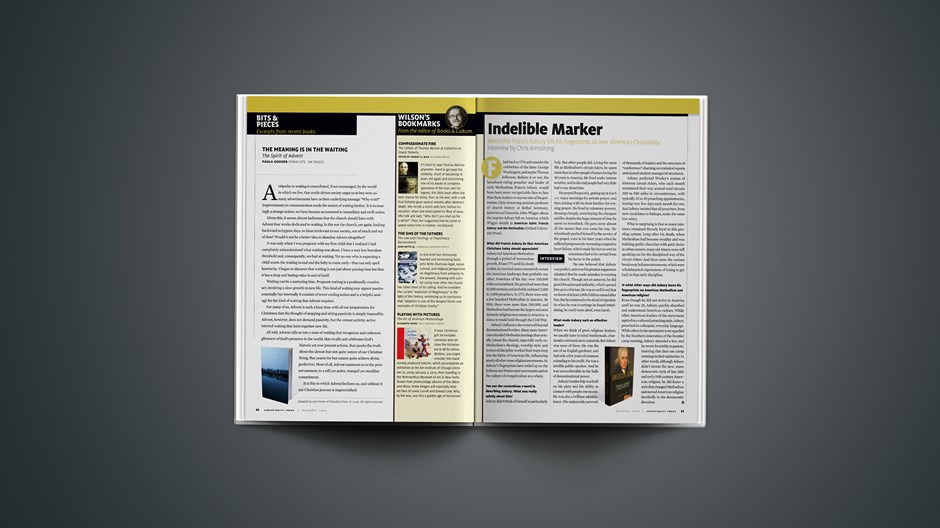
Flash back to 1776 and consider the celebrities of the time: George Washington, and maybe Thomas Jefferson. Believe it or not, the horseback-riding preacher and leader of early Methodism, Francis Asbury, would have been more recognizable face to face than these leaders or anyone else of his generation. Chris Armstrong, associate professor of church history at Bethel Seminary, interviewed historian John Wigger about the imprint Asbury left on America, which Wigger details in American Saint: Francis Asbury and the Methodists (Oxford University Press).
What did Francis Asbury do that American Christians today should appreciate?
Asbury led American Methodism through a period of tremendous growth. From 1771 until his death in 1816, he traveled more extensively across the American landscape than probably any other American of his day: over 130,000 miles on horseback. He preached more than 10,000 sermons and probably ordained 2,000 to 3,000 preachers. In 1771, there were only a few hundred Methodists in America. By 1816, there were more than 200,000, and Methodism had become the largest and most dynamic religious movement in America—a status it would hold through the Civil War.
Asbury's influence also went well beyond denominational borders. Many more Americans attended Methodist meetings than actually joined the church, especially early on. Methodism's theology, worship style, and system of discipline worked their ways deep into the fabric of American life, influencing nearly all other mass religious movements. So Asbury's fingerprints have ended up on the holiness and Pentecostal movements and on the culture of evangelicalism as a whole.
You use the contentious s-word in describing Asbury. What was really saintly about him?
Asbury didn't think of himself as particularly holy. But other people did. Living the same life as Methodism's circuit riders, he spent most days in other people's homes during his 45 years in America. He lived under intense scrutiny, and in the end people had very little bad to say about him.
He prayed frequently, getting up at 4 or 5 A.M. many mornings for private prayer, and then joining with his host families for evening prayer. He lived in voluntary poverty, dressing cheaply, even buying the cheapest saddles despite the huge amount of time he spent on horseback. He gave away almost all the money that ever came his way. He relentlessly pushed himself in the service of the gospel, even in his later years when he suffered progressively worsening congestive heart failure, which made his feet so sore he sometimes had to be carried from his horse to the pulpit.
No one believed that Asbury was perfect, and even his greatest supporters admitted that he made mistakes in running the church. Though not an autocrat, he did guard his episcopal authority, which opened him up to criticism. He was so well loved that we know of at least 1,000 children named after him. But he continued to be afraid of rejection. So when he was in settings he found intimidating, he could seem aloof, even harsh.
What made Asbury such an effective leader?
When we think of great religious leaders, we usually have in mind intellectuals, charismatic communicators, autocrats. But Asbury was none of these. He was the son of an English gardener, and had only a few years of common schooling to his credit. He was a terrible public speaker. And he was uncomfortable in the halls of denominational power.
Asbury's leadership was built on his piety and his ability to connect with people one on one. He was also a brilliant administrator. His nationwide network of thousands of leaders and the structure of "conferences" churning out statistical reports anticipated modern managerial structures.
Asbury perfected Wesley's system of itinerant circuit riders, who each month ministered their way around rural circuits 200 to 500 miles in circumference, with typically 25 to 30 preaching appointments, leaving very few days each month for rest. And Asbury insisted that all preachers, from new candidates to bishops, make the same low salary.
What is surprising is that so many ministers remained fiercely loyal to this grueling system. Long after his death, when Methodism had become wealthy and was building gothic churches with paid choirs in urban centers, many old-timers were still speaking out for the disciplined way of the circuit riders. And then came the various breakaway holiness movements, which were wholehearted expressions of trying to get back to that early discipline.
In what other ways did Asbury leave his fingerprints on American Methodism and American religion?
Even though he did not arrive in America until he was 26, Asbury quickly absorbed and understood American culture. While other American leaders of the movement aspired to a cultured preaching style, Asbury preached in colloquial, everyday language. While others in the movement were appalled by the Southern innovation of the frontier camp meeting, Asbury attended a few, and he wrote feverishly to pastors, insisting that they use camp meetings in their ministries. In other words, although Asbury didn't invent the new, more democratic style of late 18th and early 19th century American religion, he did foster a style that changed Methodism and moved American religion decidedly in the democratic direction.















 While we pray for peace, we need moral clarity about this war.
 We’ve got little information on Jesus’ appearance and personality. But that’s the way God designed it.españolFrançais
 The Grammy-winning artist was found dead at her home in Nashville at age 47.






