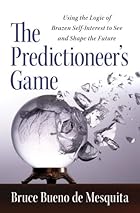
The Predictioneer's Game: Using the Logic of Brazen Self-Interest to See and Shape the Future
Author
Bruce Bueno De Mesquita
Publisher
Random House
Release Date
September 29, 2009
Pages
272
Price
14.6
The game of "What Makes Us Human?"—or what made us human at some point in our long evolutionary history, so the story goes—continues to provide entertainment. Richard Wrangham's Catching Fire: How Cooking Made Us Human, published earlier this year, must have gladdened many a kitchen. But whatever else we are—forked radishes, singing Neanderthals, political animals, and so on—we are also predictioneers, all of us, in a way that distinguishes us from our fellow creatures. (Prediction + engineer = predictioneer.) Like chess players, we look ahead, weighing alternative possibilities. By anticipating what might be, we hope—within our modest sphere of influence—to shape what is. Bruce Bueno de Mesquita—let that name roll off your tongue a couple of times—differs from most of us in that he makes his living doing what humans typically do in a less systematic fashion. He invites us into his workshop in The Predictioneer's Game: Using the Logic of Brazen Self-Interest to See and Shape the Future (Random House).
As the cheesy subtitle suggests (we are brazenly self-interested, you see, and we had better get used to it), parts of Bueno de Mesquita's brilliant mind are still controlled by his high-school self. If you simply can't endure another juvenile takedown of Mother Teresa, you should probably skip this book. But if you persist, you'll get your money's worth and more from these pages. In fact, I predict that if you do read this book, you'll be thinking about it for weeks afterward, reminded of it every time you read the newspaper or the headlines on the Web.
Like John Nash, the Nobel Prize—winning mathematician whose life was the subject of the book A Beautiful Mind and the film taking off from it, Bueno de Mesquita is a game theorist: he works with models of complex human interactions, models that assume self-interested behavior ("rational choice") by all parties. But he differs from Nash in that he's primarily engaged in applying the theory to negotiations or potential negotiations in many settings, ranging from political conflicts to corporate mergers and litigation. (To introduce and demystify the strategic thinking at the heart of game theory, he spends the entire first chapter telling us how to get the best possible deal when buying a new car.)
Whatever the nature of the problem at hand, Bueno de Mesquita and his associates conduct extensive interviews with expert observers, identifying the parties with a significant stake in the outcome and clarifying what they say they want, what their preferences are (how they would rank various possible outcomes), and who among the players might be particularly influential in the negotiation process. The information thus gathered is fed into a mathematical model that he has refined over the years, and based on the results, he will advise his clients (the CIA, various other government bodies, corporate boards) how to proceed.
None of this sounds particularly striking. What makes Bueno de Mesquita's work interesting to the rest of us? To begin with, his predictions are unusually specific. While much of the advice he's dispensed over the years remains confidential, he has shown an admirable willingness to go out on a limb in public—as he did at the TED conference in February 2009, when he predicted that Iran would not (in the near future) build a nuclear bomb. And his track record with such predictions is impressive. He likes to cite a declassified internal cia study crediting him with a 90 percent rate of success (adding that his predictions often differed from those of the cia analysts who provided the information he used to reach his conclusions).
All right. What might we learn from Bueno de Mesquita, apart from the specific perspectives his book offers on the Israeli-Palestinian conflict, U.S. withdrawal from Iraq, our relations with Pakistan, the threat posed by North Korea, and assorted other subjects? One recurring theme is his insistence that whatever the culture, whatever the local conditions, people everywhere are more alike than they are different from one another. Following from this is the assumption that the influencers in Pyongyang, say, deliberating their next nuclear provocation, are not acting fundamentally differently from your city council's members. And negotiating with them is not fundamentally different from negotiating with a car dealer, though the complexity and the consequences of the interaction are on a very different scale.
Don't get the impression that Bueno de Mesquita is soft-headed about dictators, terrorists, and others who would cheerfully do us harm. He describes Kim Jong Il, North Korea's "Dear Leader," as "a savvy, skillful, vicious demagogue. If he is erratic it is because it serves his interests." Which means it's plausible that we can reduce—not eliminate—the danger he poses with carefully constructed appeals to those interests.
This tracks pretty closely with Christian anthropology. The particularity of local cultures is not to be disdained, not to be ignored, just as we respect the uniqueness of each individual within every culture. But Christian claims about the human condition—what ails us, what we need to be made well, how we are called to participate in repairing the world—are strongly universal. All have sinned. Every knee shall bow.
Article continues below
What about the emphasis on self-interest, which allows Bueno de Mesquita to make the predictions that are his calling card? This too fits the biblical picture, where we see men and women consistently acting on what they regard as their self-interest, only to find themselves heading to destruction. Sin distorts our desires. But doesn't Jesus explicitly command us to deny ourselves and follow him? Yes—but there is a paradox here, which John Piper suggests when he speaks of "Christian hedonism." In denying ourselves, rejecting false conceptions of self-interest, we find true fulfillment.
"The key to games," Bueno de Mesquita writes,
is sorting out the difference between knowledge and beliefs. Different players in any game are likely to start out with different beliefs because they don't have enough information to know the true lay of the land. It is fine to sustain beliefs that could be consistent with what's observed, but it's not sensible to hold on to beliefs after they have been refuted by what is happening around us. Of course, sorting out when beliefs and actions are inconsistent requires working out the incentives people have to lie, mislead, bluff, and cheat.
This passage made me think. Would someone studying Christians, taking into consideration what they say they want—their self-interest as redefined in Paul's letters to the first churches—find a consistency between their beliefs and their actions? I'm sure that Bueno de Mesquita's services as a consultant come with a pretty hefty fee. But it would be fascinating to get his perspective on the outcome of Pope Benedict's recent invitation to disaffected Anglicans to join the Roman Catholic Church, for instance.
Again, what drives the predictioneer's project is a desire not simply to forecast the future, as if looking into a crystal ball, but to shape events by anticipating alternative possibilities. Bueno de Mesquita combines what some may regard as a rather pessimistic assessment of human nature with a boundless faith in "science," a naive boosterism. "In the end," he writes, "I believe advances in scientific knowledge almost always better the human condition." To think otherwise, he suggests—to recognize the tangle of good and evil in all things human—is to be a Luddite.
Never mind. This is a book worth attending to, and arguing with, and re-reading.
John Wilson is editor of Books & Culture: A Christian Review.



















 While we pray for peace, we need moral clarity about this war.
 As my doubts about his teachings grew, so did a secret fascination with Jesus.
 After lobbying from fellow Southern Baptists and Christians affected by the war, the House speaker moves a package forward.






