"The expansion of faith-based politics to include nearly every religious group in the country. Back in the 1960s, it was mostly people on the religious left, or in minority communities, who were engaged in politics. Then, in the 1980s, the religious right appeared. What we've seen in the new century, since right around 2000, is that we have both sides, and many other sides besides, all being involved in the process. The Catholic community is very involved; the Jewish community is very involved. The growing numbers of non-Christians in the United States — Muslims, Buddhists, Hindus — all have been involved in politics. We've had a spread of faith-based politics to virtually every community." John Green, senior research adviser, Pew Forum on Religion & Public Life
* * *
"The huge surge of Christianity in China is a major development that several decades down the road could make the difference between peace and war. If Christianity continues to grow in China, I think relations between the U.S. and China will develop very well. If Christianity sputters out there, we're probably looking at a military confrontation of some kind. The hopes for world peace depend on what happens in China." Marvin Olasky, editor-in-chief, WORLD Magazine
* * *
"The rapid collapse of Christian consensus against homosexual marriage in North America, including among evangelicals. This trend opens onto a variety of issues: theological method; the authority (or lack of it) of tradition; the power of the ideas of individualism and self-determination; and the impotence of ecclesiastical authorities and theologians to affect the tide." John Stackhouse, professor of theology, Regent College
* * *
"The speed with which the emerging church movement has dissipated, or lost momentum. At the beginning of the decade, 'emerging' was a huge buzzword. It peaked in 2002 or 2003; in the time since then, it has become a stigma or albatross that people don't want to associate with. You don't hear anyone talking about the emerging church any more. It doesn't really sell the books that it used to. People thought it was going to be the next big thing and revolutionize the way we do church and change everything, but it seems like the reaction against it has been even more significant." Brett McCracken, author, Hipster Christianity: When Church and Cool Collide
* * *
"The emergence of and reaction against Islam as a political and religious force. At the beginning of the decade [there was] a very militant view of Islam, which we still see. In 2001, President Bush was the first president to use the word 'mosque' in an inaugural address, and that was seen as a big thing. You went from that to 9/11 to Abu Ghraib to Guantanamo, and finally you end up in Cairo, with President Obama making a concerted outreach to the Islamic world, away from a defensive, reactionary policy. Muslims were welcomed in 2001, demonized for much of the decade, and now we have a more pragmatic, philosophical engagement with the Muslim world." Kevin Eckstrom, editor, Religion News Service
"Evangelical angst about its current state and future prospects. Evangelicals are trying to figure out who they are and who they should be. We see that in the 'Evangelical Manifesto,' the Gospel Coalition, in This We Believe. There are all these movements trying to define who evangelicals are and what evangelicals should be. Since evangelicalism is the only growing segment of American Christianity, its angst and future will matter deeply to the church in North America." Ed Stetzer, editor, president, LifeWay Research
* * *
"The epicenter of global Christianity has shifted dramatically in the past 10 years. While American faith seems to be simmering on low, or cooling off completely, spiritual fervor is reaching a boiling point in places like Jakarta, Bangalore, Nairobi, Bogota and Sao Paulo. The church in the developing world is now setting the pace, and we have so much to learn from them." J. Lee Grady, editor, Charisma Magazine
* * *
"A widespread abandonment of Christian doctrinal commitment — even doctrinal knowledge. Forget the rising number of people with no religious identity; the news to me is the vast number of self-identified Christians who have no real knowledge of, or deep commitment to, a specific Christian faith. You could say they were watering down Christianity's teachings, but I question if they even know those core teachings." Cathy Lynn Grossman, religion reporter, USA TODAY












 While we pray for peace, we need moral clarity about this war.
 A Christian reconciliation group in Israel and Palestine warned that war would come. Now the war threatens their relevance.españolالعربيةFrançais
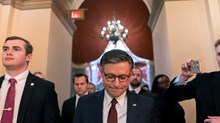 After lobbying from fellow Southern Baptists and Christians affected by the war, the House speaker moves a package forward.





