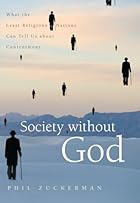
Society without God: What the Least Religious Nations Can Tell Us About Contentment
Author
Phil Zuckerman
Publisher
NYU Press
Release Date
October 1, 2008
Pages
240
Price
23.32
Scandinavians are content, caring people who don't worry too much about what happens after they die. And they aren't a tad bit religious (well, maybe a tad, but just barely). Phil Zuckerman, sociologist and author of Society without God: What the Least Religious Nations Can Tell Us about Contentment (NYU Press), spent 14 months in Scandinavia and witnessed a compassionate way of life and societal well-being. He contrasts Danes and Swedes with the marginally less-contented and less-charitable folks in the United States, who nevertheless show great religious zeal. He asks, "Is a society to be considered moral if its citizens love the Bible a lot (as in the United States), or rather, if its citizens virtually wipe out poverty from their midst (as in Scandinavia)?"
Highly secularized Scandinavian countries consistently rank high on international well-being and life-satisfaction indices (though so does the United States, a point Zuckerman fails to make). Zuckerman rarely saw a police officer during his 14-month stay, because people are just so dang nice to each other there. (Mostly, they just steal each other's bicycles.) He acknowledges that elderly people sometimes die alone in old-age homes, alcohol consumption can be too high, and racism and even murder make the newspapers occasionally. But he was mostly met with overwhelming friendliness and a sense of societal goodness that ran deep in the hearts of Scandinavians. The great social ills of the United States—failing schools, child abuse, domestic violence, systemic poverty, and inequitable health care (to name a few that Zuckerman highlights)—are largely absent in Scandinavian countries. Zuckerman marshals his observations, international well-being rankings, and interviews with Danes and Swedes to counter popular opinion that a nation has to be religious to be good, and that people have to be religious to be content. (And, contrary to popular perception, Scandinavian countries do not have unusually high suicide rates; they are only marginally higher than U.S. rates.)
While Zuckerman attributes the differences between Scandinavians and Americans largely to the presence or absence of religion, he acknowledges they might be related to other variables. A stronger explanation comes from the social, political, and economic realities that shape our values and inclinations. While the U.S. and Scandinavian countries blend capitalist and socialist ideals, Americans have put more faith in the market and individual freedom to meet human needs, while Scandinavians have entrusted government with this responsibility. In both cases, values are shaped by our cultural histories. If we are less attentive to the poor than are Scandinavian countries, it may come from our established belief that people should pull themselves up by their own bootstraps rather than expect the government to do it for them.
And here is the point that makes Zuckerman's book worth, well … worth checking out from the library. Zuckerman proposes what he calls a "socio-religious irony." The world's great religions speak of caring for the sick, the poor, and the orphaned, and of practicing mercy and goodwill toward fellow humans, yet these traits are often more evident in the world's least religious nations. Maybe that's so, at least as reflected in governmental policies, but Zuckerman does not effectively explain why it might be so. Nor does he say how U.S. Christians might respond to this irony.
Most nations, including the United States and Scandinavian countries, have histories that include shining moments of courage, compassion, and prosperity, but also darker moments of war, slavery, and systemic oppression. Sin cuts through every soul, and through every political body and institution. But nations also have unique features that lead them to develop along different paths.
For instance, Scandinavian countries are smaller and less diverse than we are. The United States is a nation of immigrants, a grand experiment in forging a collective identity from people of different nationalities. We value this diversity enough to commit to the work it requires. We have the harder task of identifying our neighbor as kin because we don't all look alike or come from similar backgrounds or share similar values. Scandinavian countries, as Zuckerman points out, are more homogeneous. Perhaps it's not surprising, then, that strong welfare states emerged in countries where neighborliness often literally meant caring for one's near and distant kin. That we have struggled more than they to embrace our neighbors, and have viewed those who look, talk, or eat differently than we do with some suspicion, makes sense given our history.
American values were shaped by people who gave up whatever security they had elsewhere to start over here. The ones who succeeded passed on the convictions that drove them—including the belief that hard work is often rewarded. (Although not everyone had bootstraps to pull themselves up by, particularly those brought here against their will or already living here before the first Europeans arrived.) We built a capitalist democracy that values owning personal property and the right to pursue whatever floats our boat. This American dream shapes how we think about rights and obligations. Americans generally believe that charity should be given freely and not demanded by the state, and that people should pay their own way through life.
Article continues below
Yet American values of rugged individualism and self-determination look suspect in light of biblical teaching about contentment and charity. Irreligious Zuckerman's poking and prodding inadvertently reminds us that living faith shows itself in neighborly expressions of care. It's hard to deny that Scandinavian governments effectively meet the material needs of their poor, elderly, and orphaned. The challenge to us American Christians lies in our congregational and personal calls to neighborliness, but also in discerning which public policies best convey this concern.
But Zuckerman flubs a fundamental point: He confuses a contented life with a good life. Zuckerman frankly admits the lack of purpose expressed by many Scandinavians. They aren't troubled by the need to find it either, but are satisfied living their lives without being overly concerned about the larger meaning of life or what happens after death. He claims that they find meaning enough in good friendships and family life. I won't deny the real delight—a common grace—to be found in these relationships, but is that really enough?
Zuckerman sells humanity short. If people are content but no longer care about transcendent meaning and purpose or life beyond death, that's not a sign of greatness but tragic forgetfulness. Their horizon of concern is too narrow. They were made for more. What does it profit a society if, as this book's jacket notes, it gains "excellent educational systems, strong economies, well-supported arts, free health care, egalitarian social policies, outstanding bike paths, and great beer," but loses its soul? Can a country build strong social systems and keep its soul? While I am thankful for Zuckerman's reminder about Christianity's social implications, and the example of a place that meets those obligations differently than we do, I am sad he misses the rest.


















 While we pray for peace, we need moral clarity about this war.
 As my doubts about his teachings grew, so did a secret fascination with Jesus.
 Christians can disciple each other toward action, prayer, and hope.






