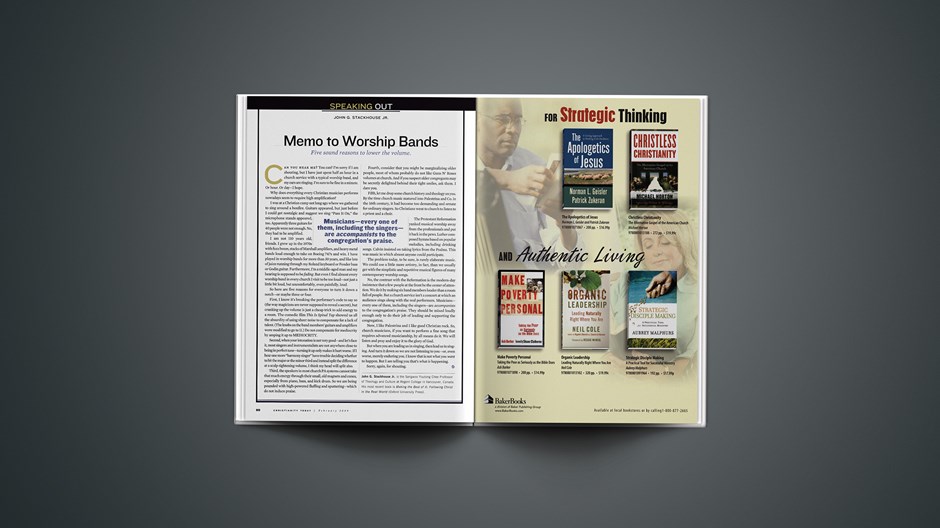
Can you hear me? You can? I'm sorry if I am shouting, but I have just spent half an hour in a church service with a typical worship band, and my ears are ringing. I'm sure to be fine in a minute. Or hour. Or day—I hope.
Why does everything every Christian musician performs nowadays seem to require high amplification?
I was at a Christian camp not long ago where we gathered to sing around a bonfire. Guitars appeared, but just before I could get nostalgic and suggest we sing "Pass It On," the microphone stands appeared, too. Apparently three guitars for 40 people were not enough. No, they had to be amplified.
I am not 110 years old, friends. I grew up in the 1970s with fuzz boxes, stacks of Marshall amplifiers, and heavy metal bands loud enough to take on Boeing 747s and win. I have played in worship bands for more than 30 years, and like lots of juice running through my Roland keyboard or Fender bass or Godin guitar. Furthermore, I'm a middle-aged man and my hearing is supposed to be fading. But even I find almost every worship band in every church I visit to be too loud—not just a little bit loud, but uncomfortably, even painfully, loud.
So here are five reasons for everyone to turn it down a notch—or maybe three or four.
First, I know it's breaking the performer's code to say so (the way magicians are never supposed to reveal a secret), but cranking up the volume is just a cheap trick to add energy to a room. The comedic film This Is Spinal Tap showed us all the absurdity of using sheer noise to compensate for a lack of talent. (The knobs on the band members' guitars and amplifiers were modified to go to 11.) Do not compensate for mediocrity by amping it up to MEDIOCRITY.
Second, when your intonation is not very good—and let's face it, most singers and instrumentalists are not anywhere close to being in perfect tune—turning it up only makes it hurt worse. If I hear one more "harmony singer" have trouble deciding whether to hit the major or the minor third and instead split the difference at a scalp-tightening volume, I think my head will split also.
Third, the speakers in most church PA systems cannot take that much energy through their small, old magnets and cones, especially from piano, bass, and kick drum. So we are being pounded with high-powered fluffing and sputtering—which do not induce praise.
Fourth, consider that you might be marginalizing older people, most of whom probably do not like Guns N' Roses volumes at church. And if you suspect older congregants may be secretly delighted behind their tight smiles, ask them. I dare you.
Fifth, let me drop some church history and theology on you. By the time church music matured into Palestrina and Co. in the 16th century, it had become too demanding and ornate for ordinary singers. So Christians went to church to listen to a priest and a choir.
The Protestant Reformation yanked musical worship away from the professionals and put it back in the pews. Luther composed hymns based on popular melodies, including drinking songs. Calvin insisted on taking lyrics from the Psalms. This was music in which almost anyone could participate. The problem today, to be sure, is rarely elaborate music. We could use a little more artistry, in fact, than we usually get with the simplistic and repetitive musical figures of many contemporary worship songs.
No, the contrast with the Reformation is the modern-day insistence that a few people at the front be the center of attention. We do it by making six band members louder than a room full of people. But a church service isn't a concert at which an audience sings along with the real performers. Musicians—every one of them, including the singers—are accompanists to the congregation's praise. They should be mixed loudly enough only to do their job of leading and supporting the congregation.
Now, I like Palestrina and I like good Christian rock. So, church musicians, if you want to perform a fine song that requires advanced musicianship, by all means do it. We will listen and pray and enjoy it to the glory of God.
But when you are leading us in singing, then lead us in singing. And turn it down so we are not listening to you—or, even worse, merely enduring you. I know that is not what you want to happen. But I am telling you that's what is happening.
Sorry, again, for shouting.
John G. Stackhouse Jr. is the Sangwoo Youtong Chee Professor of Theology and Culture at Regent College in Vancouver, Canada. His most recent book is Making the Best of It: Following Christ in the Real World (Oxford University Press).
















 While we pray for peace, we need moral clarity about this war.
 We’ve got little information on Jesus’ appearance and personality. But that’s the way God designed it.españolFrançais
 Christian artists work at the intersection of music and climate change.






