In recent years, movie and television audiences have been treated to stories both captivating and curious. We've watched extra-dimensional aliens instruct pre-Columbian Native Americans in the basics of civilization. We've looked on as an ancient super-race reluctantly assumes the role of modern superheroes. We've cheered genetically advanced humans with their assortment of superpowers. And we've marveled as residents of space or the future reveal secrets of human origin and destiny.
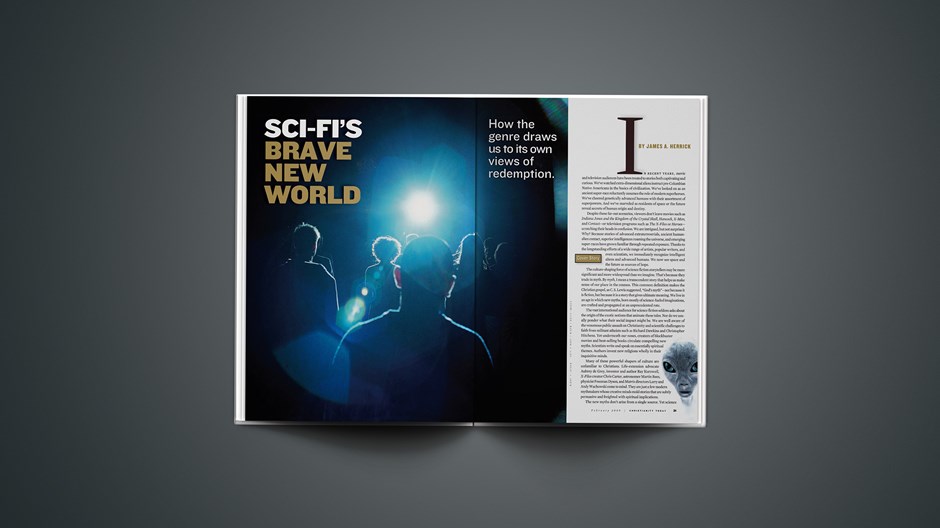
Despite these far-out scenarios, viewers don't leave movies such as Indiana Jones and the Kingdom of the Crystal Skull, Hancock, X-Men, and Contact—or television programs such as The X-Files or Heroes—scratching their heads in confusion. We are intrigued, but not surprised. Why? Because stories of advanced extraterrestrials, ancient human-alien contact, superior intelligences roaming the universe, and emerging super-races have grown familiar through repeated exposure. Thanks to the longstanding efforts of a wide range of artists, popular writers, and even scientists, we immediately recognize intelligent aliens and advanced humans. We now see space and the future as sources of hope.
The culture-shaping force of science fiction storytellers may be more significant and more widespread than we imagine. That's because they trade in myth. By myth, I mean a transcendent story that helps us make sense of our place in the cosmos. This common definition makes the Christian gospel, as C. S. Lewis suggested, "God's myth"—not because it is fiction, but because it is a story that gives ultimate meaning. We live in an age in which new myths, born mostly of science-fueled imaginations, are crafted and propagated at an unprecedented rate.
The vast international audience for science fiction seldom asks about the origin of the exotic notions that animate these tales. Nor do we usually ponder what their social impact might be. We are well aware of the venomous public assault on Christianity and scientific challenges to faith from militant atheists such as Richard Dawkins and Christopher Hitchens. Yet underneath our noses, creators of blockbuster movies and best-selling books circulate compelling new myths. Scientists write and speak on essentially spiritual themes. Authors invent new religions wholly in their inquisitive minds.
Many of these powerful shapers of culture are unfamiliar to Christians. Life-extension advocate Aubrey de Grey, inventor and author Ray Kurzweil, X-Files creator Chris Carter, astronomer Martin Rees, physicist Freeman Dyson, and Matrix directors Larry and Andy Wachowski come to mind. They are just a few modern mythmakers whose creative minds mold stories that are subtly persuasive and freighted with spiritual implications.
The new myths don't arise from a single source. Yet science fiction has played a disproportionate role in modern myth crafting. The genre has profoundly shaped not only the entertainment industry, but Western spirituality as well.
Recently deceased scientist and science fiction author Sir Arthur C. Clarke captured a generation of readers with his spellbinding visions of the future. The English mythmaker built on the foundation of elder countrymen such as H. G. Wells and Olaf Stapledon. Clarke's early short story "The Sentinel" (1948) and novel Childhood's End (1953) set humanity in a cosmos controlled by evolution and advanced aliens. But his mesmerizing 1968 collaboration with Stanley Kubrick, 2001: A Space Odyssey, revealed Clarke's force as a religious visionary. In that story, the new humanity arrives as an embryonic god floating in space, contemplating the planet of its origin.
Earlier science fiction, including The Day the Earth Stood Still (1951), explored similarly religious themes, notably technological resurrection. But godlike superhumans date to much earlier fiction, such as Edward Bulwer-Lytton's The Coming Race (1871).
Author L. Ron Hubbard chose a direct path to spiritual influence, founding the now worldwide Church of Scientology in the 1950s. Scientology's teaching that humans lived among extraterrestrial cultures before being trapped in bodies on Earth reveals Hubbard's early work as a science fiction writer. Other relatively new religions—Mormonism and the Nation of Islam among them—incorporate interplanetary narratives as well.
Science fiction also animates the work of many scientists. Jason Pontin, editor in chief of MIT's Technology Review, writes, "Most of us came to technology through science fiction; our imaginations remain secretly moved by science-fictional ideas. Only the very exalted are honest about their debt." Many working in space exploration and artificial intelligence are either fans of science fiction or freely acknowledge its deep influence on their thought.
Science fiction is important to scientists interested in transcendent themes such as the design and purpose of the cosmos and the future of humanity. Dyson, a devoted reader of Stapledon, writes, "Science is my territory, but science fiction is the landscape of my dreams." Ironically, the universe that science stripped of the supernatural is being resupplied with deities and redemptive purposes by science fiction writers and moviemakers. Apparently, we cannot do without myths.
Article continues below
Perhaps Kurzweil was correct when he said that a dawning techno-spiritual age would require a new religion. In a 1999 interview with journalist Bill Moyers, Star Wars director George Lucas said, "I put the Force into the movie to try to awaken a certain kind of spirituality in young people—more a belief in God than a belief in any particular religious system." There is some evidence that his efforts have been successful: In the 2000 British census, more than 390,000 people listed their religion as "Jedi," a reference to the pantheistic spirituality of Star Wars. The numbers probably reflect a coordinated effort to skew census results, but still suggest the vast reach of the Star Wars myth. (Lucas's view of myth's cultural role was shaped by Joseph Campbell, who more than any other writer made myth relevant to late-20th-century Americans.)
Redemption Recast
Recent polls indicate that a majority of Americans expect human contact with extraterrestrials during this millennium. Moreover, we anticipate that the aliens will be "friendly" and "superior." Major scientific figures, including Nikola Tesla, Stephen Hawking, Francis Crick, and Carl Sagan, among others, have popularized their ideas. Whether panspermia (Earth was seeded with life from space), space colonization, highly evolved extraterrestrials, or genetically enhanced post-humanity, each belief has its advocate in the academy. And well-publicized projects such as the Search for Extraterrestrial Intelligence involve both the public through donated computer time and private business through donated money.
What exactly are we expecting to encounter? Perhaps the advanced and benevolent extraterrestrials who in Star Trek: First Contact (1996) speedily usher in an earthly utopia free of poverty and warfare. Or maybe the childlike aliens of Spielberg's Close Encounters of the Third Kind (1977), who disembark from their space-faring city of light as a human priest reads from Psalm 91: "He will give his angels charge over you." After all, angels had accompanied an earlier salvific arrival.
In the exotic terrain of a foreign planet, the starry emptiness of space, and the utilitarian interiors of vast starships, we discover a new redemptive landscape. To be sure, science fiction often portrays the future as a dystopia, a world devastated by science and technology. But just as often, the genre seems hopeful about the future. Modern mythologies don't explain how space or the future will mend a broken humanity, but suggest that technological progress and vast distances from Earth somehow entail transformation.
Article continues below
This thinking migrates back and forth between science and science fiction. In 1953, Clarke imagined a space deity he dubbed the "Overmind," thus fictionally re-enchanting the empty cosmos left by naturalism. A writer who helped prepare the welcome messages launched into space with the 1977 Voyager probes recalls that project participants pursued their work "with a sense of sacred purpose." A mere two years later, a fictitious, godlike Voyager probe—altered by an advanced alien race—played a major role in Star Trek: The Motion Picture (1979).
These mythologies also place hope in the belief that through genetic and mechanical engineering, we will create an immortal, omniscient human-machine hybrid. Kurzweil eagerly anticipates the day when humans will join their slow, biologically based brains to much faster machine intelligence, introducing a humanity that will make Genesis version 1.0 pale in comparison. Kurzweil's fellow transhumanists see human enhancement as inevitable, desirable, and within our grasp. Their myth of a new humanity envisions human alteration via medical technology and a new eugenics. Advocates promise to make good on a dream that has been rumored and sometimes actively pursued since the days of Francis Galton, the father of eugenics and a cousin of Darwin's. Science, equipped with an internal moral compass of uncertain origin, can apparently be trusted to design the next human.
C. S. Lewis warned in The Abolition of Man that subsequent generations would be the slaves of the first to manufacture post-humanity. That powerful generation will decide the design of future humans. Such Christian "pessimism" notwithstanding, superhumans beckon from diverse precincts, clearly on display in science fiction from Wells to X-Men. But they also show up in the International Raelian Movement, a new religion that funds human cloning research, and in the popular biology of Lee M. Silver and others.
Rival for Our Social Imagination
I have labeled the modern myths arising from science, science fiction, and new religions scientific mythologies. These powerful narratives represent a cultural current the church needs to take seriously as the source of a growing worldview. Propelled into post-Christian public consciousness by the powerful machinery of mass marketing and media, techno-spiritual myths do not draw audiences of millions because of compelling storytelling and mind-boggling special effects alone. They also provide spiritual seekers answers to perennial questions about our nature and place in the cosmos, our predicament and redemption, and the future. Seldom are the myths adopted as a complete worldview package. Rather, readers and viewers, often young and outside the church, fashion personal spiritual systems from individual experience and elements of mythic popular culture.
Article continues below
Seekers, then, get some answers and a taste of transcendence without the moral accountability or costly interpersonal commitments of church. But they also forfeit significant checks on the reasonableness of their beliefs, a worthy object of worship, authentic spiritual community, and, most importantly, any ultimately redemptive message or means.
But seekers aren't the only group influenced by scientific mythologies.
The new myths have found their way into scientific thought, providing both direction and moral purpose for research and writing. Carl Sagan, a prominent scientist and the author of Contact, recognized the grip that the future, space, and the extraterrestrial hold on the post-Christian Western imagination. He understood the tremendous combined social force of science fiction, professional science, and mass media. Space would replace heaven as the location of our corporate spiritual hope. Extraterrestrials would supplant God as the intelligence behind all things. An enhanced post-humanity would provide a new vision of a redeemed human race.
These myths also focus hope in the redemptive work of evolution, understood as inevitable biological and moral progress. When Richard Dawkins affirms, as he did in his recent debate with John Lennox, that "our evolutionary past … built into us a lust to be good, a lust to be friendly, a lust to cooperate, a lust to be sympathetic towards suffering," he speaks not as a naturalist but as a morally hopeful pantheist. "There is," according to Dawkins, "something in the air, some other force" that is "not religion," and it is improving us morally. Indeed, the Force is strong with this one. But is he right?
Much hangs on our answer to this question.
Story Watching and Telling
Which stories will guide us as we make our way through the perilous 21st century with its stunning technologies and burgeoning data about our bodies, minds, and universe? As science holds out to us possibilities previously only imagined, which myths will shape the imaginations of our decision makers? Which narratives will form our religious sensibilities, provide our spiritual values, and craft our view of the supernatural—indeed, of God? Only the true myth at the heart of Christianity is powerful enough to prevent excesses and avert atrocities. How can the church respond?
Article continues below
First, we must become more discerning viewers and consumers of popular culture. Many of us, myself included, find science fiction and popular scientific writing entertaining, informative, and thought provoking. But we must also watch and read with critical insight. Many of the most popular narratives bursting with spiritual and worldview implications are more persuasive because they come dressed in the invisibility cloak of "mere" entertainment.
Second, the church needs to broaden its apologetics work to include serious analysis of and response to popular culture, now our most potent form of religious persuasion. Frankly, we have given these narratives a free pass in our eagerness to appear culturally savvy. But we must be clear: Arguments against Christianity and in support of rival worldviews now arrive daily as embedded components of visual and written fiction. Pop-culture fiction, not academic nonfiction, is now the cutting edge of public discourse on spirituality.
Though our desire not to moralize about secular culture is understandable, discernment in the face of challenges to the gospel remains a biblical imperative. The spiritual messages conveyed by our most popular television, movie, and literary products are often questionable and sometimes dangerously misleading. We are not the center of the cosmos, nor are we (or extraterrestrials) evolving toward divinity. Evolution is not the benevolent operating principle of the entire universe, and technological transformation of our species is not spiritual rebirth. Ignorance is not our predicament, progress is not redemption, the future is not salvation, and space is not our destiny. Responding to Gnosticism proved one of the early church's most difficult challenges. Today's Christian community faces a similar antagonist, not just in radical atheism, but in increasingly insistent pop-culture spiritualities, too. How shall we make our defense to Neo Anderson as well as to Christopher Hitchens?
Article continues below
Third, the church must attend more diligently to the presentation of her true myth in public settings. The biblical account of human origins and purpose, of our predicament as well as our redemption, and of the nature and purpose of the cosmos we inhabit, is emotionally, spiritually, and rationally more satisfying than modern myths featuring aliens, starships, divine evolution, hidden knowledge, and biomechanical post-humanity.
A discerning student of culture, Lewis answered modern scientific myths with daring retellings of the Christian story that integrated the patterns and language of the new myths. His science fiction trilogy provides an admirable model of storytelling that intelligently and artfully incorporates foundational truths from a Christian worldview. Concerned about the growing influence of writers like Stapledon and the popular scientist J. B. S. Haldane, Lewis crafted his trilogy for readers whose spiritual hope was being turned to space, the future, limitless progress, and scientifically assisted human advancement. Out of the Silent Planet (1938), Perelandra (1943), and That Hideous Strength (1945) vividly portray the reality of evil, pillory human hubris, and affirm redemption as God's work. They also show humanity's crucial role in God's unfolding work, celebrate truth while preserving mystery, and return us to Eden to contemplate the grandeur of a fresh Creation and the terrible potential of a catastrophic rejection of divine protection.
Human spiritual well-being, and thus the humaneness of civilization, depends in large measure on which narratives hold sway in our souls. The present millennium poses possibilities none of us can now fully predict, and requires decisions that will test our moral capacities in unprecedented ways. Which stories will animate our corporate imagination, guide our interpretation of limitless data, and shape our technologies? Among the myriad redemptive myths displayed before us, it is time to remind ourselves that only one has ever been God's story.















 While we pray for peace, we need moral clarity about this war.
 A Christian reconciliation group in Israel and Palestine warned that war would come. Now the war threatens their relevance.العربيةFrançais
 The Grammy-winning artist was found dead at her home in Nashville at age 47.






