When Hollywood's stars hit the red carpet for the Academy Awards on February 22, glitz and glamour — and blockbuster movies — will get the most airtime. And the whole world will be watching.
Well, not all of it. A group of women in Sudan, far removed from the bling and bright lights, will be doing something far more significant: going door to door in a quest to garner one million signatures for a petition demanding peace in their war-torn country.
Yes, there is a connection between those two paragraphs, because in a way, the former led to the latter. An award-winning movie stirred those Sudanese women to take a stand, as they had just seen others do on the big screen.
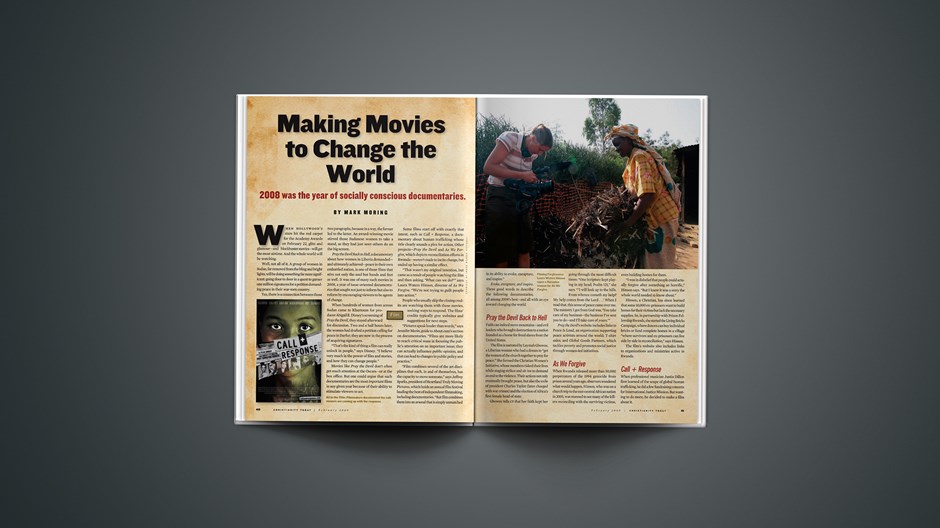
Pray the Devil Back to Hell, a documentary about how women in Liberia demanded — and ultimately achieved — peace in their own embattled nation, is one of those films that stirs not only the soul but hands and feet as well. It was one of many such movies in 2008, a year of issue-oriented documentaries that sought not just to inform but also to reform by encouraging viewers to be agents of change.
When hundreds of women from across Sudan came to Khartoum for producer Abigail E. Disney's screening of Pray the Devil, they stayed afterward for discussion. Two and a half hours later, the women had drafted a petition calling for peace in Darfur; they are now in the process of acquiring signatures.
"That's the kind of thing a film can really unlock in people," says Disney. "I believe very much in the power of film and stories, and how they can change people."
Movies like Pray the Devil don't often get much attention at the Oscars — or at the box office. But one could argue that such documentaries are the most important films in any given year because of their ability to stimulate viewers to act.
Some films start off with exactly that intent, such as Call + Response, a documentary about human trafficking whose title clearly sounds a plea for action. Other projects —Pray the Devil and As We Forgive, which depicts reconciliation efforts in Rwanda —weren't made to incite change, but ended up having a similar effect.
"That wasn't my original intention, but came as a result of people watching the film and then asking, 'What can we do?'" says Laura Waters Hinson, director of As WeForgive. "We're not trying to guilt people into action." People who usually skip the closing credits are watching them with these movies, seeking ways to respond. The films' credits typically give websites and suggestions for next steps. "Pictures speak louder than words," says Jennifer Merin, guide to About.com's section on documentaries. "Films are more likely to reach critical mass in focusing the public's attention on an important issue; they can actually influence public opinion, and that can lead to changes in public policy and practice."
"Film combines several of the art disciplines that each, in and of themselves, has the capacity to move someone," says Jeffrey Sparks, president of Heartland Truly Moving Pictures, which holds an annual film festival lauding the best of independent filmmaking, including documentaries. "But film combines them into an arsenal that is simply unmatched in its ability to evoke, enrapture, and inspire."
Evoke, enrapture, and inspire. Three good words to describe the following documentaries, all among 2008's best —and all with an eye toward changing the world.
Faith can indeed move mountains — and evil leaders who brought destruction to a nation founded as a home for freed slaves from the United States.
The film is narrated by Leymah Gbowee, a Liberian woman who had a dream to "get the women of the church together to pray for peace." She formed the Christian Women's Initiative, whose members risked their lives while staging strikes and sit-ins to demand an end to the violence. Their actions not only eventually brought peace, but also the exile of president Charles Taylor (later charged with war crimes) and the election of Africa's first female head of state.
Gbowee tells ct that her faith kept her going through the most difficult times: "One Scripture kept playing in my head, Psalm 121," she says. "'I will look up to the hills. From whence cometh my help?
My help comes from the Lord …' When I read that, this sense of peace came over me.
The ministry I got from God was, 'You take care of my business — the business I've sent you to do —and I'll take care of yours.'" Pray the Devil's website includes links to Peace Is Loud, an organization supporting peace activists around the world; T-shirt sales; and Global Goods Partners, which tackles poverty and promotes social justice through women-led initiatives.
When Rwanda released more than 50,000 perpetrators of the 1994 genocide from prison several years ago, observers wondered what would happen. Hinson, who was on a church trip to the east-central African nation in 2005, was stunned to see many of the killers reconciling with the surviving victims, even building homes for them.
Article continues below
"I was in disbelief that people could actually forgive after something so horrific," Hinson says. "But I knew it was a story the whole world needed to know about."
Hinson, a Christian, has since learned that some 10,000 ex-prisoners want to build homes for their victims but lack the necessary supplies. So, in partnership with Prison Fellowship Rwanda, she started the Living Bricks Campaign, where donors can buy individual bricks or fund complete homes in a village "where survivors and ex-prisoners can live side by side in reconciliation," says Hinson.
The film's website also includes links to organizations and ministries active in Rwanda.
When professional musician Justin Dillon first learned of the scope of global human trafficking, he did a few fundraising concerts for International Justice Mission. But wanting to do more, he decided to make a film about it. "Look, as much as I'd like to be the guy who knocks down the doors of child brothels and beats up pimps, that's not a reality for me," says Dillon. "So I'm just going to do what I'm good at and see if I can get some energy for this movement."
The result is a "rockumentary" featuring celebrities (Julia Ormond, Ashley Judd) and musicians (Switchfoot, Natasha Bedingfield, Moby) all performing gratis. All profits go to projects combating human trafficking. The film, a mix of documentary footage, interviews, and musical performances, depicts the problem clearly and points to its website for ways to respond through donations to anti-slavery organizations, advocacy, awareness campaigns, and more. In the film's opening month, ticket sales alone raised over $20,000 for those programs, with thousands more pouring in through website and text-messaging donations.
"Left home at the age of seven / one year later I'm carryin' an AK-47."
So go the lyrics of a song by hip-hop artist Emmanuel Jal, the title character in this compelling film. As a young boy caught in the chaos of Sudan's civil war, Jal was one of 10,000 child soldiers conscripted by the Sudan People's Liberation Army, forced to kill and engage in other atrocities. Jal eventually escaped and left his homeland; today, as a rising music star, he travels the world sharing his story, even in the halls of the U.S. State Department.
Jal and the film's ultimate plea is for peace in his native Sudan; he wants to be a part of that process by building a school in his home village: "If people are educated," he says, "there will be less war."
Article continues below
The closing credits show how viewers can donate to the new school or sponsor a Sudanese child through Gua Africa, an organization Jal founded.
Matt Dornic of Washington, D.C., opted for child sponsorship soon after watching the film. "For a hundred bucks a month, to take a child all the way through high school and college —you can't go wrong with that," says Dornic.
Other socially conscious documentaries from 2008 include We Are Together, about orphans in South Africa; Flow: For Love of Water, about how privatization of the world's dwindling fresh water supply is denying water to the poor; Dear Zachary, a filmmaker's memoir of a murdered friend, and a call for bail reform in Canada; Sons of Lwala, about two Kenyan brothers who came to the U.S. for their medical degrees, then returned home to finish a clinic their father had started before dying of aids; Expelled: No Intelligence Allowed, about the freedom (or lack thereof) to discuss the theory of intelligent design in academic settings; A Walk to Beautiful, about Ethiopian women who are rejected and ostracized after difficult childbirths leave them infertile; I.O.U.S.A., about America's increasing national debt and the inevitable economic meltdown; Trouble the Water, an up-close-and-personal look at the devastation caused by Hurricane Katrina.
The number of such documentaries, and their viewers' responses, suggest that they are serving "to open eyes that are blind, to free captives from prison, and to release from the dungeon those who sit in darkness" (Isa. 42:7). Many have seen that light. And it's on the big screen.
















 While we pray for peace, we need moral clarity about this war.
 We’ve got little information on Jesus’ appearance and personality. But that’s the way God designed it.españolFrançais
 When I married into a Jewish family, antisemitism hit home. Now, the holy day reminds me of our future hope.






