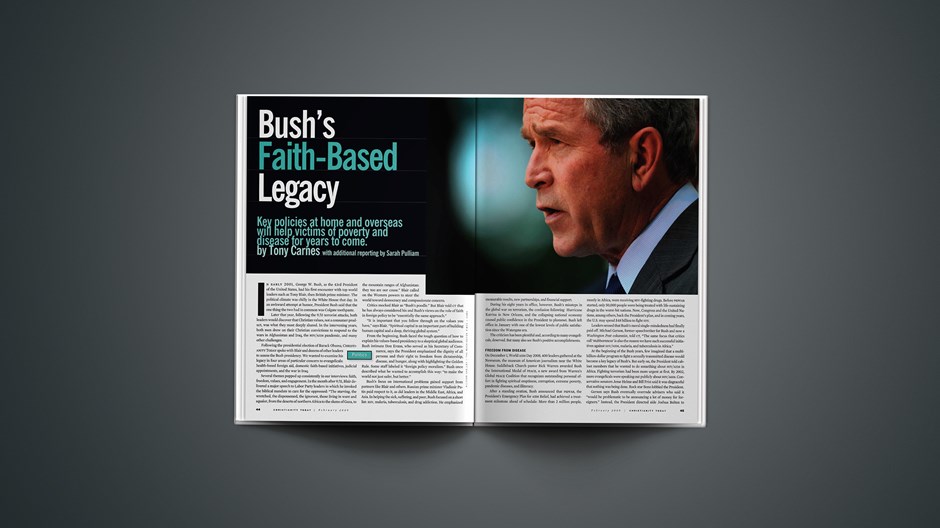
In early 2001, George W. Bush, as the 43rd President of the United States, had his first encounter with top world leaders such as Tony Blair, then British prime minister. The political climate was chilly in the White House that day. In an awkward attempt at humor, President Bush said that the one thing the two had in common was Colgate toothpaste.
Later that year, following the 9/11 terrorist attacks, both leaders would discover that Christian values, not a consumer product, was what they most deeply shared. In the intervening years, both men drew on their Christian convictions to respond to the wars in Afghanistan and Iraq, the HIV/AIDS pandemic, and many other challenges.
Following the presidential election of Barack Obama, Christianity Today spoke with Blair and dozens of other leaders to assess the Bush presidency. We wanted to examine his legacy in four areas of particular concern to evangelicals: health-based foreign aid, domestic faith-based initiatives, judicial appointments, and the war in Iraq.
Several themes popped up consistently in our interviews: faith, freedom, values, and engagement. In the month after 9/11, Blair delivered a major speech to Labor Party leaders in which he invoked the biblical mandate to care for the oppressed: "The starving, the wretched, the dispossessed, the ignorant, those living in want and squalor, from the deserts of northern Africa to the slums of Gaza, to the mountain ranges of Afghanistan: they too are our cause." Blair called on the Western powers to steer the world toward democracy and compassionate concern.
Critics mocked Blair as "Bush's poodle." But Blair told CT that he has always considered his and Bush's views on the role of faith in foreign policy to be "essentially the same approach."
"It is important that you follow through on the values you have," says Blair. "Spiritual capital is an important part of building human capital and a deep, thriving global system."
From the beginning, Bush faced the tough question of how to explain his values-based presidency to a skeptical global audience.
From the beginning, Bush faced the tough question of how to explain his values-based presidency to a skeptical global audience. Bush intimate Don Evans, who served as his Secretary of Commerce, says the President emphasized the dignity of all persons and their right to freedom from dictatorship, disease, and hunger, along with highlighting the Golden Rule. Some staff labeled it "foreign policy moralism." Bush once described what he wanted to accomplish this way: "to make the world not just safer, but better."
Bush's focus on international problems gained support from partners like Blair and others. Russian prime minister Vladimir Putin paid respect to it, as did leaders in the Middle East, Africa, and Asia. In helping the sick, suffering, and poor, Bush focused on a short list: HIV, malaria, tuberculosis, and drug addiction. He emphasized measurable results, new partnerships, and financial support.
During his eight years in office, however, Bush's missteps in the global war on terrorism, the confusion following Hurricane Katrina in New Orleans, and the collapsing national economy caused public confidence in the President to plummet. Bush left office in January with one of the lowest levels of public satisfaction since the Watergate era.
The criticism has been plentiful and, according to many evangelicals, deserved. But many also see Bush's positive accomplishments.
Freedom from Disease
On December 1, World aids Day 2008, 400 leaders gathered at the Newseum, the museum of American journalism near the White House. Saddleback Church pastor Rick Warren awarded Bush the International Medal of PEACE, a new award from Warren's Global peace Coalition that recognizes outstanding personal effort in fighting spiritual emptiness, corruption, extreme poverty, pandemic diseases, and illiteracy.
After a standing ovation, Bush announced that PEPFAR, the President's Emergency Plan for aids Relief, had achieved a treatment milestone ahead of schedule: More than 2 million people, mostly in Africa, were receiving HIV-fighting drugs. Before PEPFAR started, only 50,000 people were being treated with life-sustaining drugs in the worst-hit nations. Now, Congress and the United Nations, among others, back the President's plan, and in coming years, the U.S. may spend $48 billion to fight HIV.
Leaders sensed that Bush's moral single-mindedness had finally paid off. Michael Gerson, former speechwriter for Bush and now a Washington Post columnist, told CT, "The same focus that critics call 'stubbornness' is also the reason we have such successful initiatives against HIV/AIDS, malaria, and tuberculosis in Africa."
At the beginning of the Bush years, few imagined that a multibillion-dollar program to fight a sexually transmitted disease would become a key legacy of Bush's. But early on, the President told cabinet members that he wanted to do something about HIV/AIDS in Africa. Fighting terrorism had been more urgent at first. By 2002, more evangelicals were speaking out publicly about HIV/AIDS. Conservative senators Jesse Helms and Bill Frist said it was disgraceful that nothing was being done. Rock star Bono lobbied the President.
Article continues below
Gerson says Bush eventually overrode advisers who said it "would be problematic to be announcing a lot of money for foreigners." Instead, the President directed aide Joshua Bolten to plan "something game-changing" for Bush's 2003 State of the Union address. During that speech, Bush mapped out a plan to spend $15 billion over the coming five years to fight the virus. To the shock of many health professionals, Bush explicitly endorsed Uganda's faith-inspired approach to preventing HIV, known as abc, "Abstain, Be faithful, or use a Condom."
Evangelicals were galvanized. They had slowly become engaged in a broader set of international issues, and now saw greater collaboration with the government as an unprecedented opportunity.
Over time, Bush's rationale for fighting the virus became ever more biblical. In his successful 2007 push for increased funding for PEPFAR, Bush quoted Deuteronomy by saying, "I have set before you life and death. … Therefore, choose life."
In mid-2005, Bush launched the President's Malaria Initiative (PMI), committing the federal government to spend $1.2 billion by 2010 to fight malaria, which kills 1.2 million each year. pmi also includes new money to fight tuberculosis.
Internationally, hundreds of faith-based groups and thousands of churches in the developing world receive support through PEPFAR and pmi. The combined total spending for these programs is at least $63 billion. Bush's goal of a better, safer world is becoming a reality in terms of freedom from disease. Federal agencies use new faith-friendly networks of hospital, clinics, and village churches.
Such programs have provoked hot reactions from the political Left. Pro-choice activists such as William Smith, vice president for public policy at the Sexuality Information and Education Council of the U.S., lamented, "It will take several years to get countries" to accept abortion-friendly policies again and get rid of abstinence programs.
At the Newseum event in December, Obama lauded Bush by video, saying, "I salute President Bush for his leadership in crafting a plan for aids relief in Africa. . . . We will continue this critical work to address the crisis around the world." One leading evangelical describes Obama as a "pragmatist," and says if evangelical-supported programs show results, Obama will likely support them.
Article continues below
'Thank You, W'
From the early days of the Bush White House, evangelicals' political support was under constant cultivation. This was especially true concerning appointments to the federal judiciary. Timothy Goeglein, liaison to evangelicals for most of the Bush presidency, says the White House's efforts were "from Day 1 rooted in the relational, through personal and conference calls, speeches, and coalition meetings. My job was to keep the relationships fresh." Political operative Matthew Dowd says the Bush campaign shifted from turning out voters in Republican strongholds to turning out voters in carefully maintained networks, built from various coalitions and church membership lists. Political operatives shifted from talking about issues to talking about values.
The federal judiciary felt the most lasting influence of these efforts. Nearly every potential federal judge was brought before this conservative faith-based coalition. "As a result," Goeglein says, "35 percent of sitting federal judges are Bush appointees. The judicial coalition will continue to operate after the President leaves office, and [that] is one of his important lasting accomplishments."
Many evangelicals believe the Supreme Court appointments of conservatives Samuel Alito and John Roberts Jr. are symbolic of Bush's lasting pro-life commitment. At one White House Christmas party, pro-lifers wore pins saying, "Thank you, W," with pictures of the two Supreme Court justices on them. Charmaine Yoest, head of Americans United for Life, says, "Legacy implies something that endures. These were two lifetime appointments."
The 'Quiet Revolution'
On the domestic front, Bush moved evangelicals toward partnerships between faith-based organizations and the federal government, initiatives that emphasized equality of opportunity among faith groups.
When Bush created the White House Office of Faith-Based and Community Initiatives in 2001, his critics hammered him for blurring the lines between church and state. Church leaders were hesitant to get involved. "Early on, evangelicals were skeptical," says John C. Green of the Pew Forum on Religion and Public Life. "But they became more supportive. They like how Bush opened up the government so religious organizations could compete for funding on a level playing field and [have] their religious distinctives tolerated."
At the grassroots, the office's work was transforming. Tonja Myles, a recovering crack cocaine addict who had turned her life around as a Christian, tried for six years to get government support for faith-based drug rehabilitation in Baton Rouge, Louisiana. She had the endorsements of the local and congressional Democratic officials, but got nowhere. Her fight with addiction, Satanism, and prostitution had taken seven years; she was bracing herself for seven more.
Article continues below
Then Myles received a call from Jim Towey at the White House. Towey had moved from being Mother Teresa's aide to becoming the director of the White House Office of Faith-Based and Community Initiatives. He told Myles that perhaps one of the administration's new programs, Access to Recovery, could help her ministry. "I went from crack house to the White House in 24 years!" Myles laughingly recalls.
In 2004, the White House carefully changed the way government drug-rehab funds were distributed. It created a $600 million voucher system wherein drug addicts could pick any program they wanted, regardless of whether it used secular or religious means to combat addiction. Individuals seeking help could walk through the door, which carried Myles's banner: "If the Son sets you free, you will be free indeed—John 8:36." And many did. Towey says, "President Bush branded the term 'faith-based' in the public square, and the White House's faith-based initiative has taken root in the heartland." In a YouTube video last April, Myles gave a personal shout-out to Bush: "Mr. President, you have been a tremendous blessing in my life. You guys make our job easy." The drug-rehab program has served more than 170,000 clients, and about 30 percent of its funds are directed to faith groups nationwide.
Across the board, Bush supported nine faith-based programs. Top aides described these efforts as a "quiet revolution" in the relationship between federal agencies and faith groups. The partnerships are likely to continue in some form under President Obama, but under different regulations. During the 2008 campaign, Obama said he would rename the initiative the "President's Council for Faith-Based and Neighborhood Partnerships." But there will be a flashpoint with conservatives. Right now, organizations have the right to hire employees who affirm certain beliefs; Obama has promised to remove these protections for restrictive hiring.
Violence, Economy Drop Sharply
The Bush presidency was shaped more by the war in Iraq than by almost any other factor. Starting from the earliest hours of the conflict in March 2003, the White House worked persistently to keep evangelicals as its support base. Opinion polls consistently showed that evangelicals supported Bush's efforts in Iraq and Afghanistan by greater percentages than any other major U.S. group.
Article continues below
Kenny, a senior anti-terrorism operative who asked that his full name not be revealed, recalls that after the collapse of New York's Twin Towers, which killed some of his friends, he thanked God that Bush, not Al Gore, was commander-in-chief. "I knew Bush was old-school, would stick to his guns and not fade out in the fight."
Bush seemed to rise to the occasion with strength and poise on the pile of rubble at the site of the World Trade Center. To Kenny and many other first responders, Bush's fight talk was inspiring, and to many evangelicals, his addresses to the nation were masterpieces of godly leadership.
Bush brought to the White House a conviction that the nation's leaders had mishandled the Vietnam War and the first Persian Gulf War. To him, they had lacked the determination to see these conflicts through to a win. Bush wanted instead to strike boldly for a definitive conclusion in Iraq.
But this conviction, combined with the neo-conservative ideology of many of his appointees, encouraged rushed planning and an impatience for seeing results. This led to military quagmires in the country, and encouraged a military culture where torture became more acceptable.
Analyses of Bush's Middle East war policies have been extensive in the press, so there is no need to repeat them here. While the surge reversed fortunes in Iraq, things continued to deteriorate in Afghanistan. It's too early to say how these war efforts will be judged in the long run, but Bush has recently admitted to making mistakes.
While evangelicals largely tried to be supportive of Bush's policies, they were some of the first to speak out against torture. A few, such as Congressman Frank Wolf, were effective in urging Bush to reassess his approach in Iraq.
By the summer of 2005, events in Iraq could hardly have been going worse. Congressman Wolf became greatly concerned about the growing chaos. "I was disturbed by stories of rising causalities among American soldiers," the Virginia conservative said. "And torture is completely wrong." Wolf decided to check things inside Iraq for himself without telling the State Department. At various times, he and his companions went to Iraq, and once traveled the country posing as contract workers. Wolf recalls, "We dressed in old clothes. We lived with Iraqis."
Article continues below
The congressman was shocked by the violence and ruin. At the time, the White House had been proclaiming victory after victory. In October of that year, Bush had said, "Area by area, city by city, we're continuing offensive operations to clear out enemy forces, and leaving behind Iraqi units to prevent the enemy from returning."
Wolf, a canny and respected Washington operator, believed that as a Christian, he had "a moral responsibility to do something." He wrote an op-ed piece in The Washington Post calling for "an independent and balanced group of respected individuals" to examine the Iraq war effort. He hoped that the editorial would flush out some allies within the administration, which it did. The result was that Bush accepted the formation of the Iraq Study Group, which supported a surge of troops.
The sharp drop in the global economy at the end of Bush's last year in office overwhelmed any good news coming out of Iraq. Bush's inaction regarding rising home foreclosures gave socially liberal evangelicals such as Jim Wallis of Sojourners magazine a feeling of being crushed. "The Bush administration was an absolute disaster for poor people," Wallis says. Even social conservatives were not happy: Family Research Council's Tony Perkins says that Christian conservatives need to get "?'fiscal conservatism' back into the national bloodstream. We need a return to responsibility in personal and government finances."
For the bulk of the nation, reeling from recession, Bush leaves presidential office with a severely tattered legacy. At the same time, perhaps paradoxically, Bush's most remarkable contributions were to victims of poverty and disease overseas and sufferers in the U.S. who will be helped by faith-based organizations for years to come.
Tony Carnes is a CT senior writer. Sarah Pulliam is CT online editor.
















 While we pray for peace, we need moral clarity about this war.
 We’ve got little information on Jesus’ appearance and personality. But that’s the way God designed it.españolFrançais
 Leader explains why the movement is seeing its biggest membership bump in 30 years and its mission for the years ahead.






