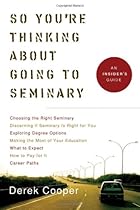
In difficult economic times, graduate school becomes a refuge for students who hope for better days ahead. Already, applications to Dallas Theological Seminary have spiked 10 percent, keeping with historical trends for theological training during unstable days. Seminaries, enduring their own financial woes, would happily welcome more refugees. Applicants don't even need to expect that they will enter pastoral ministry, says Derek Cooper, author of So You're Thinking about Going to Seminary: An Insider's Guide. Cooper, a visiting professor of New Testament at Biblical Theological Seminary, draws on his experience of attending classes at six such schools.
What is the biggest misconception about seminaries?
There are generally two. First, those who attend seminary assume that one of seminary's main purposes is to provide the answer to this or that great biblical or theological question. Instead of understanding seminary or theological education in terms of a mathematical formula to be solved, however, it is more like a tension-filled narrative that is to be lived out. Seminaries, in other words, are better at asking questions than answering them.
Second, those who do not attend seminary assume that only people called to the pastorate or some other full-time Christian ministry are encouraged or even eligible to attend seminary. The truth is, however, that seminaries are filled with students who will pursue a variety of professions after graduation.
You've attended classes at six seminaries. What lessons stand out?
I've learned that there is no such thing as the perfect seminary. Instead, each seminary has its own unique personality that distinguishes it from others. These personalities are not necessarily good or bad, just different. In my book, I use the analogy of cars to discuss how to choose a seminary. Just as cars come in all shapes and sizes and styles, so seminaries are extremely diverse. The key is to choose the one that best fits your personality.
Where do most students go wrong in choosing a seminary?
Most students are too quick to choose a seminary. They quickly settle on this or that school because a pastor recommended it or because it is the closest one geographically or because it has a flexible schedule. Students should reflect on how much seminary will affect them — spiritually, professionally, geographically, and financially. They should also, when possible, make their decisions to attend a certain school based on more than just one criterion.
What do you know now as a seminary professor that you wish you knew as a student?
I wish I knew how important it is to network and to attend a seminary that has a history of and commitment to connecting students to various forms of ministry during and after graduation. Each seminary has its own limitations, and it's good to know how a school might limit your options as a student and as a graduate.
Why do you think so many students who attend seminary do not enter ministry or last long in those fields?
I can think of two reasons. The first is finances. I personally know several seminary graduates who have eventually taken full-time secular jobs, in part due to the low income that many Christian jobs pay in relation to our high standard of living in North America. College and seminary loans, mortgages, car payments, day care, and food costs add up very quickly on a Christian worker's salary.
The second reason why those in ministry do not last long in this field is due to a lack of emotional and spiritual support. Put simply, they burn out. Their ministries demanded too much of them and did not provide an adequate support structure that could alleviate pressures or protect them and their families from undue stress and burdens.
What trends do you see about how seminary education is changing?
Seminary education has become democratized. In this way, it largely reflects our North American culture, which is committed to convenience and advances in technology. There are online programs, weekend classes, and cohort-based degrees. There are new programs designed for students who will not enter traditional professions like the pastorate upon graduation. And there are satellite campuses and other nontraditional settings that allow students to attend seminary without having to move or to change their lifestyles. I foresee these trends continuing for some time.
Do thriving seminaries share any particular traits? How about those that are struggling?
Thriving seminaries have the ability to market their appeal and to find financial supporters who understand and support their visions. They also understand the times in which they live, and know how important it is to reflect the cultural, technological, and pedagogical changes in our society. Struggling seminaries, by contrast, become isolated from the greater culture around them and are too slow to make needed changes and advances.
What one thing could seminaries do today to help their students?
Schools have to figure out a better way to reduce the price of seminary. The cost of seminary education these days is staggering!
Article continues below
It is a terrible irony that many students never enter the ministry, in part because they are forced to take jobs, usually secular ones that pay better and soon become long-term, in order to pay for seminary.
And what one thing could seminaries do today to help churches?
There needs to be more collaboration. Seminaries need to remember that they exist in order to serve the church. They should then re-imagine what that could look like in the 21st century. And one conclusion they must come to is that seminaries need to do more than just train those who come to them.
What would it help laypeople to know about seminaries today?
Not all seminarians become pastors or priests after graduating! Seminaries train all kinds of students. In this way, laypeople are delightfully welcome to attend. Seminaries today offer a broad variety of programs and formats for students who are not intending to enter full-time Christian ministry. Aside from a shorter degree program, such as the master of arts or master of theological studies, there are certificate programs and even non-credit courses that can be taken by those who want to remain laypeople yet receive some form of theological training.















 While we pray for peace, we need moral clarity about this war.
 As my doubts about his teachings grew, so did a secret fascination with Jesus.
 After lobbying from fellow Southern Baptists and Christians affected by the war, the House speaker moves a package forward.





