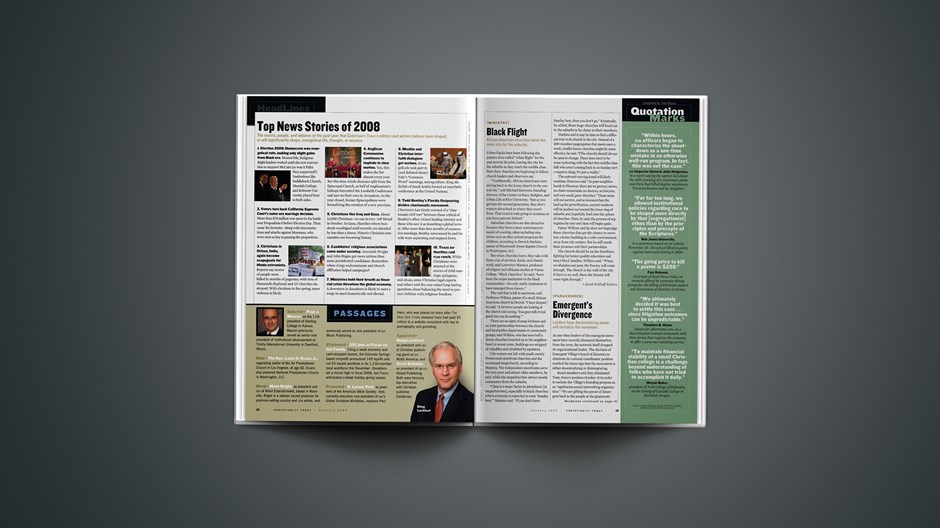
Urban blacks have been following the pattern of so-called "white flight" for the past several decades, leaving the city for the suburbs as they reach the middle class. Now their churches are beginning to follow, church leaders and observers say.
"Traditionally, African Americans were driving back to the home church in the central city," said Michael Emerson, founding director of the Center on Race, Religion, and Urban Life at Rice University. "But as you get into the second generation, they don't want to drive back to where they aren't from. That trend is only going to continue as you leave poverty behind."
Suburban churches are also attractive because they have a more contemporary model of worship, often including ministries such as after-school programs for children, according to Derrick Harkins, pastor of Nineteenth Street Baptist Church in Washington, D.C.
But when churches leave, they take with them a lot of services, funds, and charity work, said Lawrence Mamiya, professor of religion and Africana studies at Vassar College. "Black churches," he said, "have been the major institution in the black communities—the only stable institution to have emerged from slavery."
The void that is left is enormous, said DeShawn Wilkins, pastor of a small African American church in Detroit. "I hear despair," he said. "A lot more people are looking at the church and saying, 'You guys talk it real good, but you do nothing.'?"
There are no signs of soup kitchens and no joint partnerships between the church and local police departments or community groups, said Wilkins, who has seen half a dozen churches boarded up in his neighborhood in recent years. Buildings are stripped of valuables and inhabited by squatters.
City centers are left with small, mostly Pentecostal storefront churches and the occasional megachurch, according to Mamiya. The independent storefronts serve the very poor and attract older members, he said, while the megachurches attract mostly commuters from the suburbs.
"Class is a major factor in attendance [at megachurches], especially in black churches where everyone is expected to wear 'Sunday best,'?" Mamiya said. "If you don't have Sunday best, then you don't go." Eventually, he added, those huge churches will head out to the suburbs to be closer to their members.
Harkins said it may be time to find a different way to do church in the city. Instead of a 400-member congregation that meets once a week, smaller house churches might be more effective, he said. "[The church] should always be open to change. There does need to be some reckoning with the fact that middle-class folk who aren't coming back in on Sunday isn't a negative thing. It's just a reality."
The outward-moving trend will likely continue, Emerson said. "In poor neighborhoods in Houston, there are no grocery stores, no chain restaurants, no doctors, no lawyers, and very small, poor churches." Those areas will not survive, and as investors buy the land up for gentrification, current residents will be pushed out toward the inner ring of suburbs and, hopefully, back into the sphere of churches. Then, he said, the process of segregation by race and class will begin again.
Pastor Wilkins said he does not begrudge those churches that get the chance to move into a better building in a safer environment, away from city centers. But he still needs their presence and their partnerships.
The church should be on the frontlines, fighting for better-quality education and intact black families, Wilkins said. "When we abandon our post, the Enemy will come through. The church is the wall of the city. If there is no wall, there the Enemy will come right through."

















 While we pray for peace, we need moral clarity about this war.
 A Christian reconciliation group in Israel and Palestine warned that war would come. Now the war threatens their relevance.españolالعربيةFrançais
 C.S. Lewis recommended discernment over diatribes in exactly the moments we’re most eager to indulge in critique.






