Former speechwriter Michael Gerson was quick to parse President Obama's speech to the nation on Tuesday, calling it "rhetorically flat" but "quite interesting from an ideological perspective." Gerson's pen was behind President George W. Bush's inaugural addresses in 2001 and 2005, and in preparation, he studied every single presidential inaugural address in American history.
Now a columnist for the Washington Post, Gerson spoke with Christianity Today yesterday about Obama's inaugural address, religious references, and whether he thinks an evangelical should serve in the new administration.
What did you think of the inauguration?
I thought it was surprising. I came to Obama's speech in many ways expecting something that would be rhetorically masterful and maybe ideologically shallow, because of his ideological background, and we got something very different from that.
I thought it was rhetorically flat, uninteresting from a literary perspective, but quite interesting from an ideological perspective. He set out some interesting themes about political pragmatism. It was one of the strongest defenses of pragmatism against ideology in any inaugural address that I can recall. I think that his assurances on national security issues were pretty reassuring. He recognized that we're in a war and talked about defeating our enemies and talked about soft power a little bit with the fight against global poverty — I thought all those things were good. And then his closing theme of renewing America by returning to its oldest values and virtues — he used the word "virtues" — is a traditional inaugural theme, but I think a very good one.
He talked about loyalty, and duty, and responsibility, among other things, and I think that's both an effective message and an important one. In fact it's been the message of most of America's great progressive leaders, whether it's Abraham Lincoln or Martin Luther King, they always talk about recreating our country by returning to its oldest and deepest values. So that was a good theme. But I just wish the speech itself had been better.
What was missing rhetorically?
I found some of the phrasing odd when they tried to reach they did not reach effectively for memorable phrases. The use of the word 'swill' is very odd in the speech. I found a lot of use of cliché language, "gathering storms" and "children's children," and things you would expect to find in a House floor speech. There were some nice moments, but it was very uneven in its quality.
I don't think it made that much difference to the two million people on the Mall — they were into the moment, and I don't think the speech was terrible, but it was a missed opportunity. This was an unbelievably historic moment, and you look for example at the end of that speech, at the mentioning of Valley Forge and those values, and that's fine, but it could have literally been given by any president in American history. There was nothing specific to the moment, nothing that made it the summary of this great, extraordinary cultural progress culminating in an African American president. Maybe he did that on purpose, maybe he didn't want that to be the rhetorical culmination of much of American history. Maybe he just wanted to lower his sights and be less ambitious. But it's hard for me to be a fan of that as a fan of rhetoric.
How does this compare to his campaign speeches?
I think he rose in the Democratic Party because of some very fine speeches that he gave, his speech on the night of his Iowa victory I thought was a brilliant speech. His race speech in Philadelphia I thought was a serious speech, a serious and interesting speech. But now he's given two speeches in the most high profile settings: his convention speech, which was actually very poor — it was unbelievably typical — and now his inaugural speech, which was not that bad, but it wasn't equal to the moment. Somebody's going to eventually notice that this man who has risen because of his speaking ability has not risen to the moment in some very important historical contexts.
How did you prepare for President Bush's inaugural addresses?
I read every single inaugural in American history when I was preparing for the first one in 2001. There were some weak ones, but there was some marvelous rhetoric as well. The story of America is, in many ways, the story of this extraordinary founding flaw, that we were a nation dedicated to liberty that was also a prison for millions of people. It explains the arguments at the constitutional convention, the run-up to a bloody Civil War, reconstruction, civil rights, and in 45 years we've gone from a circumstance in which when Martin Luther King spoke in 1963 civil rights workers were murdered, where African Americans with doctorate degrees where denied the right to vote because of so-called literacy questions that asked how many bubbles are in a bar of soap and how many jellybeans are there in a jar. That is the central story of American history and one of the dramatic stories in world history, the progress we've made. Obama did nothing to summarize that moment. He made one reference to his father, if he had been here 50 or 60 years ago he might have been denied service. Which I thought was fine, but it needed ambitious rhetorical summary and he purposely did not do it.
Article continues below
What about Rick Warren and Lowery's prayers?
I think Rick Warren did a great job, but I also think Reverend Lowery did a great job. I was very impressed with him, because for me, who was looking for this kind of summary moment, it was very nice to have one of the large figures from the civil rights era putting his blessing on this moment in American history and to hear the cadences of civil rights rhetoric in his prayer. I know some people found it a bit much; I found it very much a great rhetorical tradition in America, which I wish I had seen a little more of in Obama's speech.
Did you parse Rick Warren's prayer?
Not really. He made a point of using Jesus' name, which I think is a genuine pluralism. Pluralism shouldn't mean that we have these common denominator situations; it means that everybody should have a voice. I thought that was a strong reassertion of that. Warren was appropriately enthusiastic about the moment. My basic view there for all the controversy is it's a biblical mandate to pray for those in authority, and that's what Rick Warren did.
He was completely within the tradition of American inaugural speeches. I mean they often have references to scriptural passages. His were 'setting aside childish things,' which I thought was a very effective line, it called attention to one of his great political strengths, which is he seems like an adult. He has a very mature manner. And he also used the phrase still waters, which I thought was interesting. But you know, there's a little bit of a double standard here.
When George W. Bush used scriptural passages they thought it was somehow a threat to the Constitution and when Barack Obama uses them they're normal rhetorical devices. But I thought it was interesting, the one thing that maybe was unprecedented in the speech was the mention of nonbelievers in the litany. That's something other presidents, including George Bush, have done in other speeches, but not an inaugural address. I think it's a recognition of an electoral reality that you've had over the last few decades, a significant growth in an area of voters identified as nonreligious. That was recognition of reality. It didn't bother me at all but it was interesting. So I thought he made fairly good use of religious references.
Article continues below
Does it matter if Obama has any evangelicals in his administration?
I've never really viewed it that somehow you need some quota of evangelicals. I think the policy matters more.
I do know that the Obama transition team has worked pretty closely with Jim Wallis and some other religious leaders in some early stages of policy development. I'm told that their director of the domestic policy council is very open to faith-based ideas and other things.
The encouraging thing is that Obama comes from a community organizer background and at least understands the role of faith and faith-based institutions in our society and you hope that translates broadly in his administration. But we also know there are elements of the Democratic party that are deeply secular and have been highly critical of any recognition or cooperation with the role of faith-based institutions in our public life, and so I think that's probably a struggle within administration. I hope Obama's viewpoint, at least the one he outlined in the campaign, prevails.












 While we pray for peace, we need moral clarity about this war.
 We’ve got little information on Jesus’ appearance and personality. But that’s the way God designed it.españolFrançais
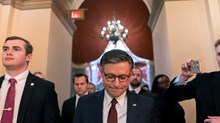 After lobbying from fellow Southern Baptists and Christians affected by the war, the House speaker moves a package forward.





