 |
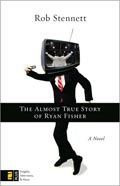
The Almost True Story of Ryan Fisher |
Rob Stennett's first novel, The Almost True Story of Ryan Fisher, is equal part dramatic fiction and biting satire. It is the engrossing story of a young real-estate agent's audacious plan to start a church and become its pastor, even though he doesn't believe in God or subscribe to any Christian faith. It is written in a meandering sort of way, akin to the storytelling of National Public Radio's This American Life. Indeed, more than once I found myself reading it with the voice of Ira Glass, the show's host, in my head.
For me, reading Fisher was like literary déjà-vu — the distinct impression that I was reading a story from great literature. That's because in some twisted way, I was. There's an uncanny resemblance, whether intentional or not, between Fisher's plot and characters and those of Fyodor Dostoyevsky's Crime and Punishment. Both main characters, Ryan Fisher and Rodion Raskolnikov, concoct a plan to commit a "crime" based on an irrational, unhealthy view of themselves as extraordinary men that sets them above the law and makes the end justify the means. Both men spend the majority of their respective stories trying to keep up appearances. Both characters have a dualistic identity that ultimately needs to be integrated into a unified whole. And both, in the end, have to face the music and reach a point of redemption: Raskolvikov heading off to Siberia for prison, and Fisher becoming a wash-up has-been (along the lines of Gary Coleman or Tonya Harding, as Stennett puts it).
Both books also place redemptive characters alongside their respective protagonist. As the soft, female voice of reason, Ryan's wife Katherine is somewhat the equivalent of Sonia Marmeladov. Katherine is the only person in the story who is fully aware of the truth and the duplicity of the situation. She is a wonderfully complex character who, in alternating scenes, both loves Ryan and detests the sham world he's created. She is also dealing with her own personal issues as she grieves the past, doubts the present, and struggles against a developing affair with worship leader Cowboy Jack.
Fisher's other redemptive character is Pastor Clark, who roughly mirrors inspector Portify in Dostoyevsky's classic. As Pastor Clark is genuine and upright as a pastor, he represents everything Ryan strives to be and becomes Ryan's haunting reminder of the truth. Thus, Fisher does his best to avoid him, just as Raskolnikov evades the advances of the police inspector who is striving to get him to confess to the crime.
But the most original redemptive character in Fisher is Clovis, a slightly deranged fundamentalist Baptist determined to expose Ryan as a phony and wage war against the decay and shallowness he observes in the contemporary church. Ultimately, Clovis's own dysfunction serves as Ryan's eventual salvation.
Fisher is filled with brilliant sarcastic wit, mostly directed against the contemporary church, though in a friendly, non-vindictive way. I do wish Stennett would have taken more time to develop Ryan as a character, perhaps revealing more of his internal struggle, rather than paint him as a fairly one-dimensional, overconfident, yet deeply insecure real-estate agent. I would have liked Ryan to have some part in his own redemption, rather than the house of cards completely crumbling around him. Only at the end of the novel, when Ryan is completely exposed, do we catch a glimpse of some real change — but only a glimpse. More character development at the expense of plot details would have made this a richer read.
Another weakness of Fisher's is the author's over-the-top pop culture allusions. There is no way anyone other than Stennett himself could ever grasp all his references to movies, television, and music, and one wonders if he was exposed to more than pop-media growing up. (Sorry, Rob, I know this probably isn't true, but the thought did cross my mind.) Stennett does use some creative literary devices, however, such as Fisher's thoughts interrupting a sentence midstream, or humorous situational comedy in which Stennett poses alternative outcomes to Fisher based on different choices he makes.
As a church planter and pastor, I have to realize that the question Stennett's novel poses is not, "Could this happen?" It has to some degree plenty of times (Stennett's own New Life Church is proof enough of this). The question for all of us in Christian leadership, whether we are full-time ministers or volunteers, is: Will we allow ourselves to become Ryan Fisher? Ultimately, Ryan serves as a potential warning for any of us who attempt to do the work of God disconnected from ourselves, from others, and from the living God we claim to serve.
Mike Moran is pastor of Kettlebrook Church in West Bend, Wisconsin.
Copyright © 2009 Christianity Today. Click for reprint information.
Related Elsewhere:
The Almost True Story of Ryan Fisher is available at ChristianBook.com and other book retailers.
Christianity Today has other book reviews on a section of our website.







Support Our Work
Subscribe to CT for less than $4.25/month