Che Guevera has always been more of an ideal than an actual person. He's been the romanticized poster boy for many a wannabe revolutionary, and his face on T-shirts has become the universal symbol for proletarian, raging-against-the-machine rebellion. His mythos is way larger and more important than his biography, because his biography—as hammered home in Steven Soderbergh's two-part, four-plus-hour film—is disappointingly mundane. If Soderbergh's goal in making this movie was to demystify Che Guevera and de-romanticize "revolution," he's succeeded winningly. But unfortunately the result is a film that is just not very compelling.
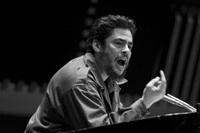
Benicio Del Toro as Che
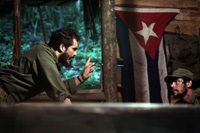
For a film of such length and epic proportions, Che is actually very specific and limited in its narrative scope. Part 1 (The Argentine) follows Che in Cuba, as he partners with a young Fidel Castro to mount an agrarian revolution by gradually winning the hearts and minds of everyday Cubans who are dissatisfied with their government. Interspersed in this narrative—to interesting effect—are some black-and-white scenes of Che in Manhattan during his 1964 trip to speak to the U.N. General Assembly. By the end of Part 1, he and the rebels have successfully overthrown Batista's current regime in Cuba, though we are not granted the luxury of actually seeing the march into Havana. Just as we are finally getting a bit of pay-off for meticulously observing the banal everydayness of revolution for the two-plus hours that comprise Part 1, Part 2 (The Guerilla) takes us out of Cuba and to Bolivia, where Che (after a failed attempt in Congo) tries to duplicate his Cuban revolutionary success in another Latin American nation. Unfortunately the revolutionary fervor among the lower classes and oppressed people groups in Bolivia is not as strong as Che had hoped, and the revolution fizzles before it begins.
That is about the extent of what happens in the film. It's chock full of busy bodies, meetings, firefights, bombs, walking through jungles and mountains, tending to injuries, smoking cigars, mumbling in Spanish, arguing and conspiring about this, that, and the other. These sorts of things are fascinating in small doses, but tiresome when it is all there is for more than four hours. I'm all for films that focus audience attention on the mundane realities of things, but Che takes it all a little too far.
Che (right) meets with Castro (Demian Bichir)
For a film with a title like Che, the expectation is that we will get to know the title character and get to know him well. Not in the least. Soderbergh's apparent commitment to raw, ground-level realism, combined with a well-intentioned (but ultimately ill-advised) ideological fidelity to Che's egalitarian socialist principles (which precludes, among other things, too many close-ups of Che) leaves very little room for character development in the traditional sense. Audiences are given very little understanding of who Che really is, and why they should care to watch him for better than one-sixth of a full day. He remains as distant at the end of the film as he is at the beginning: still just a name that has vague associations with rebellion and revolution. Benicio del Toro does his best with the material (and his best is very good), but it's painful to sit through a such a long performance that is so ingratiatingly constrained by the filmmakers' indulgent, self-imposed narrative peculiarities.
It's clear that Soderbergh wants Che to embody in style what it hopes to convey in content: the ideological underpinnings and material realities of Che Guevera's revolutionary action. This means that the film's rhythm, structure, shot-construction, and overall mood tend to reflect the sort of organic camaraderie and quiet intensity of Che's vision for revolution. It's a commendable idea, and at times quite lovely and subtly effective. But for over four hours?
Franka Potente as Tania
On the upside of things, there is the look of the film. It is visually gorgeous. Soderbergh acts as his own cinematographer and captures the natural beauty, greenery, and rugged terrain of the locations (shot in Puerto Rico and Spain) with effortless grace and an expert eye. There are next to no interior shots, few artificial lights, and a commitment to a sort of phenomenological exploration of nature that would made Terrence Malick proud. Additionally, Soderbergh crafts the two halves of the film with slightly different looks, with different film stocks and camera techniques distinguishing one from the other. As is typical of Soderbergh, he is meticulously attentive to style, making choices based on the material and the task at hand. His films have wildly disparate looks (Oceans 11 vs. Traffic, for example), but they always cohere with the content. Soderbergh knows the craft of cinema, and Che is a master class in good filmmaking. But good filmmaking does not necessarily always mean good film.
In the case of Che, Soderbergh errs on the side of subtlety. It's too artsy for its own good. He's a daring filmmaker and has a string of experimental films to his resume that sometimes work (Bubble, Schizopolis) and sometimes don't (Solaris), and though Che is easy to admire, it is hard to love. There is a paralyzing detachment in Che, a self-consciousness that alienates the audience. Soderbergh falls prey to this often. He loves pointing out that his films are, indeed, films. This works well for pop culture fluff like Ocean's 11, but for Che—a film that seems like its story should do the talking—our hyper-awareness of its artifice (such as the fact that Soderbergh perennial Matt Damon makes an inexplicable cameo) proves to be an annoying distraction.
Article continues below
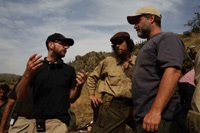
Director Soderbergh (left) on the set with Del Toro and executive producer Gregory Jacobs
It's too bad. Che Guevera is a compelling figure, if only because of his durability and importance as an icon. Whatever you might think of Che's politics, his mythos certainly deserves a better treatment than this. There are moments in the film where we get glimpses of interesting ideas, little exchanges and one-liners that spark some potential epiphanies. A character will ask Che, "What do you have faith in?" to which he will respond, "I have faith in mankind." But these quips are never elaborated on, and it's always on to another battle or meeting instead.
By the end of Part 2, Che is a suffering asthmatic, his men starving, his cause waning. But it's hard to feel any sympathy for him. The film gives us no reason to resonate with his ideals, because it only vaguely outlines them. It's a marathon homage to the birth and death of idealism, of martyrdom, but by the end we feel less inspired than exhausted. A much better exploration of similar terrain is the 2008 film Hunger, about Bobby Sands' 1981 hunger strike in Northern Ireland. That film was equally arty, but only 90 minutes long. Concise, to-the-point filmmaking makes a world of difference.
Che is a lot of things, but—to the unfortunate detriment of what it endeavors to commemorate—it is anything but concise and to-the-point.
Talk About It
Discussion starters
Do you have a sense for what drove Che to be a revolutionary? What were the ideals he was fighting for?
What does Che mean when he says that he has faith in mankind and nothing else? What about mankind does he have faith in?
In what ways does the style of Che represent the themes or spirit of it?
The Family Corner
For parents to consider
Che is rated R for language and violence. It is in many ways a war film; there are executions, bombs, and gunfire, though none of it is excessively explicit. There is no sex in the film, but an off-screen rape is implied. Some mild profanities and language (in Spanish), but not excessive.
Christian artists work at the intersection of music and climate change.
Kelsey Kramer McGinnis
Che
1 of 4
Benicio Del Toro as CheChe (right) meets with Castro (Demian Bichir)Franka Potente as TaniaDirector Soderbergh (left) on the set with Del Toro and executive producer Gregory Jacobs














 While we pray for peace, we need moral clarity about this war.
 We’ve got little information on Jesus’ appearance and personality. But that’s the way God designed it.españolFrançais
 Christian artists work at the intersection of music and climate change.