"Why are we bringing it back?" asked Bishop Nicholas A. DiMarzio of Brooklyn, who has embraced the move [to revive the practice of indulgences]. "Because there is sin in the world."
Paul Vitello, reporting on the pope's decree of indulgences to celebrate the 2,000th anniversary of the apostle Paul's birth ("For Catholics, a Door to Absolution Is Reopened," The New York Times, February 9, 2009). Until this June, Roman Catholics were able to receive credit up to full (plenary) exemption from purgatory in fulfillment of various good works.
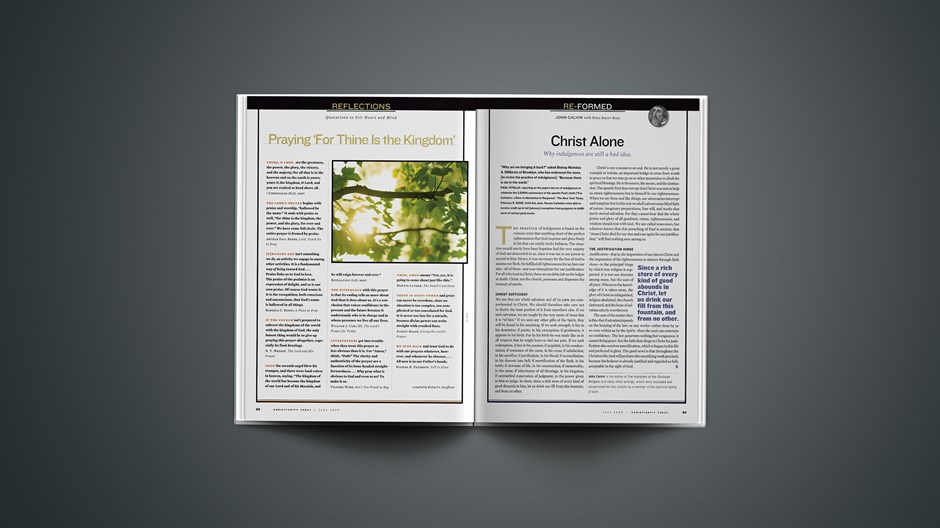
The practice of indulgences is based on the ruinous error that anything short of the perfect righteousness that God requires and gives freely in his Son can satisfy God's holiness. The situation would surely have been hopeless had the very majesty of God not descended to us, since it was not in our power to ascend to him. Hence, it was necessary for the Son of God to assume our flesh. He fulfilled all righteousness for us, bore our sins—all of them—and rose triumphant for our justification. For all who trust in Christ, there are no debts left on the ledger at death. Christ, not the church, possesses and dispenses the treasury of merits.
Christ Sufficient
We see that our whole salvation and all its parts are comprehended in Christ. We should therefore take care not to derive the least portion of it from anywhere else. If we seek salvation, we are taught by the very name of Jesus that it is "of him." If we seek any other gifts of the Spirit, they will be found in his anointing. If we seek strength, it lies in his dominion; if purity, in his conception; if gentleness, it appears in his birth. For by his birth he was made like us in all respects that he might learn to feel our pain. If we seek redemption, it lies in his passion; if acquittal, in his condemnation; if remission of the curse, in his cross; if satisfaction, in his sacrifice; if purification, in his blood; if reconciliation, in his descent into hell; if mortification of the flesh, in his tomb; if newness of life, in his resurrection; if immortality, in the same; if inheritance of all blessings, in his kingdom; if untroubled expectation of judgment, in the power given to him to judge. In short, since a rich store of every kind of good abounds in him, let us drink our fill from this fountain, and from no other.
Christ is not a means to an end. He is not merely a great example to imitate, an important bridge to cross from wrath to grace so that we may go on to other mountains to climb for spiritual blessings. He is the source, the means, and the destination. The apostle Paul does not say that Christ was sent to help us attain righteousness but to himself be our righteousness. When we say these and like things, our adversaries interrupt and complain that in this way we shall subvert some blind light of nature, imaginary preparations, free will, and works that merit eternal salvation. For they cannot bear that the whole praise and glory of all goodness, virtue, righteousness, and wisdom should rest with God. We are called innovators, but whoever knows that this preaching of Paul is ancient, that "Jesus Christ died for our sins and rose again for our justification," will find nothing new among us.
Justification—that is, the imputation of our sins to Christ and the imputation of his righteousness to sinners through faith alone—is the principal hinge by which true religion is supported. It is not one doctrine among many, but the sum of all piety. Whenever the knowledge of it is taken away, the glory of Christ is extinguished, religion abolished, the church destroyed, and the hope of salvation utterly overthrown.
The sum of the matter then is this: that if salvation depends on the keeping of the law, or any works—either done by us or even within us by the Spirit—then the soul can entertain no confidence. The law generates nothing but vengeance; it cannot bring grace. But the faith that clings to Christ for justification also receives sanctification, which is begun in this life and perfected in glory. The good news is that throughout the Christian life, God will perform this sanctifying work precisely because the believer is already justified and regarded as fully acceptable in the sight of God.
John Calvin is the author of The Institutes of the Christian Religion and many other writings, which were excerpted and paraphrased for this column by a member of the Calvinist family of faith.
To commemorate the 500th birthday of John Calvin in 2009, Christianity Today published a bimonthly column adapted and paraphrased from Institutes of the Christian Religion. It was ghostwritten by Michael Horton, professor of theology and apologetics at Westminster Seminary California, and editor-in-chief of Modern Reformation magazine.















 While we pray for peace, we need moral clarity about this war.
 We’ve got little information on Jesus’ appearance and personality. But that’s the way God designed it.españolFrançais
 The founder of Concerned Women for America was credited by President Ronald Reagan with “changing the face of American politics.”






