When Tim Keller came to Manhattan in 1989, New York City had a well-deserved reputation as a snarling, scary place. Violent crime, drug dealing, and other urban pathologies had weakened or chased off many of the faithful. While a barely perceptible renewal was under way, it seemed as if the few remaining orthodox Protestants were huddled together in historic buildings. All of Keller's formal pastoral experience had happened in a small, blue-collar town in Virginia.
Yet today, almost 20 years later, he steps onstage before a packed auditorium at Hunter College on Manhattan's Upper East Side. His church, Redeemer Presbyterian, has five crowded Sunday services in three rented locations—Keller dashes between them—with an average total attendance of 5,000. The service at Hunter is the largest, the "tourist service." (For many years, Redeemer deliberately avoided publicity, but word has spread lately, and Keller estimates that hundreds of out-of-towners show up each Sunday.) Well over 2,000 people—mainly young whites and Asians you would expect to be sleeping off a late Saturday night—have come to this morning's service.
Redeemer's worship is seemly and traditional. Instead of using video monitors, casually dressed worshipers follow a 20-page bulletin that includes hymns, prayers, and Bible texts. Organ and a brass quartet lead the music. For evening services, jazz musicians play contemporary Christian songs.
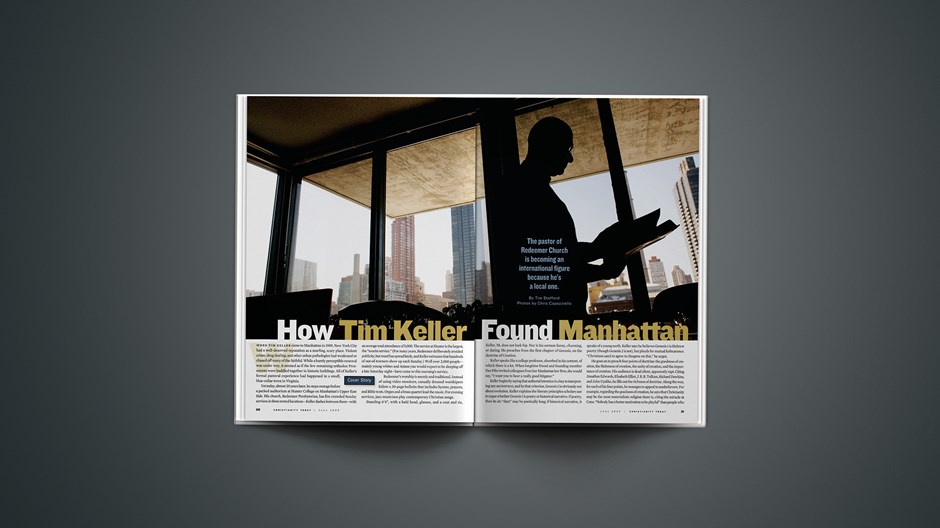
Standing 6'4", with a bald head, glasses, and a coat and tie, Keller, 58, does not look hip. Nor is his sermon funny, charming, or daring. He preaches from the first chapter of Genesis, on the doctrine of Creation.
Keller speaks like a college professor, absorbed in his content, of which there is a lot. When longtime friend and founding member Dee Pifer invited colleagues from her Manhattan law firm, she would say, "I want you to hear a really good litigator."
Keller begins by saying that authorial intention is a key to interpreting any ancient text, and by that criterion, Genesis 1 is obviously not about evolution. Keller explains the literary principles scholars use to argue whether Genesis 1 is poetry or historical narrative. If poetry, then its six "days" may be poetically long; if historical narrative, it speaks of a young earth. Keller says he believes Genesis 1 is Hebrew poetry (though Genesis 2 is not), but pleads for mutual forbearance. "Christians used to agree to disagree on this," he urges.
He goes on to preach four points of doctrine: the goodness of creation, the finiteness of creation, the unity of creation, and the importance of creation. His audience is dead silent, apparently rapt. Citing Jonathan Edwards, Elisabeth Elliot, J. R. R. Tolkien, Richard Dawkins, and John Updike, he fills out the richness of doctrine. Along the way, for each of his four points, he manages to appeal to nonbelievers. For example, regarding the goodness of creation, he says that Christianity may be the most materialistic religion there is, citing the miracle at Cana. "Nobody has a better motivation to be playful" than people who know that God made the earth and made it good.
Or, regarding the unity of creation, Keller points out that all human beings are equally formed by both the Creation and the Fall, so "nonbelievers are far better than their wrong beliefs should make them, and we Christians are far worse than our beliefs should make us."
Keller closes by asking: "Why does nature move everybody?" Why may even the most hardened atheist find that a forest dawn prompts tears, laughter, or joy? Keller dismisses explanations offered by evolutionary psychology and suggests that we are moved as we sense creation's song of praise to its Creator, a glorious fulfillment of its God-given nature. We are moved, Keller says, because we wish to join that chorus and cannot. He points to the Cross as the way by which we can regain that song.
Keller's final words: "Have you accepted Jesus into your life as your Creator?"
Journey to the City
In the late 1980s, Keller was happily teaching at Westminster, the staunchly Reformed Philadelphia seminary, while working for his denomination, the Presbyterian Church in America (PCA). Two things happened. At Westminster, he came under the influence of a small band of urban missiologists led by Harvie Conn. At the PCA's home missions department, he was recruited by its head, Terry Gyger, who wanted to start a church in Manhattan.
Actually, Gyger had already tried to start one, a flop. And those who felt called to Sodom and Gomorrah, er, New York City, were scarce. Gyger latched on to Keller, a Tolkien-fascinated son of eastern Pennsylvania. When Keller begged off, Gyger asked him to visit New York once a week to do research to lay the groundwork for somebody else.
Keller found some signs of life in the churches of the outer boroughs. Manhattan itself, however, with its artists and musicians and 80-hours-a-week doctors and financial service personnel, had mostly gloomy, half-empty church buildings. Manhattan, a financial and cultural hub that today is home to 70,000 people per square mile, had suffered a series of painful setbacks in the 1960s and '70s, from race riots to crime waves, that had made putting down roots there a sheer act of faith.
Article continues below
One hopeful sign: On the Upper East Side, an offshoot of Campus Crusade for Christ had opened the DeMoss House to reach New York executives, and scores of them were coming to faith. They needed a church. DeMoss was a starting place.
Keller began talking to anyone who would sit still, asking questions he had learned from the urbanists at Westminster: "What would be a New Yorker's worst disaster?" and "What kind of church would a New Yorker want to attend?" For months he sat in restaurants, learning New Yorkers' ways.
Working with Gyger, Keller identified two PCA pastors to lead the start-up. Both, after consideration, turned him down. Keller returned from a trip to England to find a message on his answering machine. It was Tim Keller or nothing.
The months of research and relationship-building in Gotham had an unexpected effect on Keller: He discovered that the prospect of starting a church excited him. His heart for the city had been plowed for years by his mentors and colleagues at Westminster. Daily interactions with fellow teachers who worked in urban ministry, such as Conn, planted in him a growing urban theology. Through his involvement with inner-city ministries in Philadelphia, most notably Tenth Presbyterian Church, he had developed a positive view of the city. However, he was a suburban man by lifestyle, and the thought of raising kids in Manhattan was daunting.
And terrifying to his wife, Kathy, who focused on their three boys, ages 5, 9, and 11, a.k.a. "the hellions." She couldn't imagine her unruly children surviving New York. "My mother said, 'All your kids will be in gangs by the end of the first week.'"
Besides, plenty of counselors doubted the family's fitness for sophisticated Manhattan. "Tim doesn't know what he has on most of the time," friends worried, "and Kathy is pure Pittsburgh."
Kathy had become a Christian after reading the Chronicles of Narnia as a girl; the books opened her to a wider world in which the unthinkable was true. (She wrote to C. S. Lewis, and his replies, among her most precious possessions, are included in C. S. Lewis' Letters to Children, by Lyle Dorsett and Marjorie Lamp Mead.) Later, while preparing for ordained ministry, Kathy became convinced that women's ordination is unbiblical. She wields plenty of influence without being ordained, however.
Article continues below
"He really depends on her," says Scot Sherman, who joined the Kellers' team that first year and planted their first New York daughter church, in Greenwich Village. Later, he launched a Redeemer-inspired start-up in San Francisco. "They were both nerds who read Tolkien," Sherman says, "and probably know more Elvish than they would like you to know. He is inexplicable apart from her. She has her fingerprints all over his brain, and I mean that in a very good way."
Kathy had a meeting with God in which she concluded that she would go and live in a cardboard box, if God told her to. The Kellers were finally ready to leave the suburbs and head for what they had thought of as hell.
But it wasn't hell. They had caught a vision for Manhattan as a place terribly underserved by the church, and a place with gigantic multipliers of influence throughout society. It was both needy and strategic.
Just as important, the Kellers discovered that they liked Manhattan. The kids thrived on the freedom of going anywhere by themselves via the subway. They were desperately proud of their dad and would tell checkout clerks about his new church. No longer was their rowdiness a problem. Kathy says they could never be the worst kids in their classes, "because the worst kids had jail time." They found a new group of heroes in the young adults who began attending Redeemer.
Tim found Manhattan non-Christians amazingly, sometimes naïvely, curious. Though the borough's 1.6 million people were used to religious diversity, many had never talked to an evangelical. Tim's interest in art and music was an indispensable gift in communicating. His omnivorous reading also helped. New York is a city of high achievers to whom, Keller says, it made sense that a minister should be a scholar of ancient texts, exposing them to ideas and information beyond their experience. They needed someone who spoke their language, though, and Keller was a quick learner. "I saw New York mentor Tim," Sherman says. "There's something about the density of the city, the way your lives get intertwined with a secular culture."
In the spring of 1989, the Kellers and a small team of locals launched the church in a Seventh-day Adventist building. They eschewed advertising, believing New Yorkers would be skeptical of someone selling them something. Only personal invitations brought new people. That was part of the vision: "We want to start a church for you, but also for your friends that you want to introduce to Christ." According to Jeff White, another early associate who went on to start New Song Community Church in Harlem, those who came from the DeMoss House were wonderfully evangelistic.
Article continues below
"Every single week," Kathy remembers, "we wondered, will anybody come? Often there was nobody there when we arrived. But 10 minutes into the service, it was full."
New York City, of which Manhattan is the hub, has experienced significant demographic changes in recent years. According to the American Society of Criminology, the city's crime rate dropped sharply between 1996 and 2005. The New York Police Department reports that in north Manhattan, where Redeemer is situated, the number of murders dropped from 379 in 1990 to 43 in 2008; rapes, from 482 to 180. However, nyc's poverty rate remained high from 1969 to 1999, as wages stagnated at the bottom of the economic ladder. Manufacturing jobs have been disappearing, as in the rest of the U.S., while there has been a boom in knowledge-based employment, particularly on the wealthy Upper East Side. Many of these highly educated workers, now under economic stress because of the recession, have found their way to Redeemer.
"The most interesting people came," Tim says. "It was astounding how easy it was to have curious nonbelievers come to church. Before too long there were people in the aisles. There was enthusiasm. There was enormous energy after the service." By the end of 1989, they had an average of 250 people attending, which was as many as they had hoped to attract in the long run. The next fall, they had 600.
The Kellers stick to a few rules. They never talk about politics. Tim always preaches with a non-Christian audience in mind, not merely avoiding offense, but exploring the text to find its good news for unbelievers as well as believers. The church emphasizes excellence in music and art, to the point of paying their musicians well (though not union scale). And it calls people to love and bless the city. It isn't an appeal based on guilt toward a poor, lost community.
Influencing the Influential
"Most churches look at New York as a cesspool," says Charles Osewalt, a Bronx high school principal and Redeemer elder. A big, bearded man, Osewalt often wears basketball jerseys to church and talks with the accent of a lifetime New Yorker. "There's something ugly about people coming into New York and saying, 'we're going to save you.'"
Article continues below
By contrast, Keller enjoyed New York's lack of ceremony and openness to the new. In Manhattan he wasn't competing with other preachers. Gordon MacDonald came to Manhattan's Trinity Baptist Church at about the same time the Kellers arrived. One major financial supporter almost pulled out when he heard the news, thinking that Trinity would be the big draw. But Keller looked on MacDonald's coming as an advantage: MacDonald's name drew many New York Christians, leaving Redeemer to focus on non-Christians. Longtime believers joined Redeemer only if they caught the vision of creating a church that appealed to their non-Christian friends.
Keller recalls a "Wall Street guy" who found Christ at the DeMoss House. "I said, 'What in the world led you to come here and go to the Bible study?' He said, 'I lacked a spiritual center. But it wasn't until I came to New York and came under the pressure of New York that I realized it. New York is so big and scary and difficult. And I realized that I really didn't know what I was living for.'
"Suppose," Keller says, "you are the best violist in Tupelo, Mississippi. You go to Manhattan, and when you get out of the subway, you hear a beggar playing, and he's better than you are." New York attracts the best and the most ambitious. The sheer density of competition, along with the diversity of points of view, makes for a "culture-forming engine," says Keller. It also exposes the weaknesses of those caught in it.
Sherman relates Keller's vision to the apostle Paul. "Paul had this sense of, I really should go talk to Caesar. He's not above caring for Onesimus the slave, but somebody should go to talk to Caesar. When you go to New York, that's what you're doing. Somebody should talk to the editorial committee of The New York Times; somebody should talk to Barnard, to Columbia. Somebody should talk to Wall Street."
The Kellers became absolute enthusiasts for the city. Artist Makoto Fujimura had returned from years of study in Japan to join the New York art scene, but he lived with his wife and young children in a safe New Jersey suburb. "Tim was the first to say, 'Live in the city.' That was really compelling. I'd never heard that before. It was a crazy idea."
Article continues below
Keller's reading of Scripture fueled his enthusiasm. Conn had taught him a positive biblical view of cities. As he studied New York, he began to draw out that understanding. Surely God's command to exiled Israelites applied to Christians in New York: "seek the peace and prosperity of the city to which I have carried you" (Jer. 29:7). Long before that, God had designated cities as places of refuge when Israel entered the Promised Land. They remain so today, Keller noted—which explains why poor people, immigrants, and vulnerable minorities such as homosexuals cluster in cities. They attract people who are open to change. Paul did most of his missionary work in cities, and early Christianity flourished within them. Revelation portrays the final descent of the kingdom of God to earth as a city, although a garden city, with fruit trees and a life-giving river at its center. Keller suggests that, had Adam and Eve lived sinlessly and obeyed God's directions, they would have made Eden into just such a city.
Keller, however, isn't blind to the ugliness that often blights urban life. Keller says the city has a "powerful magnifying glass effect"—emphasizing the best and the worst aspects of human nature.
"Redeemer was the first to lead this change of posture to the city," says Andy Crouch, Christianity Today's Global Conversation editor and author of Culture Making, "[to take Christians] from being a beleaguered minority to being a confident minority."
The city has changed in a way unimaginable to an older generation, who knew it as a good place to get mugged. Nowadays, Manhattan's crowded streets feel safe and exciting day and night, and New York is a magnet for young people. Crouch says the renewal of cities—not just New York, but cities all over America—is one of the most interesting phenomena of his lifetime. "Where is the cause and effect in this? To what extent has Redeemer been pushed along by the tailwind of demographic change? Probably a lot. At the same time, you have to have a sail. Tim came to New York and put his sails up."
Gospel DNA
What has Redeemer accomplished after 20 years? Keller pauses. "We have a beachhead. A beachhead means we have a pretty significant, balanced ministry from which you can get a lot of things done." But the work itself isn't done. "I feel there is a way of doing ministry with this particular balance that other people can do, and right now I feel other people aren't doing it. How can we leave behind a generation of people who know how to do this—and will do it?"
Article continues below
Redeemer has a dense array of innovative ministries, but these are not particularly what Keller wants to share. He's talking about theological vision, what he calls Redeemer's "gospel DNA."
On a recent trip to England, Keller carried a one-page summary of gospel DNA notes to himself under nine headings, such as "contextual and missional" and "unity and catholicity of spirit." The unifying theme is grace, just as Keller lays it out in his latest book, The Prodigal God, an exposition of the parable of the Prodigal Son.
White believes Keller's unique gift is to preach to both Christians and non-Christians in the same terms, without making a choice between evangelism and discipleship: "Tim uses the gospel surgically on the heart. The gospel is what we need to come to faith and also what we need to grow." A theology of grace uses the same language to challenge both the runaway son and the solid older brother.
"The seminal idea," says Kathy, "is that the world is full of taskmasters—parents, job, society—and [to most people,] God is the worst of the bunch." Tim adds, "Performance is such a high standard, the strain is unsupportable."
Redeemer holds high moral standards, but Keller puts all 10 commandments under the first one—to have no other gods. Preaching about idolatry—the sin of putting something or someone else in the place of God—enables Keller to communicate with relativists, who would respond to Christian moral standards by saying, "That's just your opinion."
"When you say the ultimate sin is to put things in the place of God," Keller says, "you take that argument away. You find that they say, 'Hmm, I don't know if there is a God.' When I describe sin in such a way that people wish there were a God, I'm making progress."
Redeemer doesn't participate in culture wars. It aims to focus on Jesus, and on the incredible good news that God is not, in fact, the worst taskmaster in the world but the one who died for us.
The gospel DNA of grace is crucial to Redeemer's embrace of center-city culture. It gives people permission to try and fail, to mix freely with those of other faiths and morals, and to tolerate ambiguity. Someone who works in advertising or theater may have to serve for many years at projects he or she finds morally ambivalent. Even those who rise to positions of responsibility will find no clearly marked path. Without a grasp of grace, there will be no Christians working in such areas. Keller likes to describe Redeemer's stance as "cultural presence," which enhances flavor but doesn't take over.
Article continues below
Reformed, but Catholic
Keller's PCA denomination proclaims classic Puritan doctrine. Keller not only adheres firmly to that doctrine, he also is a student of it, with a first-class knowledge of such luminaries as Jonathan Edwards. Yet he balances this doctrinal narrowness with catholicity, appreciating not only the Reformed theology of his heritage, but also actively supporting the efforts of charismatics, Lutherans, and the Christian and Missionary Alliance. Of the 65 churches that Redeemer has helped to plant in the New York area, only 10 are PCA. The largest is Southern Baptist.
Pastor Gyger puts it this way: "He has a practical understanding that if we are going to reach the whole city, we need a wide spectrum of the church."
Much of Redeemer's impact has been through friendships, word of mouth, and sermons passed on from one person to another. Redeemer resisted publicity, avoiding reporters. For years, Keller did little writing or speaking outside the church.
But now Keller is writing and speaking extensively, and has also put formal mentoring programs in place. For example, four young pastors who are on the verge of planting churches in the New York area spend an hour with Keller every month, going through a syllabus. "Redeemer Labs" was launched a year ago to spread the church's vision through books, online downloads, curricula, and other media approaches, and to attract a new generation of leaders to carry it out.
Keller reckons they should be planting churches not just in nyc but in "center cities" worldwide as well. This vision came into sharp focus when church leaders from Amsterdam approached Keller. They had investigated other North American church-planting centers, but felt that they didn't fit culturally (too suburban). Since that initial meeting, Redeemer has helped Amsterdam pastors plant 18 churches, and is helping new churches in cities around the world.
Article continues below
Keller realized that Manhattan may have more in common with Amsterdam and London than it does with small towns in eastern Pennsylvania. It may even have more in common with Mumbai. Gyger, who now heads Redeemer's Church Planting Center, says, "You go to Soho or London or Berlin or Madrid or Sao Paolo, and you'll find a new kind of international culture of young elites and professionals. We go to these city centers and try to reach these kinds of people."
Good and Great
Redeemer no longer runs on volunteers and adrenaline. A large staff handles ministry administration, with considerable long-range planning. A 10-year succession plan includes projected ownership of two Manhattan buildings (one already purchased and scheduled for renovation) and eight or nine congregations, each with its own pastor and rotating preaching from Keller. The mission field has shifted outward to new church plants throughout New York and the world. Yet Keller still spends time modestly sharing his gospel DNA with small groups of pastors. Again, it's not flashy or daring. But it is pure Keller.
"The difference between a solid church and a terrible church is pretty much up to you," he tells one group. "The difference between a solid church and incredible success has almost nothing to do with you at all. It's like you are out there paddling on your surfboard, and suddenly the wave comes and you ride in, standing up like you're a Greek god. That has everything to do with the wave."
Tim Stafford is a ct senior writer. Download a companion Bible study for this article at ChristianBibleStudies.com.
More information about Tim Keller and his church can be found on Redeemer Presbyterian's website. Tim Keller's books include The Reason for God and The Prodigal God.
Previous Christianity Today articles on or by Tim Keller and Redeemer Presbyterian include:
Tim Keller Reasons with America | The New York pastor explains why he's taking his ministry model on the road. (June 20, 2008)
The Advent of Humility | Jesus is the reason to stop concentrating on ourselves. (December 22, 2008)
New York's New Hope | From inner-city gardens, to fine-art exhibitions, to political activism, street-smart churches are changing the culture of America's largest and most dynamic city. (December 1, 2004)















 While we pray for peace, we need moral clarity about this war.
 A Christian reconciliation group in Israel and Palestine warned that war would come. Now the war threatens their relevance.العربيةFrançais
 Christian artists work at the intersection of music and climate change.






