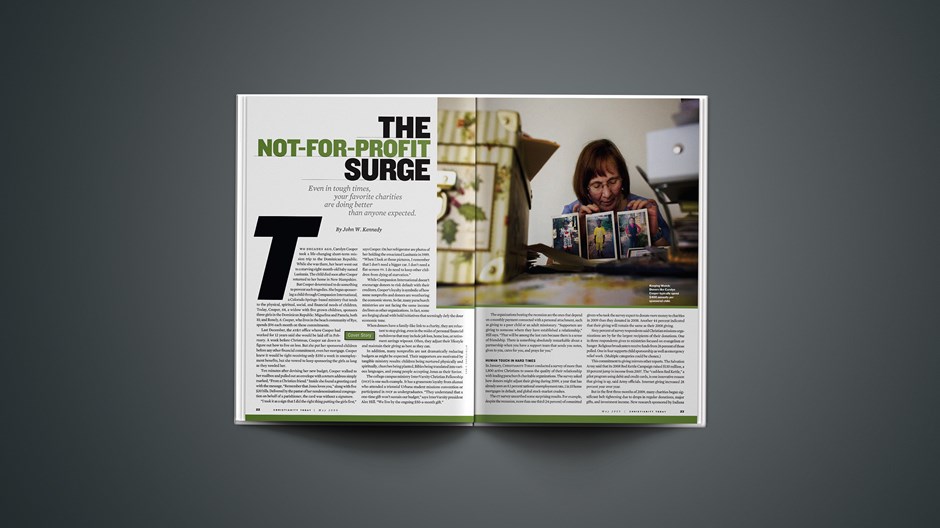
Two decades ago, Carolyn Cooper took a life-changing short-term mission trip to the Dominican Republic. While she was there, her heart went out to a starving eight-month-old baby named Lusitania. The child died soon after Cooper returned to her home in New Hampshire. But Cooper determined to do something to prevent such tragedies. She began sponsoring a child through Compassion International, a Colorado Springs-based ministry that tends to the physical, spiritual, social, and financial needs of children. Today, Cooper, 64, a widow with five grown children, sponsors three girls in the Dominican Republic: Miguelina and Pamela, both 10, and Ronely, 6. Cooper, who lives in the beach community of Rye, spends $96 each month on these commitments.
Last December, the AT&T office where Cooper had worked for 12 years said she would be laid off in February. A week before Christmas, Cooper sat down to figure out how to live on less. But she put her sponsored children before any other financial commitment, even her mortgage. Cooper knew it would be tight receiving only $350 a week in unemployment benefits, but she vowed to keep sponsoring the girls as long as they needed her.
Ten minutes after devising her new budget, Cooper walked to her mailbox and pulled out an envelope with a return address simply marked, "From a Christian friend." Inside she found a greeting card with the message, "Remember that Jesus loves you," along with five $20 bills. Delivered by the pastor of her nondenominational congregation on behalf of a parishioner, the card was without a signature.
"I took it as a sign that I did the right thing putting the girls first," says Cooper. On her refrigerator are photos of her holding the emaciated Lusitania in 1989. "When I look at those pictures, I remember that I don't need a bigger car. I don't need a flat-screen TV. I do need to keep other children from dying of starvation."
While Compassion International doesn't encourage donors to risk default with their creditors, Cooper's loyalty is symbolic of how some nonprofits and donors are weathering the economic storm. So far, many parachurch ministries are not facing the same income declines as other organizations. In fact, some are forging ahead with bold initiatives that seemingly defy the dour economic tone.
When donors have a family-like link to a charity, they are reluctant to stop giving, even in the midst of personal financial meltdowns that may include job loss, home loss, or retirement savings wipeout. Often, they adjust their lifestyle and maintain their giving as best as they can.
In addition, many nonprofits are not dramatically reducing budgets as might be expected. Their supporters are motivated by tangible ministry results: children being nurtured physically and spiritually, churches being planted, Bibles being translated into various languages, and young people accepting Jesus as their Savior.
The college campus ministry InterVarsity Christian Fellowship (IVCF) is one such example. It has a grassroots loyalty from alumni who attended a triennial Urbana student missions convention or participated in IVCF as undergraduates. "They understand that a one-time gift won't sustain our budget," says InterVarsity president Alec Hill. "We live by the ongoing $50-a-month gift."
The organizations beating the recession are the ones that depend on a monthly payment connected with a personal attachment, such as giving to a poor child or an adult missionary. "Supporters are giving to someone where they have established a relationship," Hill says. "That will be among the last cuts because there is a sense of friendship. There is something absolutely remarkable about a partnership when you have a support team that sends you notes, gives to you, cares for you, and prays for you."
HUMAN TOUCH IN HARD TIMES
In January, Christianity Today conducted a survey of more than 1,800 active Christians to assess the quality of their relationship with leading parachurch charitable organizations. The survey asked how donors might adjust their giving during 2009, a year that has already seen an 8.1 percent national unemployment rate, 1 in 10 home mortgages in default, and global stock-market crashes.
The CT survey unearthed some surprising results. For example, despite the recession, more than one third (34 percent) of committed givers who took the survey expect to donate more money to charities in 2009 than they donated in 2008. Another 44 percent indicated that their giving will remain the same as their 2008 giving.
Sixty percent of survey respondents said Christian missions organizations are by far the largest recipients of their donations. One in three respondents gives to ministries focused on evangelism or hunger. Religious broadcasters receive funds from 26 percent of those polled. One in four supports child sponsorship as well as emergency relief work. (Multiple categories could be chosen.)
This commitment to giving mirrors other reports. The Salvation Army said that its 2008 Red Kettle Campaign raised $130 million, a 10 percent jump in income from 2007. The "cashless Red Kettle," a pilot program using debit and credit cards, is one innovative reason that giving is up, said Army officials. Internet giving increased 28 percent year over year.
Article continues below
But in the first three months of 2009, many charities began significant belt tightening due to drops in regular donations, major gifts, and investment income. New research sponsored by Indiana University found that gifts of $1 million or more plummeted 33 percent during the second half of 2008 compared with 2007. Also, the Evangelical Council for Financial Accountability (ECFA) surveyed its 1,000 member organizations and found that
• 41 percent had frozen or delayed salary increases;
• 38 percent had frozen or reduced hiring; and
• 53 percent had cut travel and conference expenses.
In January, ecfa member organization Prison Fellowship laid off 40 people as part of a 12 percent budget reduction. While no more large staff cuts are anticipated, president Mark Earley says he expects another expenditures decrease in the next fiscal year. In an "urgent prayer and budget request" e-mail appeal in March, Earley told partners that the nonprofit faced a $2.8 million deficit in donations. "We know that if we do not make up this shortfall," Earley wrote, "we will be forced to make even more cuts."
"The positive in this is that it's causing us to be more focused on our mission in a very clear way, and to invest our resources more pointedly in the core aspects of that mission," Earley told CT.
The harsh economy can be especially difficult on ministries to "the least of these," Earley says. "Historically, we have always been an early warning sign for charities situated like us.
"When there are higher prices at the gas pump, when food costs more, and when equity starts shrinking out of homes, folks who support our ministry postpone giving until they have more confidence. Most of our supporters are small donors giving out of their discretionary income."
Earley says the majority of contributors give less than $100 a year to Prison Fellowship, which has annual revenues of $53 million. (The CT survey indicated an average donation to Prison Fellowship of $104 per year.) Many give sporadically rather than on a monthly basis.
Responding to the weakening economy, charities have ramped up the frequency of communication with donors, sending more e-mails and traditional letters from their presidents. Executives are going the extra mile with personal phone calls, handwritten notes, and one-on-one visits to make sure substantial and longtime donors know they are valued.
Article continues below
Last fall, World Vision launched what the global relief and development organization is calling its FAITH campaign, "Fiscal Actions in Times of Hardships." World Vision mobilized its 800 Seattlearea employees to phone 87,000 donors on their own time—not to ask for more money, but to thank donors for continuing to give sacrificially. And for the first time, World Vision directed overseas managers who supervise work at the local level to write directly to sponsors with updates.
In addition to pledging monthly financial support, Compassion International's child sponsors write letters to their child, buy a Christmas and birthday present for him or her, and sometimes go visit the child at their own expense. The typical outlay per child amounts to $400 or more annually, once additional gifts are factored in. Sponsorships may begin at the prenatal stage and continue on through a child's time in university.
Until Cooper, who is fluent in Spanish, lost her job, she made two trips each year to the Dominican Republic to deliver gifts and see how her girls were progressing. It's no wonder most donors wouldn't give up supporting their overseas child any more than they would forsake their own child or grandchild.
"We work to make sure people view this as not just another bill to pay," says Mark Hanlon, senior vice president for Compassion's U.S. group. "If the sponsor sees the child as only a monthly payment, we have lost the battle."
Cooper is among a cadre of highly committed sponsors known as "compassion advocates" who are trained and certified annually to speak publicly about the ministry's mission and vision. She has enlisted more than 100 other people to sponsor children.
Another major organization is implementing the relational strategy, even though its mission has little to do with fighting poverty. Wycliffe Bible Translators, based in Orlando, Florida, uses traditional mass mailings twice a year to potential new donors acquired from a mailing list. Those who give for the first time receive a phone call expressing appreciation. "The human touch is vital for us," says Les Kline, vice president for advancement at Wycliffe. "Early on we want them to know that we don't take them for granted."
BUDGETS IN FLUX
Not-for-profits that rely on monthly donor support are faring much better than organizations that rely on investment income. Harvard University, for instance, registered an $8 billion (22 percent) quarterly decline in endowment value in late 2008, the worst drop in the school's modern history. Harvard has responded by cutting its budget significantly.
Article continues below
Dan Busby, the newly appointed president of ecfa in Winchester, Virginia, says the uncertainty about the global economy has required charity leaders to be more flexible. Some ecfa members have devised three fiscal scenarios for 2009, including a bare-bones option if circumstances become dire. A few organizations are revising their budgets almost monthly to get through the crisis. "Small- and mediumsized charities are the most significantly impacted," Busby says. "The larger ones are better able to shift programs and continue."
Still, Busby agrees that the missionary deputation model of raising funds allows groups to survive the recession better than other economic models. "The donor doesn't want to see missionaries brought back from the field where they are doing a great job," Busby says. "We have also sensed that same strong support with child sponsorship organizations because the donor feels an intense interest in the child." Nevertheless, the ecfa survey reported that only 44 percent of its members had met contribution goals in the fourth quarter of 2008. Another 28 percent had performed 10 percent or more below expectations.
Africa Inland Mission (AIM), an organization that has been around since 1895 and raises $24 million each year, is emblematic of the volatile fiscal environment. AIM avoided extreme downsizing because of its donors' steady monthly giving. "As long as Christian donors in the United States have income flowing in, they are very loyal to their missionaries because of personal relationships," says Ted Barnett, chief executive of AIM, based in Pearl River, New York.
Even so, Barnett says AIM is reducing expenses. Its staff is not attending conferences. Professional development efforts for employees are on hold. Travel has been reduced. More meetings occur via conference calls rather than in person. Vendors have cut their prices to keep AIM's business.
Some charities are actually seeing a giving boost. For example, for the first four months of its fiscal year ending in January, Wycliffe was 7 percent ahead of income compared with one year earlier. "Donors are being more cautious and probably not giving to as many organizations," Kline says. "But to those where they have a history, where they have a confidence in gifts resulting in transformed lives, there is growth."
Article continues below
One way charities have earned the trust of givers is by transparency. Many ministries now post financial audits and IRS filings on their websites. ecfa members are required to provide copies of their most recent audit and financial statement to anyone who asks.
Hill says giving to InterVarsity has been up by about 4.5 percent in each of the past four years, in part because IVCF has been stressing the ease of electronic giving. Instead of merely accepting automatic withdrawals or credit card payments, some charities are getting creative and gaining revenue through pursuing stock transfers, liquidation of foundations, and estate bequests.
When other organizations recently curtailed advertising on the Web, World Vision made an unprecedented splurge, buying Internet banner ads to get its message out to a different audience. World Vision cash giving rose 4 percent in the quarter ending in December, and the nonprofit foresees a 3-4 percent growth rate this year, according to senior vice president and chief financial officer Larry Probus.
$50 MILLION KICK-START
Last November, just as the global economic situation was worsening, Wycliffe announced its ambitious Last Languages Campaign, a $1 billion fundraising effort to provide Scriptures to the remaining one third of language groups that still do not have them.
That same week, Wycliffe received an anonymous $50 million gift to kick-start the campaign. "God came through with a lightning bolt, saying, 'Keep your focus on me and my economy. I will provide the resources. You provide the faith to move forward,' " Kline says. "We're sharing with donors that this is a wonderful time to be investing in this ministry."
As part of the push to create awareness of the need, Wycliffe is partnering with other gospel-focused organizations such as the Jesus Film Project and Faith Comes by Hearing, an audio Bible ministry. If the recession deepens, partnering will become more intensive. "We are seen as a key player laying the groundwork for other ministries," Kline says. "Our donors understand that this ministry is foundational to so many others that they probably also support."
Wycliffe is nearly done assembling a team of 15 relational representatives across the country to connect face to face with current and prospective donors.
The role of professional fundraising started only five years ago at Wycliffe, which hired Kline after he had spent 30 years at World Vision. Historically, Wycliffe has been financed mostly by missionaries who raise monthly support chiefly among family and friends in their home churches. Revenue in the past five years has grown 26 percent, to $139.5 million last year.
Article continues below
"Earlier, people knew of the ministry, but they were not asked to support it," Kline says. "Now we are giving them that opportunity, and we're seeing generous gifts."
Kline tells of how one Midwestern family made a first-time gift of $25 last year. When the household received a Wycliffe ministry gift catalog before Christmas, family members decided to underwrite the entire $125,000 cost of a particular project.
Another organization that's retooling is Greater Europe Mission (GEM), headquartered in Monument, Colorado. Chief executive Henry Deneen says that in February 2009, GEM reduced its budget and cut personnel as part of a strategy shift. The new approach involves more direct contact with congregations through personal visits.
GEM has traditionally focused on monthly support to individual missionaries carrying out ministry in one location. Now GEM is highlighting the importance of rapidly reproducing innovative churches in an urgent appeal to reach non-Christians.
"We're sharing the idea that Europe is becoming a place that is a gateway to all nations," Deneen says. "This helps donors understand that when they invest, it not only blesses Paris, Vienna, or wherever the fieldworker may be, but potentially [blesses] other nations because nationals are coming to Europe and going back home." Deneen says GEM has hired a major donor group that will train fieldworkers to communicate better with supporters.
Compassion International has doubled in size in the past five years to $314 million in annual revenue, thanks in large part to an advertising blitz via television, radio, magazines, and direct mail. Consequently, Compassion has become one of the top 10 incomegenerating ministries. Hanlon, who has been with Compassion for 31 years, says the organization has always emerged from slowdowns in a stronger position than before.
"It's not a bad thing for an organization to pause from time to time to reassess what the top priorities are, even if it's not out of necessity," Hanlon says. "A slowdown can help [us] get back to the fundamentals of what we're all about."
GIVING WITHOUT REGRETS
Belt tightening is widespread during a recession, and many ministries are figuring out new ways to help donors keep their commitments.
World Vision has offered to keep paying child sponsorships for a three-month stretch if donors need to halt giving. The number of those who cancel their child sponsorships has not risen compared with recent years. "Our prayer is that God is going to use this time to make us even better stewards of the resources we have," Probus says. World Vision has told workers there will be no pay raises this year. Along with the Salvation Army, World Vision ranks at the top of revenue-making ministries, with income hitting $1.1 billion in 2008.
Article continues below
InterVarsity, which had giving revenues of $59.8 million last year (unchanged from 2007), is in the middle of a campaign to raise funds from major donors. Hill tells of a corporate leader who had expressed interest in making a hefty donation before his company went bankrupt and he lost the equity he had built up in the firm over two decades. Hill visited the patron to offer his consolation. "He said, 'My regret now is that I didn't give it when I had it. I was going to give it later on,' " Hill recalls. "He said, 'I'm not going to make that mistake again.' "
The donor has found another job, and even though he lost 80 percent of his net wealth, he has committed to giving InterVarsity $100,000 this year, Hill says.
Meanwhile, Carolyn Cooper is mindful of the faithfulness of her adult son, who has sponsored Compassion children since high school. He once continued his contributions during an 18-month stretch of unemployment.
"I am going to keep supporting these three girls no matter what," Cooper declares. "I can't do any less than my own child did."
John W. Kennedy, a Christianity Today contributing editor, is based in Springfield, Missouri.















 While we pray for peace, we need moral clarity about this war.
 We’ve got little information on Jesus’ appearance and personality. But that’s the way God designed it.españolFrançais
 NIL deals in college athletics present new challenges—and opportunities—for colleges and students.






