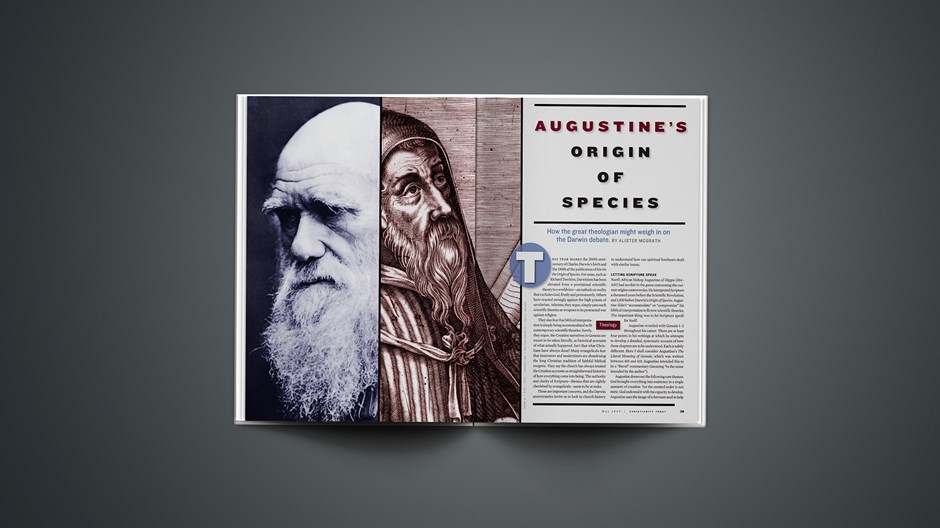
This year marks the 200th anniversary of Charles Darwin's birth and the 150th of the publication of his On the Origin of Species. For some, such as Richard Dawkins, Darwinism has been elevated from a provisional scientific theory to a worldview—an outlook on reality that excludes God, firmly and permanently. Others have reacted strongly against the high priests of secularism. Atheism, they argue, simply uses such scientific theories as weapons in its protracted war against religion.
They also fear that biblical interpretation is simply being accommodated to fit contemporary scientific theories. Surely, they argue, the Creation narratives in Genesis are meant to be taken literally, as historical accounts of what actually happened. Isn't that what Christians have always done? Many evangelicals fear that innovators and modernizers are abandoning the long Christian tradition of faithful biblical exegesis. They say the church has always treated the Creation accounts as straightforward histories of how everything came into being. The authority and clarity of Scripture—themes that are rightly cherished by evangelicals—seem to be at stake.
These are important concerns, and the Darwin anniversaries invite us to look to church history to understand how our spiritual forebears dealt with similar issues.
Letting Scripture Speak
North African bishop Augustine of Hippo (354–430) had no skin in the game concerning the current origins controversies. He interpreted Scripture a thousand years before the Scientific Revolution, and 1,500 before Darwin's Origin of Species. Augustine didn't "accommodate" or "compromise" his biblical interpretation to fit new scientific theories. The important thing was to let Scripture speak for itself.
Augustine wrestled with Genesis 1–2 throughout his career. There are at least four points in his writings at which he attempts to develop a detailed, systematic account of how these chapters are to be understood. Each is subtly different. Here I shall consider Augustine's The Literal Meaning of Genesis, which was written between 401 and 415. Augustine intended this to be a "literal" commentary (meaning "in the sense intended by the author").
Augustine draws out the following core themes: God brought everything into existence in a single moment of creation. Yet the created order is not static. God endowed it with the capacity to develop. Augustine uses the image of a dormant seed to help his readers grasp this point. God creates seeds, which will grow and develop at the right time. Using more technical language, Augustine asks his readers to think of the created order as containing divinely embedded causalities that emerge or evolve at a later stage. Yet Augustine has no time for any notion of random or arbitrary changes within creation. The development of God's creation is always subject to God's sovereign providence. The God who planted the seeds at the moment of creation also governs and directs the time and place of their growth.
Augustine argues that the first Genesis Creation account (1:1–2:3) cannot be interpreted in isolation, but must be set alongside the second Genesis Creation account (2:4–25), as well as every other statement about the Creation found in Scripture. For example, Augustine suggests that Psalm 33:6–9 speaks of an instantaneous creation of the world through God's creative Word, while John 5:17 points to a God who is still active within creation.
Further, he argues that a close reading of Genesis 2:4 has the following meaning: "When day was made, God made heaven and earth and every green thing of the field." This leads him to conclude that the six days of Creation are not chronological. Rather, they are a way of categorizing God's work of creation. God created the world in an instant but continues to develop and mold it, even to the present day.
Augustine was deeply concerned that biblical interpreters might get locked into reading the Bible according to the scientific assumptions of the age. This, of course, happened during the Copernican controversies of the late 16th century. Traditional biblical interpretation held that the sun revolved around the earth. The church interpreted a challenge to this erroneous idea as a challenge to the authority of the Bible. It was not, of course. It was a challenge to one specific interpretation of the Bible—an interpretation, as it happened, in urgent need of review.
Augustine anticipated this point a millennium earlier. Certain biblical passages, he insisted, are genuinely open to diverse interpretations and must not be wedded to prevailing scientific theories. Otherwise, the Bible becomes the prisoner of what was once believed to be scientifically true: "In matters that are so obscure and far beyond our vision, we find in Holy Scripture passages which can be interpreted in very different ways without prejudice to the faith we have received. In such cases, we should not rush in headlong and so firmly take our stand on one side that, if further progress in the search for truth justly undermines our position, we too fall with it."
Article continues below
No Compromise
Augustine's approach allowed theology to avoid becoming trapped in a prescientific worldview, and helped him not to compromise in the face of cultural pressures, which were significant. For example, many contemporary thinkers regarded the Christian view of creation ex nihilo as utter nonsense. Claudius Galenus (a.d. 129–200), physician to the Roman Emperor Marcus Aurelius, dismissed it as a logical and metaphysical absurdity.
Augustine also argues that Scripture teaches that time is also part of the created order, that God created space and time together. For some, however, the idea of time as a created thing seemed ridiculous. Again, Augustine counters that the biblical narrative is not open to alternative interpretations. Time must therefore be thought of as one of God's creatures and servants. For Augustine, time itself is an element of the created order. Timelessness, on the other hand, is the essential feature of eternity.
So what was God doing before he created the universe? Augustine undermines the question by pointing out that God did not bring creation into being at a certain definite moment in time, because time did not exist prior to creation. For Augustine, eternity is a realm without space or time. Interestingly, this is precisely the state of existence many scientists posit existed before the big bang.
Now, Augustine may be wrong in asserting that Scripture clearly teaches that the Creation was instantaneous. Evangelicals, after all, believe in the infallibility of Scripture, not the infallibility of its interpreters. As others have pointed out, Augustine himself was not entirely consistent about the Creation. Other options certainly exist—most notably, the familiar idea that the six days of Creation represent six periods of 24 hours, or the related idea that they represent six more extended periods, possibly millions of years. Nevertheless, Augustine's position ought to make us reflect on these questions, even if some of us believe him to be incorrect.
Ongoing Creation
So what are the implications of this ancient Christian interpretation of Genesis for the Darwin celebrations? First, Augustine does not limit God's creative action to the primordial act of origination. God is, he insists, still working within the world, directing its continuing development and unfolding its potential. There are two "moments" in the Creation: a primary act of origination, and a continuing process of providential guidance. Creation is thus not a completed past event. God is working even now, in the present, Augustine writes, sustaining and directing the unfolding of the "generations that he laid up in creation when it was first established."
Article continues below
This twofold focus on the Creation allows us to read Genesis in a way that affirms that God created everything from nothing, in an instant. However, it also helps us affirm that the universe has been created with a capacity to develop, under God's sovereign guidance. Thus, the primordial state of creation does not correspond to what we presently observe. For Augustine, God created a universe that was deliberately designed to develop and evolve. The blueprint for that evolution is not arbitrary, but is programmed into the very fabric of creation. God's providence superintends the continuing unfolding of the created order.
Earlier Christian writers noted how the first Genesis Creation narrative speaks of the earth and the waters "bringing forth" living creatures. They concluded that this pointed to God's endowing the natural order with a capacity to generate living things. Augustine takes this idea further: God created the world complete with a series of dormant powers, which were actualized at appropriate moments through divine providence.
Augustine argues that Genesis 1:12 implies that the earth received the power or capacity to produce things by itself: "Scripture has stated that the earth brought forth the crops and the trees causally, in the sense that it received the power of bringing them forth."
Where some might think of the Creation as God's insertion of new kinds of plants and animals readymade into an already existing world, Augustine rejects this as inconsistent with the overall witness of Scripture. Rather, God must be thought of as creating in that very first moment the potencies for all the kinds of living things to come later, including humanity.
This means that the first Creation account describes the instantaneous bringing into existence of primal matter, including causal resources for further development. The second account explores how these causal possibilities emerged and developed from the earth. Taken together, the two Genesis Creation accounts declare that God made the world instantaneously, while envisaging that the various kinds of living things would make their appearance gradually over time—as they were meant to by their Creator.
Article continues below
The image of the "seed" implies that the original Creation contained within it the potential for all the living kinds to subsequently emerge. This does not mean that God created the world incomplete or imperfect, in that "what God originally established in causes, he subsequently fulfilled in effects." This process of development, Augustine declares, is governed by fundamental laws, which reflect the will of their Creator: "God has established fixed laws governing the production of kinds and qualities of beings, and bringing them out of concealment into full view."
Augustine would have rejected any idea of the development of the universe as a random or lawless process. For this reason, Augustine would have opposed the Darwinian notion of random variations, insisting that God's providence is deeply involved throughout. The process may be unpredictable. But it is not random.
Authority or Interpretation?
Unsurprisingly, Augustine approaches the text with the culturally prevalent presupposition of the fixity of species and finds nothing in it to challenge his thinking on this point. Yet the ways in which he critiques contemporary authorities and his own experience suggest that, on this point at least, he would be open to correction in light of prevailing scientific opinion.
So does Augustine's The Literal Meaning of Genesis help us engage with the great questions raised by Darwin? Let's be clear that Augustine does not answer these questions for us. But he does help us see that the real issue here is not the authority of the Bible, but its right interpretation. In addition, he offers us a classic way of thinking about the Creation that might illuminate some contemporary debates.
On this issue, Augustine is neither liberal nor accommodationist, but deeply biblical, both in substance and intention. While his approach hardly represents the last word, it needs to be on the table.
We need patient, generous, and gracious reflection on these big issues. Augustine of Hippo can help us get started.
Alister McGrath is Professor of Theology, Ministry, and Education at King's College, London, and holds a D.Phil. from Oxford University in molecular biophysics. This article has been adapted from his 2009 Gifford Lectures, newly published as A Fine-Tuned Universe: The Quest for God in Science and Theology (Westminster John Knox).
















 While we pray for peace, we need moral clarity about this war.
 As my doubts about his teachings grew, so did a secret fascination with Jesus.
 Christian artists work at the intersection of music and climate change.






