Jim Jarmusch offers a confounding but beautiful look at meaning, language, and spirituality set in surrealist Spain, but it might test the limits of audience attention.
Isaach De Bankolé, Alex Descas, Jean-François Stévenin
Theatre Release
September 19, 2009 by Focus Features
The Limits of Control is a film about subjective meaning. Its title comes from a William S. Burroughs essay ("The Limits of Control") about how language is used as a control mechanism. "No control machine so far devised can operate without words," writes Burroughs, "and any control machine which attempts to do so relying entirely on external force or entirely on physical control of the mind will soon encounter the limits of control." It's not entirely clear exactly how this idea fits into writer/director Jim Jarmusch's film. There are a number of ways you could look at it. And for better or maybe worse, that is exactly the point.
Jarmusch is an arthouse director. Throughout his career, his films—whether Down by Law or Dead Man, Ghost Dog or Broken Flowers—have been less about understanding "meaning" than appreciating "moments," which has resulted in a resume full of eccentric cult classics, oddball gems, and maddeningly esoteric art experiments. The Limits of Control follows strongly in this tradition: it's a resoundingly subjective, trippy experience, not recommended for the hardcore objectivists of the world (or even the moderate objectivists).
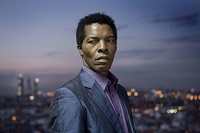
Isaach DeBankole as 'Lone Man'
The film opens with an appropriately cryptic quote from Arthur Rimbaud: "As I descended impassable rivers / I no longer felt guided by the ferrymen." Importantly, the quote is first given to us in French, and then English. Language, translation, and the fluid meaning of words is a motif that pops up again and again in this film. Fans of Derrida will resonate.
The "plot" follows "Lone Man" (Isaach De Bankolé), a well-dressed, methodical man on a mysterious mission in a foreign land (Spain) to do something that is by all appearances criminal in nature. But we never know any of the details, and Lone Man says maybe two dozen words the entire film. He moves deliberately through each scene, with a zen-like intensity and a fondness for leisurely enjoying a pair of single espressos at seemingly every opportunity. He's unbridled by relationships, emotions, or sex (even when naked women literally throw themselves on him), and at times appears to be in some sort of trancelike state. De Bankolé—a French/African actor who has worked with Jarmusch on three other films—basically acts the part of a blank slate, and yet it is a credit to his talents that we can watch him be silent and slow for two hours and still be compelled.
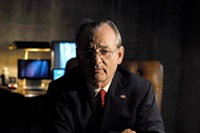
Bill Murray as 'American'
Control consists of Lone Man traveling around Spain, having a series of déjà vu–like encounters with a motley assortment of curiously dressed people, each providing him with a matchbox containing some sort of code on a small piece of paper (which he reads and then eats). All of it is very secret and ambiguous, in a subversively carefree sort of way. By the time we find out what the trail of codes apparently had been leading Lone Man to do, it hardly even matters. This is not a film about what happens. It's a film about arresting images, atmospheric sounds, and how they work together to create something beautiful (if a little too inaccessible, at times).
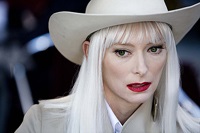
Most of Jarmusch's films include a hodgepodge of characters of different backgrounds, ethnicities and perspectives who are brought together for a time to sort of see what transpires when they interact. This is pretty much what Coffee and Cigarettes was about, and it's what Control is about too. Lone Man has one-scene encounters with all sorts of great actors: Bill Murray, Gael Garcia Bernal, John Hurt, and the scene-stealing Tilda Swinton, looking very much like a hipster/albino riff on the White Witch. None of these encounters have much if anything to do with each other, but each offers a compelling momentary glimpse at the details of people, their mannerisms, and how they communicate. What they say to each other is mostly random and/or indecipherably cryptic, but no matter: it's still interesting to hear them talk.
Tilda Swinton as 'Blonde'
Many viewers are likely to see this all as a disposable hipster indulgence. But in my opinion, what this film lacks in narrative coherence and conventional entertainment value, it makes up for in its expert craftsmanship and acute attention to sensory, material detail. Cinematographer Christopher Doyle (Paranoid Park, In the Mood for Love) is definitely the film's best aesthetic asset. You've never seen a plate of sliced pears look so beautiful. The overall look of the film—with Picasso-esque angular lines and fragmentary cutting—certainly fits its deconstructionist theme. Nothing is definite in the film, and most images are shot from multiple angles and distances. There are also several things in the film—city vistas, buildings, human forms—that are seen both in "reality" and also in subjective "artistic" form. Lone Man makes a habit of visiting Madrid's Museo Nacional Centro de Arte Reina Sofia, where he stands in front of a painting of something that later in the film he sees in person (or vice versa).
This sort of self-reflexiveness is what Control is all about. What is more real? The thing or the artistic rendering of it? "Reality is arbitrary," we hear one character say. "Everything is subjective—whatever that means," we hear from another, who is translating "everything is subjective" from French to English. It's dizzying and self-consciously pretentious, and even though Jarmusch realizes that his questions about meaning have been asked hundreds of times, he asks them anyway. Is this film any less real than a dream? Are dreams any less real than reality? What else but our subjective perceptions of the world define what is real? It's Cartesian philosophy meets Buddhism-lite meets David Lynch.
Article continues below
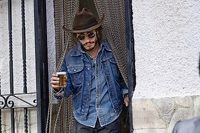
Gael Garcia Bernal as 'Mexican'
Actually, Control feels very much like a David Lynch film, complete with layered industrial ambient music (courtesy of Japanese experimental trio Boris), comically ambivalent female nudity, and an extended flamenco dance sequence (which seems like an homage to the Silencio Club scene in Mulholland Drive). The film also reminded me of a more surreal version of Sofia Coppola's Lost in Translation, what with the "loner in a foreign land" plot, perceptive white noise sound editing, and Bill Murray.
Perhaps the tie that binds both the Lynch and Lost in Translation threads of Control is that it has a very Eastern/Zen/Buddhist sensibility. Jarmusch dabbles in Buddhism and—like Lone Man—practices tai chi and qigong. The film at large seems to embody this spiritual, meditative space, probing the inner reaches of consciousness and attempting to evoke some sort of transcendental, minimalist focus on the details of life. At times, the film succeeds at this and feels sublime; at others, it feels a bit ridiculous. But either way, it's clear that Jarmusch is interested in a realm beyond the physical. He's a "spiritual seeker," to be sure, and whatever other adjective you might slap on this admittedly challenging film, you have to admit that The Limits of Control is, if nothing else, spiritual.
Talk About It
Discussion starters
What do you think director Jarmusch is trying to say about language and meaning? Can what we say ever truly correspond with what we mean to say?
What is the point of having the female character who is always nude? What point do you think Jarmusch is trying to make?
What purpose do the scenes in the art museum serve?
What role does spirituality play in the film?
The Family Corner
For parents to consider
The Limits of Control is rated R for graphic nudity and some language. It's not a family film by any stretch, nor is it a film that children of any age should see. It's a highly cerebral film with very niche appeal for fans of arthouse cinema. The most objectionable content is certainly nudity. One female character, "Nude," is completely nude in nearly all of her scenes. It is as tasteful as it could be, however, and there is no sexual content to go along with it. The point of the nudity is to compare it with the type of nudity we see in old paintings all the time in museums. There is also some language, and one brief scene of mild violence.













 While we pray for peace, we need moral clarity about this war.
 As my doubts about his teachings grew, so did a secret fascination with Jesus.
 The Grammy-winning artist was found dead at her home in Nashville at age 47.