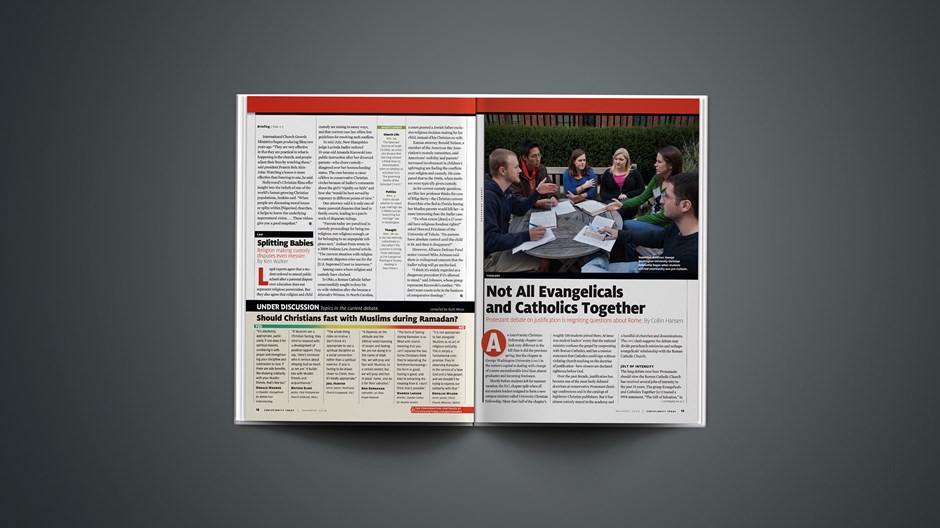
An InterVarsity Christian Fellowship chapter can look very different in the fall than it did the previous spring. But the chapter at George Washington University (GWU) in the nation's capital is dealing with change of a more uncomfortable kind than absent graduates and incoming freshmen.
Shortly before students left for summer vacation, the D.C. chapter split when all ten student leaders resigned to form a new campus ministry called University Christian Fellowship. More than half of the chapter's roughly 100 students joined them. At issue was student leaders' worry that the national ministry confuses the gospel by cooperating with Roman Catholics, and has a mission statement that Catholics could sign without violating church teaching on the doctrine of justification—how sinners are declared righteous before God.
Over the past decade, justification has become one of the most hotly debated doctrines at conservative Protestant theology conferences and in the catalogs of highbrow Christian publishers. But it has almost entirely stayed in the academy and a handful of churches and denominations. The GWU clash suggests the debate may divide parachurch ministries and reshape evangelicals' relationship with the Roman Catholic Church.
Jolt of Intensity
The long debate over how Protestants should view the Roman Catholic Church has received several jolts of intensity in the past 15 years. The group Evangelicals and Catholics Together (ECT) touted a 1994 statement, "The Gift of Salvation," in which several prominent Roman Catholics affirmed "justification by faith alone." The unofficial statement predated an official agreement between the Vatican and the Lutheran World Federation in 1999, called "The Joint Declaration on the Doctrine of Justification." The church allowed that anathemas the Council of Trent delivered in the mid-1500s do not apply to Protestants who agree with the joint declaration.
But Protestants' internal disagreement over justification has complicated matters. A Presbyterian Church in America committee reported in 2007 that reformulations of justification (especially two views known as the Federal Vision and the New Perspective on Paul) fall outside the bounds of historic Presbyterian confessions.
The committee's study of the New Perspective focused largely on N.T. Wright, the Anglican bishop of Durham and a prolific biblical scholar. This year Wright published Justification: God's Plan and Paul's Vision. The book counters his critics, especially John Piper, who published The Future of Justification: A Response to N.T. Wright in 2007. (See "The Justification Debate: A Primer," CT, June 2009.)
Another bombshell hit in May 2007, when Francis Beckwith, then president of the Evangelical Theological Society, reverted to Catholicism. The Baylor University philosopher has since published an account of his journey, titled Return to Rome.
"I have no doubt that the New Perspective and Federal Vision have had an effect on the Protestant-Catholic debate," Beckwith told Christianity Today. "I have met several former evangelical Protestants who have told me that Wright's work in particular helped them to better appreciate the Catholic view of grace."
Taylor Marshall went even further. Now a Ph.D. philosophy student at the University of Dallas, he started reading Wright while attending Westminster Theological Seminary in Philadelphia. He said Wright's work shifted his assumptions so he could understand the Council of Trent's position. Marshall does not believe Wright holds to the full Catholic view. But he said Wright's critique led him to conclude that the Reformers departed from Scripture by teaching "forensic justification through the imputed alien righteousness of Christ."
Marshall briefly served as an Anglican priest before converting to Catholicism in 2006 and becoming assistant director of the Catholic Information Center in Washington, D.C. Marshall said he speaks with new Catholic converts every month, about half of whom have been "deeply influenced" by Wright.
"If you buy into Wright's approach to covenantal theology, then you've already taken three steps toward the Catholic Church. Keep following the trail and you'll be Catholic," said Marshall, who blogs at PaulIsCatholic.com. "Salvation is sacramental, transformational, communal, and eschatological. Sound good? You've just assented to the Catholic Council of Trent."
Wright himself finds strange the notion that he's leading people to Rome. "I am sorry to think that there are people out there whose Protestantism has been so barren that they never found out about sacraments, transformation, community, or eschatology. Clearly this person needed a change. But to jump to Rome for that reason is very odd," he said. The best Reformed, charismatic, Anglican, and even some emerging churches have these emphases, he said.
Wright, the Anglican observer at the Vatican's Synod of Bishops last October, said he was struck by the bishops' emphasis that every Catholic read the Bible in his or her own language. "Let's engage cheerfully in as much discussion with our Roman friends as we can," Wright said. "They are among my best ecumenical conversation partners, and some of them are among my dear friends. But let's not imagine that a renewed biblical theology will mean we find ourselves saying, 'you guys were right after all,' just at the point where, not explicitly but actually, they are saying that to us."
Article continues below
Chris Castaldo studied under Wright for a semester at Harvard Divinity School. He identifies several reasons why Wright's Pauline theology might lead Protestants to consider the merits of Catholic teaching. Like Catholics, Wright emphasizes the positive contribution of "works" in salvation, worships in a liturgical church, and places the church's call to social justice in the foreground. But Castaldo, author of Holy Ground: Walking with Jesus as a Former Catholic, also sees a growing movement of Catholics more willing to confront Protestant belief as the reason for so many conversions—and for renewed Protestant-Catholic tensions.
"In keeping with the spirit of Vatican II, the 'new evangelization' of Pope John Paul II sought to deepen personal faith and stimulate innovative forms of outreach," Castaldo said. "Not unlike renewal movements surrounding the Council of Trent, an element of this recent Catholic fervor has morphed into strident opposition [to] Protestantism. Listen to the Catholic apologists on Relevant Radio or ewtn. Faced with millions who have left Rome for evangelical Protestant pastures, it's not too surprising that Catholic polemics would take such a turn."
Long History, Little Agreement
Beeson Divinity School founding dean Timothy George signed the 1994 ECT statement, which he said was a "circumscribed step forward" in Protestant-Catholic dialogue. Among ECT participants, George said, there is strong agreement with the Augustinian emphasis on the gratuity of grace, that we do not earn salvation by good works or merits. He acknowledges Protestants' and Catholics' lingering disagreement over how justification relates to sanctification and Luther's famous phrase simul iustus et peccator ("at the same time righteous and a sinner"). But he does not see justification as the focal point of Protestant-Catholic disagreement.
"The gaping divide between evangelicals and Catholics is ecclesiology and authority, not justification and salvation, as important as that debate remains," George said. "There is enough commonality that evangelicals and Catholics with a living faith can recognize one another as brothers and sisters in Jesus Christ with a common Lord and common grace that brought them together. The hard issues are questions related to the church, such as the Petrine office [the papacy] and the Eucharist. Those discussions will occupy us for the next 100 years."
Article continues below
They have already occupied us for several hundred years. During the English Reformation, the Puritans were united in their disagreement with Roman Catholic teaching. Yet some viewed Rome as a true church in error, while others treated it as a false church. John Owen took fellow Puritan leader Richard Baxter to task over a view of justification that resembles Wright's. During the 1800s, American Presbyterians disagreed over whether to recognize Roman Catholic baptisms as valid. More recently, conflict over ECT has strained some long-term friendships between prominent theologians with opposing views on how to regard Catholics.
And even ECT is changing. Its October statement on Mary was the first to include, after an initial statement on areas of agreement, sections where each side attempted to correct the other's views.
Basis of Doctrine
Until recent years, debates over justification were handled mainly by theologians and select pastors. But the release of Wright's and Piper's books have led more church leaders to choose sides and act on their convictions. Several of the GWU students who left InterVarsity are members of Capitol Hill Baptist Church, whose associate pastor, Michael Lawrence, formerly served on InterVarsity staff. "Whether or not you agree with the students, they are not impulsive firebrands," Lawrence said.
Concern among GWU student leaders began when they noticed promotional material on InterVarsity's website and during the organization's Urbana conference that conveyed a willingness to cooperate with Catholics. Then, during a spring mission trip, InterVarsity staff took students to a Mass. Finally, local staff pushed back when the student-led executive team unanimously declined to select a student for a leadership position because she was a Catholic.
The GWU executive team then examined the InterVarsity Doctrinal Basis, adopted in 2000, and concluded that Catholics could sign the InterVarsity statement because it does not specify that grace comes through "faith alone" in Jesus Christ.
"We believe that the Roman Catholic Church does not agree with the gospel that we emphasize, meaning that it would not be good to hold up someone as a leader who has associated with them," said Tristan Stiles, a 2009 GWU graduate and former member of the executive team.
Article continues below
InterVarsity president Alec Hill responded in a letter, telling the students, "I can unequivocally assure you that InterVarsity holds to the position of justification by faith alone." Hill observed that InterVarsity is corporately federated under the International Fellowship of Evangelical Students (IFES), whose statement of faith lists "the justification of the sinner by the grace of God through faith alone" as a central Christian truth. All InterVarsity staff must reaffirm their commitment to the Doctrinal Basis and the IFES statement each year.
Hill also allowed that the GWU executive team could require leaders to affirm "justification by faith alone" in the student application process.
InterVarsity's Bear Trap Statement, adopted in 1960 at the national staff conference, specified that sinners are justified "by the Lord Jesus Christ through faith alone." By contrast, the Doctrinal Basis of 2000 said that InterVarsity believes in "justification by God's grace to all who repent and put their faith in Jesus Christ alone for salvation."
The word alone's shift in placement is significant, said Doug Sweeney, professor of history of Christian thought at Trinity Evangelical Divinity School.
"Tridentine Roman Catholics could not sign the Bear Trap Statement, for justification by faith alone was anathematized at the Council of Trent," said Sweeney. "Such Roman Catholics could sign the 2000 statement, however, for Catholics have always taught that salvation is found in Christ alone. Further, the 2000 statement allows for a Tridentine commitment to the necessity of faith being formed or perfected by love before one is finally justified. This is the doctrine that the 16th-century Reformers opposed most strenuously."
Hill said some critics are thinking "with their church history primer rather than their biblical text."
"What evangelical Protestant could possibly object to that language [in the 2000 doctrinal basis]?" he said. "It is biblically centered. It is biblically correct. Faith is in Christ Jesus alone …. This was run by many Reformed theologians inside and outside the fellowship when it was adopted. No one objected. As a matter of fact, they felt it strengthened the prior statement by specifically stating in whom we put our faith. To suggest that Inter-Varsity has somehow watered down its statement of justification by faith is erroneous, to be honest."
Article continues below
So far, the GWU debate shows no sign of spreading to other InterVarsity chapters. But given the importance of justification to Protestants' understanding of the gospel, said Lawrence, more ministries can expect more conflict over it.
"This debate has a long pedigree," he said. "Again and again, it has caused division among Protestants."
Let Us Reason Together About Life | A new statement from Evangelicals and Catholics Together encourages discourse on the most divisive of issues. (October 10, 2006)
Sticking Points | Despite recent rapprochement, evangelicals and Catholics remain far apart on key issues. Collin Hansen reviews Is The Reformation Over? by Mark Noll and Carolyn Nystrom (December 10, 2005)
Betraying the Reformation? | Two responses to R. C. Sproul's critical assessment of the ecumenical document "Evangelicals and Catholics Together." An Evangelical Response by Donald G. Bloesch (October 7, 1996)

















 While we pray for peace, we need moral clarity about this war.
 A Christian reconciliation group in Israel and Palestine warned that war would come. Now the war threatens their relevance.العربيةFrançais
 Helping marine biodiversity flourish is a means of participating in God’s work, says an Indonesian theologian.






