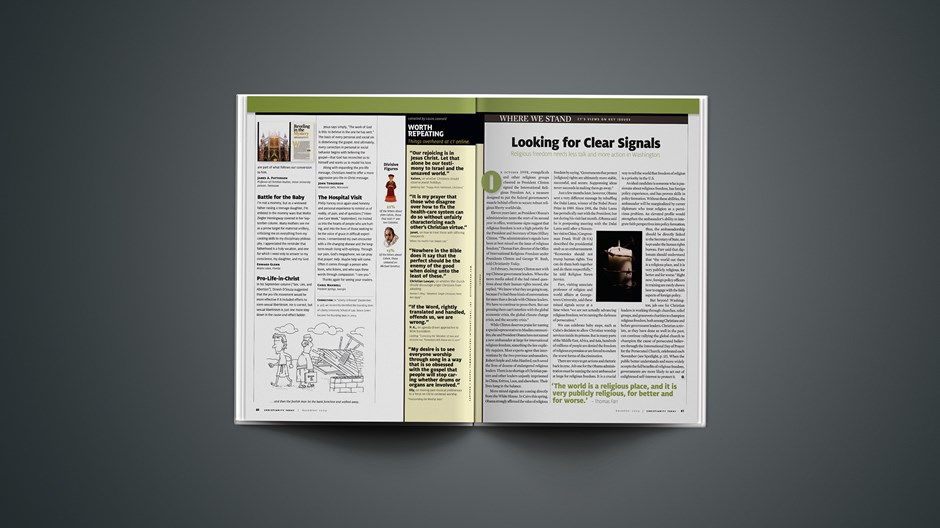
In October 1998, evangelicals and other religious groups cheered as President Clinton signed the International Religious Freedom Act, a measure designed to put the federal government's muscle behind efforts to secure robust religious liberty worldwide.
Eleven years later, as President Obama's administration nears the start of its second year in office, worrisome signs suggest that religious freedom is not a high priority for the President and Secretary of State Hillary Clinton. "The administration's signals have been at best mixed on the issue of religious freedom," Thomas Farr, director of the Office of International Religious Freedom under Presidents Clinton and George W. Bush, told Christianity Today.
In February, Secretary Clinton met with top Chinese government leaders. When the news media asked if she had raised questions about their human rights record, she replied, "We know what they are going to say, because I've had those kinds of conversations for more than a decade with Chinese leaders. We have to continue to press them. But our pressing them can't interfere with the global economic crisis, the global climate change crisis, and the security crisis."
While Clinton deserves praise for naming a special representative to Muslim communities, she and President Obama have not named a new ambassador at large for international religious freedom, something the law explicitly requires. Most experts agree that interventions by the two previous ambassadors, Robert Seiple and John Hanford, each saved the lives of dozens of endangered religious leaders. There is no shortage of Christian pastors and other leaders unjustly imprisoned in China, Eritrea, Laos, and elsewhere. Their lives hang in the balance.
More mixed signals are coming directly from the White House. In Cairo this spring, Obama strongly affirmed the value of religious freedom by saying, "Governments that protect [religious] rights are ultimately more stable, successful, and secure. Suppressing ideas never succeeds in making them go away."
Just a few months later, however, Obama sent a very different message by rebuffing the Dalai Lama, winner of the Nobel Peace Prize in 1989. Since 1991, the Dalai Lama has periodically met with the President, but not during his visit last month. (Obama said he is postponing meeting with the Dalai Lama until after a November visit to China.) Congressman Frank Wolf (R-VA) described the presidential snub as an embarrassment. "Economics should not trump human rights. You can do them both together and do them respectfully," he told Religion News Service.
Farr, visiting associate professor of religion and world affairs at Georgetown University, said these mixed signals occur at a time when "we are not actually advancing religious freedom; we're cursing the darkness of persecution."
We can celebrate baby steps, such as Cuba's decision to allow Christian worship services inside its prisons. But in many parts of the Middle East, Africa, and Asia, hundreds of millions of people are denied the freedom of religious expression or are forced to endure the worst forms of discrimination.
There are ways to get actions and rhetoric back in sync. Job one for the Obama administration must be naming the next ambassador at large for religious freedom. It is a crucial way to tell the world that freedom of religion is a priority in the U.S.
'The world is a religious place, and it is very publicly religious, for better and for worse.' ˜ Thomas Farr
An ideal candidate is someone who is passionate about religious freedom, has foreign policy experience, and has proven skills in policy formation. Without these abilities, the ambassador will be marginalized by career diplomats who treat religion as a pernicious problem. An elevated profile would strengthen the ambassador's ability to integrate faith perspectives into policy formation; thus, the ambassadorship should be directly linked to the Secretary of State, not kept under the human rights bureau. Farr said that diplomats should understand that "the world out there is a religious place, and it is very publicly religious, for better and for worse." Right now, foreign policy officers in training are rarely shown how to engage with the faith aspects of foreign policy.
But beyond Washington, job one for Christian leaders is working through churches, relief groups, and grassroots charities to champion religious freedom, both among Christians and before government leaders. Christian activists, as they have done so well in the past, can continue rallying the global church to champion the cause of persecuted believers through the International Day of Prayer for the Persecuted Church, celebrated each November (see Spotlight). When the public better understands and more widely accepts the full benefits of religious freedom, governments are more likely to act out of enlightened self-interest to protect it.
See No Evil | International religious freedom has been too low a priority. (October 23, 2008)
Christianity Today also blogged about President Obama's nod to China and a report from the United States Commission on International Religious Freedom.















 While we pray for peace, we need moral clarity about this war.
 A Christian reconciliation group in Israel and Palestine warned that war would come. Now the war threatens their relevance.españolالعربيةFrançais
 NIL deals in college athletics present new challenges—and opportunities—for colleges and students.






