If I were ever asked to make a list of my top five recordings of the classic rock era, I think The Who Sell Out would be a top contender. Released in 1967, the album is mostly an homage—and perhaps a bit of a parody—of the pirate radio stations that broadcast the hottest rock 'n' roll to a voracious, largely teenage audience. At that time, the BBC refused to play more than a half hour of popular music per day, and when the bureaucrats began campaigning to rid the airwaves of "immoral" music, a bunch of roguish DJs took to the seas and piped rock to the mainland from their bulky floating transmitters. It's this cheerfully renegade spirit that The Who Sell Out captures so well; smashing rock numbers are piled on one after another, linked by fake commercials and made-up jingles (at times, it's hard to tell where the songs end and the adverts begin) and united by a merrily impish sense of humor.
Richard Curtis' film Pirate Radio is set in 1966, just a year before that Who classic, and it captures much the same spirit. The movie is based on one of the actual pirate radio stations, and that odd period of rock history more generally; the vast majority of it takes place on the boat, the large cast of characters is primarily made up of DJs, and the film itself has a gloriously ramshackle feel to it. It's stuffed almost to overflowing with sly humor, a bit of bawdiness, a winning batch of characters, and of course, lots of rock 'n' roll.
Philip Seymour Hoffman as The Count
And—crucially, perhaps—it is at once a tribute and a commentary. Curtis doesn't mind picking sides—the film is very much a celebration of the free-spiritedness of the cheery pranksters who rock the boat, while the government censors are stiff, unhip, and totally unlikable—but he's also unafraid to be honest about the consequences of a lifestyle devoid of roots or responsibility.
The film is based on the station known as Radio Caroline, though it weaves together various myths and anecdotes from the pirate radio days. Here the station is simply called Radio Rock, and their rig is run by Quentin (Bill Nighy), though their biggest draw for listeners is an American expatriate who simply calls himself The Count (Philip Seymour Hoffman) and has a nearly religious level of love for the music he's playing. There are eight DJs in total, and of course the mixture of close quarters, rock music, drugs, and alcohol make for a fair dose of drama—particularly upon the arrival of young Carl (Tom Sturridge), who is pretty sure Quentin is his father, and, later, of notorious broadcaster Gavin (Rhys Ifans), another yank whose ego is just as big as The Count's.
If the events that transpire on the boat are cheerfully loose, what's happening on dry land move the story forward and give it its structure. Sir Alistair Dormandy (Kenneth Branagh) is a prudish government-type who obsessively seeks to abolish pirate radio—though, as he is reminded daily, they are not actually doing anything illegal.
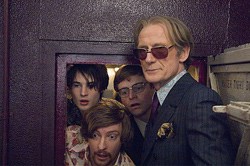
Bill Nighy (right) as Quentin
Sir Alistair is a caricature; his reasons for hating pirate radio so vehemently are never fully developed, and the film clearly sides against him. Quentin, in one early scene, notes that government censorship is an enemy to freedom, a position maintained throughout the film. And yet, Sir Alistair's concerns are not roundly dismissed; we see for ourselves the kind of heartache that can come from living a life with no rules. For all the camaraderie and good-natured hijinks on the boat, there are also cold consequences—in particular, an ugly incident when DJ Simon's (Chris O'Dowd) lady love Elenore (January Jones) joins the crew of the boat so that the two of them might marry. When her true motives come to light, though, the loose sexual morals of the men on the boat are revealed for their emptiness and grief.
Curtis, who previously directed Love Actually, has a history of balancing large ensemble casts, and Pirate Radio is no exception; the boat is packed from top to bottom with memorable characters, but the story never capsizes. There is humor aplenty, and also warmth: Curtis cares about all of the characters on the boat, and so do we. And though there is drug use and sex aplenty—a legitimate concern for Christian moviegoers—what is ultimately affirmed is the family-like spirit that develops among these men; they sacrifice for one another, stick up for one another, look out for one another. They are deeply concerned for their makeshift family, but also for their work—the film honors these things, and is, therefore, in its own way, honorable.
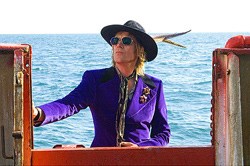
Rhys Ifans as Gavin
And it's a lot of fun. Over the end credits, Curtis displays pictures of a wide array of classic album covers—everyone from Bob Dylan to U2, The Clash to Tom Waits. That reveals what's at the movie's heart—a love for rock 'n' roll—and indeed, the film feels very much like a labor of love. There's so much warmth, so much humor, so much humanity onboard that it's hard not to be drawn in to this strange, seafaring band of brothers. We may not always approve of their behavior, but we love them just the same.
Article continues below
Talk About It
Discussion starters
What do the men on the boat seem to value? Would you say that their values are mostly positive, or mostly negative?
What view does the film take toward government, or authority in general? Do you agree with its views about censorship? Do you see a link between art and morality?
In what ways does the community on the boat resemble a family? Do you think any of the men on the boat can be termed "responsible" in any way? Do you think they are loving? Caring and supportive? Honorable?
Many people can relate to these characters' passion for music, even if one's passion isn't rock 'n' roll. What's your favorite kind of music, and why? In what ways can music enrich your life? Your spiritual journey?
The Family Corner
For parents to consider
Pirate Radio is rated R for language and sexual content, as well as brief nudity. This being a boat full of free-thinking rock DJs, there is a fair amount of foul language and sexual dialogue, as well as some implied sexual encounters on the boat, though nothing explicit is seen save for one bare backside. There is also talk about homosexuality and drug use, though again, we don't actually see anything.














 While we pray for peace, we need moral clarity about this war.
 A Christian reconciliation group in Israel and Palestine warned that war would come. Now the war threatens their relevance.العربيةFrançais
 We must always be people of the Word, but we’ll have to reimagine deep engagement with Scripture.