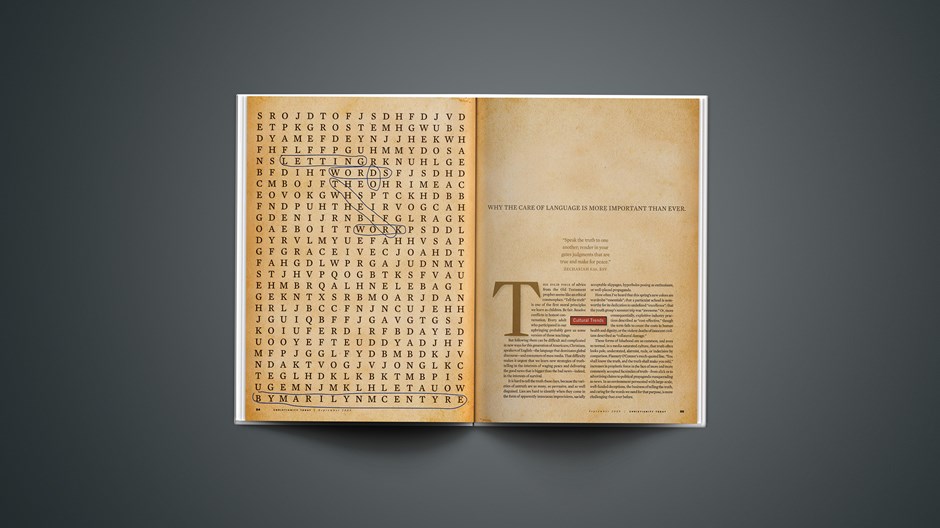
"Speak the truth to one another;render in your gates judgments that are true and make for peace." Zechariah 8:16, ESV
This solid piece of advice from the Old Testament prophet seems like an ethical commonplace. "Tell the truth" is one of the first moral principles we learn as children. Be fair. Resolve conflicts in honest conversation. Every adult who participated in our upbringing probably gave us some version of these teachings.
But following them can be difficult and complicated in new ways for this generation of Americans, Christians, speakers of English—the language that dominates global discourse—and consumers of mass media. That difficulty makes it urgent that we learn new strategies of truth-telling in the interests of waging peace and delivering the good news that is bigger than the bad news—indeed, in the interests of survival.
It is hard to tell the truth these days, because the varieties of untruth are so many, so pervasive, and so well disguised. Lies are hard to identify when they come in the form of apparently innocuous imprecisions, socially acceptable slippages, hyperboles posing as enthusiasm, or well-placed propaganda.
How often I've heard that this spring's new colors are wardrobe "essentials"; that a particular school is noteworthy for its dedication to undefined "excellence"; that the youth group's summer trip was "awesome." Or, more consequentially, exploitive industry practices described as "cost-effective," though the term fails to count the costs in human health and dignity; or the violent deaths of innocent civilians described as "collateral damage."
These forms of falsehood are so common, and even so normal, in a media-saturated culture, that truth often looks pale, understated, alarmist, rude, or indecisive by comparison. Flannery O'Connor's much-quoted line, "You shall know the truth, and the truth shall make you odd," increases in prophetic force in the face of more and more commonly accepted facsimiles of truth—from slick PR to advertising claims to political propaganda masquerading as news. In an environment permeated with large-scale, well-funded deceptions, the business of telling the truth, and caring for the words we need for that purpose, is more challenging than ever before.
Not every one of us is called to public speaking, writing, political activism in streets and on telephones, or investigative journalism, but all of us are called to seek truth and follow after it, to do justice, to love mercy, and to walk humbly with our God. Caring for the words we speak and testing the words we hear are indispensable dimensions of that vocation.
Recently I helped a committee review some publicity material for a local organization. I raised an objection to the clichés and vapid abstractions that seemed to bury the main points (such as they were) in wet cotton. It seemed that said organization was "forward-looking" and sought to "enrich" the cultural life of the surrounding community, "deepen" its commitment to supporting the arts, and "broaden the horizons" of all it could reach. There's nothing wrong with such terms, but they have no bones; they can't stand for anything substantial without definitions that link them to specific practices and competencies. But my objection met with polite dismissal.
"This is what works," was the reply. "This is what PR writing looks like. It reassures people." Imprecision had become acceptable in the interests of generalized good feeling—and perhaps in the interests of forestalling some critical scrutiny.
No thoughtful writer or speaker would question that precision is difficult to achieve. Imprecision is easier. Imprecision is available in a wide variety of attractive and user-friendly forms: cliché s, abstractions, generalizations, jargon terms, passive constructions, hyperbole, sentimentality, and reassuring absolutes. Imprecision minimizes discomfort and creates a big, soft, hospitable place for all opinions; even the completely vacuous can find a welcome there. The practice of precision requires not only attentiveness and effort: it may also require the courage to afflict the comfortable and, consequently, tolerate their resentment. The practice of precision is a spiritual discipline that requires courage. Precision is an aspect of the "renewal of the mind" that Paul commends.
Precision begins with a definition of terms. I asked a group of students recently to write down their working definitions of five terms whose imprecise usage poses a serious threat these days to domestic peace and safety: liberal, conservative, patriotic, terrorist, and Christian. The results were sobering in their range and banality.
One immediate response to liberal was "bad." One to conservative was "narrow." These terms are routinely co-opted to serve partisan agendas and to prevent serious discussion of particulars. If patriots could be required to specify which particular U.S. policies they support and why, we might have some talking points. If Christians could use terms like evangelical, progressive, biblical, salvation, or even believe in with more care for clear definition and context, the community of believers might be able to deliver a livelier witness to the capaciousness and complexity of our faith in spirited (and I use that term advisedly) debate.
Article continues below
Precision requires attention to process. Precise verbs give a true account of process. One way to make ourselves more responsible, accountable stewards of language is to commit ourselves to more carefully chosen verbs. Certainly one of the most consequential instances of strategic imprecision is in political and theological discourse that justifies violence and injustice. Any one of us could come up with a lengthy list of euphemisms designed to obscure the processes and costs of war, violence, or systemic injustice.
Think of how the term "collateral damage" spares us the discomfort of imagining the bodies of women and children ripped open by the explosions of "smart bombs" that destroy everything within a 120-foot radius of their target. Or how the idea of economic "health" begs the question of how we measure a healthy economy and how that term fails to take into account the health of the humans within the economic system.
Wendell Berry's little story "Making It Home" offers a memorable example of uncommon truth-telling about war. In it he undertakes to describe in plain language the experience of a soldier returning from battle:
The fighting had been like work, only a lot of people got killed and a lot of things got destroyed…[W]hatever interfered you destroyed. You had a thing on your mind that you wanted, or wanted to get to, and anything at all that stood in your way, you had the right to destroy. If what was in the way were women and little children, you would not even know it, and it was all the same. When your power is in a big gun, you don't have any small intentions. Whatever you want to hit, you want to make dust out of it. Farms, houses, whole towns—things that people had made well and cared for a long time—you made nothing of…You got to where you could not look at a man without knowing how little it would take to kill him. For a man was nothing but just a little morsel of soft flesh and brittle bone inside of some clothes. And you could not look at a house or a schoolhouse or a church without knowing how, rightly hit, it would just shake down inside itself into a pile of stones and ashes.
Article continues below
This representation of the altered state of awareness one enters in the midst of perpetrating and suffering violence, the "zone" in which a soldier might insulate him or herself from pain and guilt, relies for its impact on simple language: verbs like kill, destroy, hit, want, and the nouns morsel, bone, dust, stones and ashes. The precision of the language has to do not with technical sophistication—no particular weapons are named or military jargon used—but rather with the felt accuracy of elemental feelings and appetites. This kind of precision is strenuous and morally relevant—it will not allow the moral dimension of the experience to be softened by words that make it aesthetically tolerable.
Such precision produces what Edmund Wilson called a "shock of recognition," or what we still call a "ring of truth" when tested against our own memories of fear and numbness and moments of crude will to power. Notice how part of its power lies in understatement. There is no report of explosions, no wide-angle vision of a devastated landscape, no cries of the dying. Berry's work is exemplary in its resistance to the temptations of hyperbole.
Splashier Than Thou
The problem of bland hyperbole—endemic to current popular discourse—is too familiar to need much elaboration. I contrast this with thoughtful hyperbole, which has been so effectively employed by, among others, our Lord (plucking out the eye, letting the dead bury the dead, and so forth). But let me just specify a particular concern that the currency of hyperbole has made its way into discourse where evangelism seems often to be confused with marketing. This tendency is most conspicuously true in many church and parachurch youth ministries where every pizza party, campout, mission trip, fall program, and brainstorming session, it appears, is "awesome." Or "incredible" or "fantastic" or (my particular pet peeve) "exciting."
When we import the culture of bland hyperbole into the church, we lose our countercultural edge. As people invested in a "kingdom not of this world," we are specifically called to be countercultural—in the world, but not of it. I recently heard a colleague observe, with reference to a particularly splashy Christian event, "Christians have finally found a way to be of the world but not in it." To be in the world—planted here with both feet, having accepted life and work on this planet at this time for God's sake—is to be socially and politically engaged, to work for the kingdom here and now, caring for one another with the resources we share, recognizing the radical interdependence and even intimacy of our relatedness with our fellow beings. To be of this world is to capitulate to its terms and its agendas.
Article continues below
The intention, when churches imitate the commercially driven discourse of the culture, may be to appropriate the power of media-speak and redirect it to good ends, but the medium does become the message, and at great cost. The discourse of the church, the subtleties of biblical language and the nuances of translation, the ear for poetry and care for theological distinctions may be eroded when the language of popular media is allowed to overtake the dialect of worship and conversation among believers. We need to help one another—reading, speaking, and praying thoughtfully together—to maintain the strenuous pleasures of precision, clarity, and lively confrontation that are mutually empowering and that keep us accountable to one another, to the responsible reading of Scripture, and to the God we serve.
Finally, if we give way to bland hyperbole—and to the comparable temptations of sentimentality, slogans, and other kinds of language designed to "sell"—we lose credibility. The corporate media, with multimillion-dollar marketing budgets, have the competitive edge in devising and using those instruments of persuasion. I suggest we let them have it, and avoid their persuasive strategies in favor of the plainness, clarity, beauty, and even elegance in the worship, song, and speech we share, and that we also remember the power of silence in a culture of noise. A "still small voice" still speaks beneath the whirlwind. Our words depend upon silence for restoration as plants depend upon the fallow season for nourishing soil.
We who love the God who gave us the precious gift of language have an obligation to help each other tell complex truths and resist the lure of lies. This means to demand definitions, specific language, and clarifications; to learn methods of nonviolent communication, use them, and teach them; where we have identified lies, to turn off the TV, stop the subscription, and discredit them; and to take these obligations quite personally. Sometimes, as Emily Dickinson put it, we need to find ways to tell the truth slant—to be subversive in the service of reclaiming what is endangered.
Word Stewards
Stewardship of words is a high calling, and truth-telling a matter of spiritual survival. We can cultivate good stewardship by reading and listening to good words: the Bible; proclamation from preachers we commit to training and supporting and then hold accountable; literature that still deserves to be called "the best that has been thought and said"; and literature that stretches us beyond our cultural boundaries and biases. We can claim and extend the ancient practice of lectio divina, listening for the words or phrases of Scripture that stop us and speak to us along the way. We can practice noticing how words are used and considering how they may be heard; we can pick them up from the dusty corners where most of the good ones have been consigned to disuse and reintroduce them, hoping to ambush the careless listener contented with cliché.
Article continues below
Like the poet Adrienne Rich, who called herself "a woman sworn to lucidity," we can pledge our energies to the work of smithing words for purposes they have never before had to serve. We can temper our urgencies (if we are given to wild-eyed prophesying) with play, because no responsible word work can happen without it. Precise language comes from high play and trust in the Spirit who gives us the words we need when the occasion arises, if we have prepared ourselves to receive them.
Used well and with care, cleaned and polished and placed with a jeweler's precision, words can not only ensure the integrity of our daily transactions, or deepen our relationships in nourishing conversation, but can also allow, now and then, a "way of putting it" that surprises us out of our conventionalities and lifts us into epiphany and delight.
Marilyn Chandler McEntyre is Fellow at the Gaede Institute for the Liberal Arts, Westmont College, and author of Caring for Words in a Culture of Lies (Eerdmans, 2009).
All Apologies | Are today's kinda culpas more safe than sorry? (July 2004)
God's Own Dictionary | You won't believe the words that didn't exist until the first English translations of the Bible (Feb. 2003)
Article continues below
Trashy Talk | Former Indiana coach Bobby Knight provokes examination of current speech standards as he continues to rage against the dying light. By Richard A. Kauffman (Nov. 2000)
The Word from Geecheetown | Gullah-speaking slave descendants welcome New Testament translation. (Jan. 2006)
Wycliffe in Overdrive | Freddy Boswell describes the most audacious Bible translation project ever. (Feb. 2, 2005)
The Whole Word for the Whole World | Fewer than 10 percent of the world's languages have the Old Testament. But that's about to change. (Sept. 2006)















 While we pray for peace, we need moral clarity about this war.
 A Christian reconciliation group in Israel and Palestine warned that war would come. Now the war threatens their relevance.العربيةFrançais
 Eastern Orthodox poet Scott Cairns reflects on his new collection, his journey of faith, and poetry’s capacity to apprehend inexhaustible realities.






