With the recent popularity of High School Musical and TV programs such as American Idol, So You Think You Can Dance, and Glee, it comes as no surprise that Hollywood would attempt to revitalize Fame. The 1980 original is an Oscar-winning classic that birthed a franchise: a popular TV show, hit singles, albums, a tour, a musical, and other forms of merchandising. Unfortunately, the film itself has aged poorly over the last three decades.
This reinvention gives Fame a modern makeover for a new generation and a chance to reboot the franchise. (Not to mention making it more family-friendly—the original was rated R, this is PG). The culture has changed significantly in 30 years. Gone are the cheesy synthesizers, leg warmers, post-disco pop music, and '70s racial tensions. Cue up the DJs, rappers, karaoke bars, multi-cultural arts, student diversity, and the Internet.
Asher Book as Marco, Kay Panabaker as Jenny
Even the nature of becoming famous has changed with the times. Through today's technology—computers, cell phones, Facebook, YouTube—a would-be starlet doesn't have to work hard to gain their 15 minutes of fame. But then stardom and notoriety are hardly the same things. As Debbie Allen used to say on the TV show, "Fame costs, and right here is where you start paying … in sweat." If only the movie explored this idea more fully.
Like the original, Fame loosely follows a talented group of young artists—singers, dancers, actors, filmmakers—as they diligently study their craft under tough-but-sympathetic instructors at the New York City High School of Performing Arts over the course of four years. It's a bit like a documentary told in four acts, bouncing between the various students and their experiences as they grow from nervous candidates at the auditions and insecure freshmen to confident upperclassmen and professionals.
Here we come to the chief problem: How do you follow the lives of ten students over four years in two hours time with any depth? Well, the first film really didn't, and neither does this one. Fame relies on archetypes in a series of vignettes to make a broader point about our culture, rather than deep investment in a roster of characters. This might explain why the TV show had a successful run—we could become acquainted with the soap opera roster and watch them grow over time. Yet despite the lack of deep characters, the original movie still managed to connect with genuine heart and emotion, collectively relating the anxiety of the young struggling artist to the audience.
This new Fame, however, leans too heavily on the clichés with generic characterizations that are never adequately explained. Jenny (Kay Panabaker) has the most screen time, but she's out of place. Her auditions are so uptight, it's a mystery how she made the final cut of 200 out of 10,000 applicants. And though Jenny's specialty is acting, we never truly see her shine. We only see her flounder with insecurity as an actress and singer in class. Her story arc is more concerned with gaining confidence (again, never explained) and fostering friendships outside the classes, primarily the romance she kindles with singer Marco (Asher Book).
Then there's Denise (Naturi Naughton), a gifted classical pianist who secretly wants to break out as a pop star, which she does beginning with a passionate performance during a (seemingly) solitary rehearsal. But hers is a story that's all too familiar in movies of this kind, involving overbearing parents who insist that she stick to classical or else. It culminates in one of those hackneyed face-to-face confrontations after a public performance that any other parent would be proud of.
And yet these two characters are the most fleshed out. The movie doesn't devote nearly enough time to Kevin (Paul McGill), the ballet dancer from Iowa who may not have the skills to cut it professionally. As the comic relief, Neil (Paul Iacono) has a potentially interesting anecdote as a would-be filmmaker with an opportunity, but he isn't given enough weight to merit substance. Victor (Walter Perez) and Malik (Collins Pennie) are budding producers/musicians/actors, but their parts are more ancillary to the other characters. And though the trailers make the most of Alice (Kherington Payne from So You Think You Can Dance) and her sultry dance moves, she's little more than eye candy with ten lines of dialogue.
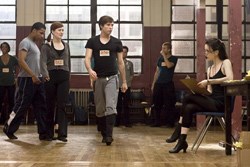
Kevin (Paul McGill) auditions for instructor Lynn Kraft (Bebe Neuwirth)
So the students (all played by relative newcomers) are paper-thin, but Fame isn't all bad. The movie works best in two kinds of scenes: teachers imparting wisdom to their students, and students finding their moment to shine in performance. Conversely, Fame falters when it ditches the teachers for too long, focusing instead on life outside the classrooms.
That unfortunately wastes the potential of the faculty. Debbie Allen (back from the movie and TV series) is stuck with a cameo role as Principal Simms, while Kelsey Grammer and Bebe Neuwirth have little more screen time as the music teacher and dance instructor, respectively (and no, the Frasier couple don't share screen time together). Charles S. Dutton has some memorable moments as the acting teacher, but only Megan Mullally is given enough to shine as the vocal instructor. Not only does she demonstrate her singing and deliver some funny quips, but her character offers a touching portrait of a teacher's regret over what might have been had she pursued Broadway.
Article continues below
Nevertheless, while the faculty is underused, their scenes carry the most resonance. They're tough, yet sympathetic, preparing their students for the harsh realities of show business. There are good lessons here about expressing emotion as an actor, mastering technique to unleash musical talent, and remaining true to one's self. Jenny also delivers a meaningful little monologue at the end about true success—schmaltzy as it may be, the words are spot on.
Kherington Payne as Alice
As for the performance numbers, they're not the greatest, but 25-year-old director Kevin Tacharoen brings a lot of energy and skill to the camera in his feature film debut. He may not have been alive when the first Fame was released, but he knows how to film a musical number (particularly the finale) thanks to his experience as a choreographer and music video director.
This new version of Fame has a lot to offer to teens, particularly those considering a career in the performing arts. But it still falls short as a compelling drama with original and memorable characterizations. (My wife and I had trouble even remembering the characters' names after the film.)
Remember those confident words from the theme song? "I feel it coming together/People will see me and cry … Fame/I'm gonna live forever/Baby, remember my name." Sadly, none of that applies to this hollow, impersonal movie.
Talk About It
Discussion starters
What's the difference between stardom and notoriety? Are both kinds of "fame"? Why are some people more drawn to notoriety than stardom?
What does the Bible have to say about the pursuit of fame? Is it un-Christian to pursue fame and stardom? How can fame be reconciled with Christian humility?
Do you feel some of the instructors are too hard on the students? Why or why not? In what ways could they have been tougher? In what ways could they have been kinder? Give other examples in today's culture of teachers and critics, both good and bad.
What do you think of Jenny's definition of success at the end of the movie? Is her explanation accurate? How do you define success in your life?
Article continues below
The Family Corner
For parents to consider
Fame is rated PG for thematic material including teen drinking, a sexual situation, and language. The thematic material is presented with consequences, however. After getting drunk, one student becomes sick and receives disapproval from her teacher. Another girl naively puts herself in a compromising situation to further her career, but wisely leaves the room when the guy begins taking advantage of her. And despite one misuse of God's name, profanity is fairly scarce. These elements are overshadowed by the film's positive qualities: demonstrating the tough realities of show business while instilling the virtues of hard work, friendship, and pursuing one's calling (even when it doesn't match our initial dreams). Appropriate for pre-teens and up as a realistic portrait of high-school students trying to find their big break.
Eastern Orthodox poet Scott Cairns reflects on his new collection, his journey of faith, and poetry’s capacity to apprehend inexhaustible realities.
Interview by Joey Jekel
Fame
1 of 4
Asher Book as Marco, Kay Panabaker as JennyNaturi Naughton as DeniseKevin (Paul McGill) auditions for instructor Lynn Kraft (Bebe Neuwirth)Kherington Payne as Alice

















 While we pray for peace, we need moral clarity about this war.
 As my doubts about his teachings grew, so did a secret fascination with Jesus.
 Eastern Orthodox poet Scott Cairns reflects on his new collection, his journey of faith, and poetry’s capacity to apprehend inexhaustible realities.