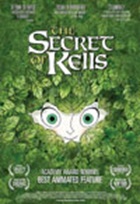
Irish monks, a woodland sprite, a young boy and Ireland's most famous illuminated manuscript grace this charming Irish indie, a Best Animated Feature nominee in an unusually competitive year.
I love that Brother Aidan's cat in The Secret of Kells is called Pangur Bán. In the eighth or ninth century, an unknown Irish monk, in a playful respite from his normal work, penned in the margins of a Latin New Testament manuscript an affectionate ode to the mouse-catching prowess of his white cat. That monk would surely be astounded to find Pangur Bán again commemorated in pen and ink over a millennium later, romping across backgrounds that look at times like the decorative work of the monks themselves, brought to cinematic life.
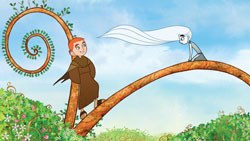
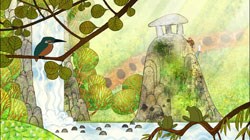
Ornate scrollwork, endless knots, spirals, plaits, circles, arches, panels, and decorative borders dance and frolic throughout The Secret of Kells. Developed at the Irish media company Cartoon Saloon by co-founder Tomm Moore, who wrote the story with screenwriter Fabrice Ziolkowski and directed with Nora Twomey, the animated indie weds the design sensibilities of traditional Insular art with the stylized simplicity of such contemporary retro animation as "Samurai Jack" or "Star Wars: The Clone Wars." Astonishingly, the breathtakingly beautiful work (witness the dappled light playing over the hero as he walks through the forest) is nearly all hand-drawn, with very little computer animation.
Brendan, voiced by Evan McGuire
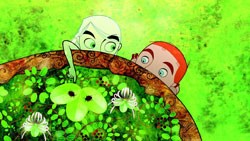
A similar blend of simplicity and elaboration animates the narrative, told from the perspective of young Brendan (Evan McGuire), an orphan living at the abbey of Kells under the sternly watchful eye of Abbot Cellach (Brendan Gleeson), Brendan's uncle. Brendan's world is half Christian, half Faerie, with barbaric invaders, woodland sprites and dark gods coexisting, at least for the time being, with the work of the monks—works like "the book that turns darkness into light," according to the opening voiceover by the woodland fairy Aisling (Christen Mooney), whom Brendan meets and befriends in the forest.
"Turning darkness into light" is the last line of a well-known free rendering of the poem "Pangur Bán"; and the book, of course, is the Book of Kells, also called the Book of Iona or the Book of Columba. One source claims that the monk who wrote "Pangur Bán" did so while working on the Book of Kells (dubiously enough, though they date to approximately the same period). It's enough of a hook to place Pangur Bán in the keeping of Brother Aidan, an illuminator who brings the unfinished book from the isle of Iona to Kells.
The Book of Kells, a fantasticallydecorated edition of the Four Gospels, is both one of the finest works of medieval Irish illumination, and the best-known symbol of the Irish illuminated manuscript tradition. The Irish monks have been credited with "turning darkness into light," not only with respect to the light of the gospel, but also in helping to preserve the light of classical learning through the Dark Ages of barbarian conquest. "If there were no books," exclaims an elderly brother, "all knowledge would be lost forever!" (Thomas Cahill, with perhaps more rhetorical flair than historical accuracy, has elaborated on the contributions of the Irish monks in his hyperbolically titled How the Irish Saved Civilization.)
Much of this is implicitly presupposed, but not spelled out, in The Secret of Kells, which offers virtually no hint of the contents of the Book of Kells, or of the contents of the Faith it embodies. We are told about, and finally shown, the splendor of the Chi-Rho page, a stylized depiction of the Chi-Rho monogram representing the first two letters of "Christ" in Greek (often seen, like the Ichthus fish, in sacred art)—but not what the Chi-Rho is.
It must be admitted that The Secret of Kells somewhat short-changes Brendan's Christian world in relation to Ireland's lingering paganism. The Faerie world is matter-of-factly depicted as living, magical and powerful; Christianity is mundane and limited. In the Irish countryside Brendan encounters spirits both charming and terrifying (Aisling the fairy, the bloodthirsty dark god Crom Cruach)—but he sees nothing to evoke the extravagant miracles of the saints that are equally a part of Irish lore. The film teases us with the alleged powers of the Book—said to have the power to blind sinners who gaze upon it—but when this is put to the ultimate test, it is the sinner, not the book, that has the upper hand.
Beautiful art is a highlight of the film
Even in brief, fanciful flashbacks of St. Columcille of Iona, here credited with initiating the Book of Kells, we get only contradictory anecdotes that turn out to be at least partly based on natural phenomena (Columcille's "third eye"). Of the legendary exploits of St. Columcille (his divine power over beasts and weather, or his imbuing a stone with powers of healing and of floating on water) there is no hint or echo, either in flashback or onscreen.
Brendan is aided by wild animals, like Saints Patrick, Brigid and others; a way through the wilderness is supernaturally opened for him, as for St. Lateerin of Cullin; he even escapes from attackers like the people of Lugna escaping the Connaught hosts through the graces of St. Attracta. The catch is, all of these occur through the aid of Faerie, not faith. If only there were something miraculous on the Christian side to balance the pagan miracles—if, say, Brendan's adventures involved an angel as well as a fairy—the film might be a nearly ideal distillation of Irish patrimony.
Article continues below
Perhaps I should speak of Christianities rather than Christianity, since Cellach and Aidan represent such different approaches. For the dour, authoritarian Cellach, the Faith is a wall to keep evil out and adherents safe within. "The pagans and worshippers of Crom will come to trust the strength of our faith when they see the strength of our walls," he predicts. Aidan has a very different vision, more aesthetic and joyful, but his idea about evil is that it's so powerful that when it comes you can only run away and hope that you're fast enough. In the end, alas, neither version of Christianity offers sufficient defense against evil.
The cat Pangur Ban casts a long shadow
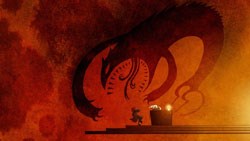
Having said all that, Christianity does seem vindicated over paganism in other ways. Echoing the traditional exploits of St. Patrick (driving the snakes out of Ireland, defeating Crom Cruach) and all the legends of the Irish saints confounding paganism and vindicating the Faith, a daring, dreamlike sequence pits Brendan against the bloodthirsty powers of paganism's darker side, as the film suggests Columcille did before him. Evil is literally circumscribed and confined, rendered incapable of harm. The Ouroboros motif, a serpent eating its own tail, is borrowed here from the Book of Kells—a symbol, perhaps, of the self-destructive nature of evil.
Notably, even the fairy Aisling (pronounced more or less "Ashlyn"; the name means "dream") lives in fear of Crom. Not only does The Secret of Kells implicitly acknowledge paganism's demonic side, it also suggests that paganism's own more winsome face is powerless to exorcise the dark side. Only the coming of Christianity can do that. Aisling even says that Crom Cruach has devoured her family. It is paganism's own dark side—not the coming of Christianity—that threatens paganism's better nature.
As for the Book, if the promise of "turning darkness to light" is more gestured at than depicted, even the gesture is worth something. Brother Aidan tells Brendan to bring the book to the people to give them hope in dark days, and even Aisling, as noted above, acknowledges the book's luminous power. The film's final image is a poetic paean to the Book's living power—a power that The Secret of Kells, like Aisling, recognizes without, perhaps, fully understanding.
Article continues below
Talk About It
Discussion starters
What do you think "the secret of Kells" is? Is it the Book? The Eye of Columcille? Something else?
Why do you think the movie sees the Book of Kells as all-important? Can a book "turn darkness into light"? How? Is the important thing about the book its artistic beauty? Its historic importance? Its message? All of these?
In order to help Brother Aidan with the Book of Kells, Brendan repeatedly disobeys his uncle's orders. Once, Aidan even encourages him to do so. Is Cellach being fair or unfair? If he is being unfair, does that make it okay for Brendan to disobey him? Does the fact that it is for the Book make it okay? Why or why not?
Is it ever okay for children to disobey parents, teachers or other authority figures? If so, when and why? When are children no longer obliged to obey their parents? When they reach adulthood? When they are living on their own?
The Family Corner
For parents to consider
The Secret of Kells is not rated, but would probably get a PG for a few scary images, such as the monster-like "Northmen" (Vikings) raiding and pillaging. (Then again, Disney's The Princess and the Frog got a G rating despite probably scarier shadow-like demons and such; such are the vagaries of Hollywood politics and the MPAA.)













 While we pray for peace, we need moral clarity about this war.
 A Christian reconciliation group in Israel and Palestine warned that war would come. Now the war threatens their relevance.españolالعربيةFrançais
 After lobbying from fellow Southern Baptists and Christians affected by the war, the House speaker moves a package forward.