In the 1960s, a girl and boy meet in second grade, and navigate a romantic relationship over the next five years—but it never finds the magic of Rob Reiner's best films.
Madeline Carroll, Callan McAuliffe, Rebecca De Mornay
Theatre Release
September 10, 2010 by Castle Rock Entertainment
Can it be love at first sight if you're seven years old? Flipped proposes that, yes, it can, if you're a bold and lively little girl; the little boy who is the object of her affection might need a few more years to catch on. When Juli Baker spots the Loski family moving in across the street, she strides right into the moving van and tries to lend a hand. Bryce and his dad are put off by her intrusiveness, and Bryce escapes under the pretense that his mother is calling him. From Bryce's perspective, goofy Juli just can't take a hint and runs after him, pursuing him to the point that he has to hide behind his mom.
But then the episode is run through again, this time from Juli's point of view. What Juli sees is that Bryce is just as smitten as she is. When he pushes her hand away, he's trying to hold it, she thinks. She reads in his "dazzling eyes" a love that is fully requited. He's "walking around with my first kiss inside of him," she tells herself.
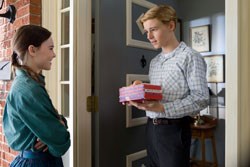
Madeline Carroll as Juli, Callan McAuliffe as Bryce
Thus begins "a half-decade of strategic avoidance and social discomfort," Bryce tells us. Juli continues to get starry-eyed whenever Bryce is around, even leaning forward from her school desk to sniff his hair, to his overwhelming embarrassment. Through the years Bryce continues to be discomfited and irritated by her attentions. It doesn't help that Juli's family is weird: her overworked mom cooks, cleans, and holds down a job while her dad stands outside painting landscapes. Their front yard is a wreck, the embarrassment of the neighborhood, and Juli develops a habit of spending hours sitting in a sycamore tree.
Then, when Bryce is in 7th grade, his recently-widowed grandfather Chet comes to live with the family. About this time Juli learns that her tree is going to be cut down, to make way for a house. She occupies the tree in order to save it, and the newspaper runs a story headed "Local Girl Takes a Stand." For Chet, this is the kind of spunkiness his dear wife would have shown, and he begins to encourage Bryce to get to know Juli better. For Bryce, however, tree-sitting is more of the weirdo behavior that has had him running in the opposite direction for years.
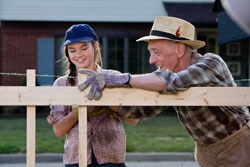
Juli with Bryce's grandfather Chet (John Mahoney)
The novel Flipped, by Wendelin Van Draanen, has been a hit with kids in that 10-14 age bracket for whom feelings about romance are new—exciting, confusing, and seldom efficiently in synch. Van Draanen's technique of telling an incident from both points of view amounts to a tutorial in adolescent romantic communication.
But director Rob Reiner has brought the story to the screen aiming, I think, at a different audience. Youthful fans of the book can be taken for granted, but Reiner has transposed the action from the present day (as it is in the book) to 1963, angling for a catch of baby boomers as well. The result is a relentless exercise in nostalgia—clothes, hair styles, cars, and doo-wop soundtrack—that begins to feel manipulative.
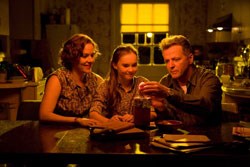
Penelope Ann Miller and Aidan Quinn as Juli's parents
In a way, the film is a throwback to two of Reiner's hits from the 1980s, When Harry Met Sally and Stand by Me. Flipped may have looked like an opportunity to emulate the first by depicting a romantic relationship as it evolves over time, and the second by setting events in the context of sentimental boomer adolescence. The result feels labored. In Stand by Me there was a much-quoted, delightful sequence in which the boys discuss whether Mighty Mouse or Superman would win a fight, and what kind of creature Goofy is. In Flipped, Bryce's best friend Garrett complains that there aren't Three Stooges, there are five, and that Curly Joe shouldn't be counted as a Stooge at all. This patch of dialogue sounds like something developed after consulting a focus group.
Dramatically, the film doesn't quite snap together. Though the young actors do their job well (as do the older ones), there's little urgency or narrative drive. The various episodes are strung along in sequence, each with its single point to make (Juli is ecologically sensitive, Bryce's daddy is a jerk), and the net effect is airless. While there are two sequences that are stirring and effective (one depicting a couple's dinner-table fight, and another a mentally-disabled man's meltdown in an ice cream shop), neither episode advances the main plot. On either side of them are yards and yards of bubble wrap.
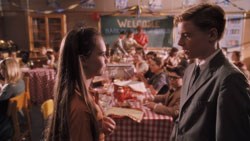
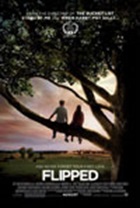
Hmm, maybe things won't turn out so bad for these two
Julie spends some time puzzling over the concept of how something can be either more or less than the sum of its parts. In Flipped we get a parade of highly-polished, overly-controlled parts, but the whole is disappointing. A screening audience is often grateful and eager to applaud, but when the last line of this movie was spoken at my screening, accompanied by swelling orchestration, the audience of youthful book fans sat in silence.
This is one of those movies where you have to ask, well, what are you looking for when you buy a movie ticket? If you're happy with a somewhat-entertaining story of young love, mostly free of offensive elements (when did it become OK to use barnyard epithets in a PG movie?), then you'll be satisfied with Flipped. But if you want to be surprised and delighted with a movie that is funny and true, you'll be happier with some of Reiner's earlier films. Flipped tries so hard to sell itself that it is the sales pitch we hear, rather than the ostensible subject: the unaffected charm of first love.
Article continues below
Talk About It
Discussion starters
Juli is a lively character with a strong sense of integrity. But Bryce shows that he is not able to stand up for himself, and when a friend says something cruel about Juli, he does not voice any disagreement. Do you think Juli will be disappointed in Bryce in the long run?
Juli's dad devotes himself to his painting, though his wife is overworked; Bryce's dad gave up artistic pursuit to earn a good living. It is Bryce's dad who is depicted as making the wrong choice, one that left him touchy and bitter. Yet in It's a Wonderful Life, the main character is viewed as heroic for giving up his dreams of being an explorer in order to support his family. When did this viewpoint change? Is it possible to re-imagine the story in a way that would treat Bryce's dad's self-sacrifice as heroism?
When Bryce's family invites Juli's family to dinner, Juli's mom is so thrilled and excited that she is overcome with "nervous energy." Why does this invitation delight her so much? What does it represent, to her?
The Family Corner
Flipped is rated PG for language and some thematic material. There are a handful of crude four-letter words. A provoked dad slaps his daughter on the face.
Beyoncé’s right. Whether listening to Cowboy Carter or reading theology, diversity is a good thing.
Khristi Adams
Flipped
1 of 4
Madeline Carroll as Juli, Callan McAuliffe as BryceJuli with Bryce's grandfather Chet (John Mahoney)Penelope Ann Miller and Aidan Quinn as Juli's parentsHmm, maybe things won't turn out so bad for these two













 While we pray for peace, we need moral clarity about this war.
 We’ve got little information on Jesus’ appearance and personality. But that’s the way God designed it.españolFrançais
 Beyoncé’s right. Whether listening to Cowboy Carter or reading theology, diversity is a good thing.