One need not be a Chamber—to be Haunted –
One need not be a House –
The Brain has Corridors—surpassing
Material Place –
Far safer, of a Midnight Meeting
External Ghost
Than its interior Confronting –
That Cooler Host –
Emily Dickinson's words in this poem offer severe insights into the psychological torments within the human mind—"Ourself behind Ourself." It's a theme that has been paramount in literature and art ever since: the depths, mysteries, and hidden horrors not of some external phantom, but of our internal self.
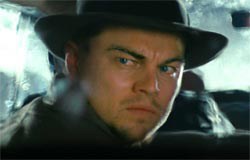
Leonardo DiCaprio as detective Teddy Daniels
Martin Scorsese's Shutter Island is a film about the war within. It's a deeply psychological, feverish madhouse of a movie that relentlessly pushes its protagonist to the brink of sanity, and forces us to question our own distinctions between things like heroes/villains, real/unreal, and order/chaos.
Based on the 2003 novel by Dennis Lehane (Mystic River), Shutter follows two fedora-clad U.S. marshals in 1954 New England as they investigate the disappearance of an inmate at a hospital for the criminally insane—a hospital conveniently located on a craggy, mysterious island cut off from the mainland.
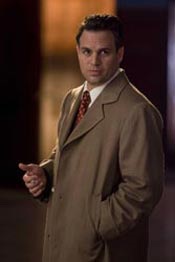
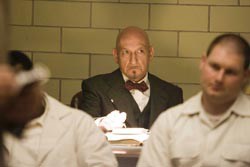
Leonardo DiCaprio plays the lead investigator (and the film's focal point), Teddy Daniels, who has his own secrets, demons, and delusions that become more and more evident the longer he stays on Shutter Island. As he and his partner Chuck (Mark Ruffalo) go about uncovering the secrets of the island, they encounter a motley crew of bizarre/creepy/insane characters, including a duo of the hospital's top physicians (Ben Kingsley and Max von Sydow at their malevolent best), lots of disturbingly off-kilter mental patients, and a smattering of guards, orderlies, and hospital administrators. It doesn't take long for things to really get crazy, and for Teddy to realize two things: 1) He has no friends on the island, and 2) No one is going to let him leave.
Mark Ruffalo as Chuck Aule
"Shutter Island" is an appropriate name for the place. It's closed off. Patients are locked in. Once you get there, you don't leave. And so what starts as a simple investigation for Teddy ultimately turns into a desperate attempt to get off the island before he loses his mind—or worse.
With Shutter Island, Scorsese takes a leap into an unfamiliar genre—vintage film noir—though it's not altogether a departure from his larger oeuvre. As a filmmaker, he is first and foremost an interpreter of America. That is, the gritty, violent, darker-than-we-seem nation still trying to reconcile its religious commitment to order and its baser, instinctual urges to dominate and "take what's ours." His films—particularly Mean Streets, Taxi Driver, Raging Bull, Goodfellas, and The Departed—can be seen as statements about unresolved American tensions and anxieties (particularly through the eyes of men), and the noir explorations in Shutter Island fit squarely into this theme.
Film noir has come to be known as one of the most distinct and "wholly American" film styles that grew out of a specific reflection of post-war American culture. The genre developed in the 1940s and 50s and featured expressionistic lighting, urban settings (often wet city streets at night), influence from hard-boiled detective fiction (James Cain, Raymond Chandler), depraved anti-heroes, moral ambiguity, fear of sexuality/women, and a pervasive feeling of dread/fate/alienation. Each of these qualities speaks to the preoccupations and anxiety of post-war America, and each is present in spades in Shutter Island.
Ben Kingsley as Dr. Cawley
DiCaprio's character, Teddy, is a WWII veteran who was among the troops who liberated the Dachau concentration camp. In war he saw unimaginable horrors and encountered all sorts of evil, the most unsettling of which was found in his own heart. Back home, in the white-picket fence perfection of post-war Waltons America, Teddy had a lovely wife (Michelle Williams), three beautiful children, and a job in federal law enforcement—protecting "the good and the right" values that ensured America would never fall victim to the depraved temptations of other 20th century superpowers.
Alas, the post-war dream was marred by an insistent, unsettling anxiety—a Cold War/technocratic/Freud-era fear that the good vs. evil binary might in the end betray those who wholeheartedly subscribed to it. As a genre, noir was always about throwing such binaries into question, and asking the probing, frightful question of what might lurk inside the human heart—inside the "corridors surpassing material place."
Shutter Island is all about the visceral, head-scratching embodiment of questions like this. Who is crazy? Am I crazy? Or are they crazy? As the film progresses and becomes more complicated and twisty by the minute, these questions press on us like the needle-sharp migraines Teddy suffers from.
Scorsese's direction in Island—particularly his pacing—is purposefully discombobulated, and the overall "I don't know what's going on but it can't be good" hallucinatory mood is aided by dreamlike bursts of color saturation and an eclectic, ominous soundtrack (with music by modern composers like John Cage, Ingram Marshall and Brian Eno). All of this well serves the insane asylum motif of the film, which can be enjoyed on the level of mystery/thriller but also as a deeper, more thought-provoking examination of both existential issues (are we inherently evil?) and societal problems (mental illness and institutionalization).
Article continues below
Director Martin Scorsese on the set
The film's deeper side comes largely through the compelling performance of DiCaprio, who—as in previous Scorsese collaborations like Gangs of New York and The Departed, and in his 50s era tour de force Revolutionary Road—plays a man longing for stable domesticity and moral order amidst circumstances that harshly and relentlessly suggest that the world is a dark, unruly place.
"God loves violence," one character tells Teddy. "There is no moral order at all. There's only, 'can my violence conquer yours?'"
It's a philosophy of life that the twentieth century—with its nukes, holocausts, and social Darwinism—seemed to support. And yet as much as mid-century film noir mistrusted man and placed him in the grime of his own wretchedness, it rarely threw in the towel on moral order. In those old hardboiled crime films, wrong choices always ended up costing. Sin always had its wages, and depravity was never abandoned as an unconquerable part of the self. And neither is it in Shutter Island.
Talk About It
Discussion starters
Who, if anyone, comes out of this film with integrity and morality intact? Can we discern the heroes from the villains?
What do you think Scorsese is trying to observe about good and evil in Shutter Island?
What do you make of the last line of the film?
The Family Corner
For parents to consider
Shutter Island is rated R, mostly for language (quite a few f-words) and violence (rather light by Scorsese standards, but still present in the form of a few disturbing images). There is also a very brief scene of male nudity (prisoners in a dark cell). In general, the film's dark thematic content and pervasive sense of dread makes it a "mature audiences only" type film. Definitely not for kids.














 While we pray for peace, we need moral clarity about this war.
 We’ve got little information on Jesus’ appearance and personality. But that’s the way God designed it.españolFrançais
 NIL deals in college athletics present new challenges—and opportunities—for colleges and students.