With his first feature film, That Evening Sun, writer-director Scott Teems wants to depict truth—even when it's ugly—and thinks all Christian filmmakers should aim for that.
In what some are calling his best performance, Hal Holbrook plays Abner Meecham, an aging Tennessee farmer looking to reclaim his old life in the critically acclaimed That Evening Sun, a film now playing in limited release.
The film begins with Abner fleeing a nursing home and returning to his country farm to live out his days in peace, only to discover that his son has leased the farm to Abner's old enemy and his white trash family. Not one to suffer fools or go down easy, Abner moves into the old tenant shack on the property and declares that he won't leave until the farm is returned to his possession. But Lonzo Choat, the new tenant, has no intention to move out or give in to the old man's demands. This sets up a ruthless grudge match between Abner and Choat, each man right in his own eyes, each too stubborn to give an inch.
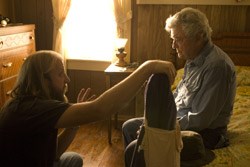
Scott Teems and Hal Holbrook on the set
It all plays out under the watchful eye of 34-year-old Scott Teems, who wrote and directed the film, based on a short story by William Gay. Teems, a Christian, talked with CT about That Evening Sun, working with Holbrook, and his philosophy of filmmaking.
That Evening Sun has been described as a Flannery O'Connor-esque tale from the South, also as a "classic Southern Gothic." Would you agree those assessments?
The great difference between O'Connor and William Gay is the action of grace in the midst of chaos. Perhaps this is where I diverged most from the original story, bringing a hint of hope and grace to the ending, where Gay's story was more bleak and hopeless. I'm not sure whether this betrays Gay's vision or not—I've asked myself this question often in the months since finishing the film, as I believe that fidelity to the original author's intent is my highest responsibility in the adaptation process. What's ironic is that a recurring comment I get when we screen the film for audiences is that they wish the ending was "happier" or somehow more satisfying. It doesn't play into their expectations, and is often perceived as sad or depressing. But I think it ends the only way it could, because there are no winners in a war of attrition, no victors in a battle over things of the earth. And somehow I find that quite hopeful, because it forces us to look beyond ourselves, beyond our small worlds, for meaning and purpose in life.
This is the second William Gay story you've adapted for film. What do you like about his work?
His work is very cinematic, because he balances a hardscrabble, stripped-down style—his sentences are generally very sparse, using no quotations or unnecessary punctuation, much like Cormac McCarthy, with occasional bursts of gorgeous poetry. It lends itself quite well to the cinema, where one can echo both his minimalist language and his poetic flourishes. But more than that, Gay writes flesh-and-blood human beings.
A character like Abner Meecham, who was fully formed on the page before I ever showed up, is strong and sharp and funny and fiercely independent, honorable qualities to which an audience can relate. Yet he's also callous and cruel and refuses to see anyone's point of view but his own. He's fully human, warts and all, and as the story progresses you are forced to constantly reevaluate how you feel about him, because he pushes against your expectations of the "hero." He's a tremendously captivating protagonist, but he's no hero. He's a man in great pain, but one who has never been given permission to be vulnerable. He comes from a generation of men who equate vulnerability with weakness, and there's no room for weakness in a battle of wills. Thus, he builds walls around himself and claws like a caged tiger whenever someone tries to break through. I think he's downright fascinating.
How did you, a relatively unknown filmmaker, land Holbrook for this film? And what was it like working with him?
Hal took a great risk in committing to this film, precisely because of my lack of experience. This was my first feature film; it was Hal's 44th, give or take, to go along with hundreds of TV appearances and countless stage performances. Yet this was also a first for him—his first solo lead in a feature film. So we were both treading in some unfamiliar waters.
What I respect so much about Hal, among other things, is that he cares immensely about his craft. At an age when the large majority of his peers have long since given up the ghost and settled into the leisurely life of retirement, he still approaches each role with great vigor, and each collaborator as if they have something to teach him. But, as you might imagine, most of the time it's the other way around. The first thing I realized, when we framed up Hal on day one of the shoot, was that my job was to put the camera on his face and get out of the way. Just holding on a close-up of him—there is history there, and mystery too. In the lines on his face, in the depths of his steel blue eyes. And there is power in his presence. You can't stop watching him.
Article continues below
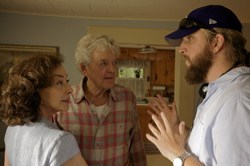
Teems directs Holbrook and Dixie Carter
Christians have all sorts of ideas about what makes a "Christian movie." What are your thoughts on that?
To poorly paraphrase C.S. Lewis, there is no such thing as a "Christian film," just as there is no such thing as "Christian cooking." What we have are stories, and storytellers, and points of view. All I can do as a storyteller is focus on what I'm primarily concerned with and explore with earnestness and conviction the truth contained therein. And what I'm primarily concerned with is manhood, the South, and Christianity, and where the three intersect (or, more often, collide). I want to explore the warring parts of my soul; I want to know why the man I am is in such conflict with the man I know I am called to be. I want to know why my desires and motivations are so crudded up by the ugliness of the human condition. These things I want to ask, and I know that God is not afraid of my questions.
In regards to filmmakers who desire to make films with overtly Christian agendas, whose goals are solely to convert the unsaved through apocalyptic proclamations or false promises of miracles and bounty—save your time and money. Give it to the poor. It will do more good there, I promise. As Christians we are called to excellence in everything we do, and that includes the crafts of storytelling and filmmaking. We aren't called to make hackneyed propaganda, no matter how earnest our intentions. Just because somebody bought you a bullhorn doesn't mean you get to use it. You've got to earn the right by putting in the effort, by mastering the craft.
What would you want Christians to know about watching movies—about how to watch a movie, no matter where it's coming from theologically/philosophically?
Go watch Kieslowski. Go watch Bergman. Go watch Malick. Go watch Wenders. Go watch the Dardennes. Learn by doing. Don't go to the multiplex for six months. Go to films that star people you've never heard of. Challenge yourself with foreign cinema, which will be a new language for some (literally and figuratively). But don't be afraid of something new. That's the only way we learn.
Do you have a "personal mission statement" as a filmmaker?
My mission statement is simply to make films about which I can say, "I believe this is true. I believe this is honest (not always the same thing as what is true). I believe it was made for the right reasons. And I believe it has value in this world." That's also my definition of success.
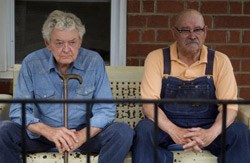
Holbrook and Barry Corbin in a scene from the film
The honesty vs. truth thing is of particular importance to me: Just because something is true doesn't mean it's honest, and vice versa. This fact is often shied away from (or downright ignored) by artists attempting to tell stories with Christian values or morals. For example, I absolutely believe our God is a God of miracles. But to posit the idea that when you give your life to Christ then suddenly all your problems are miraculously solved—your wife gets pregnant, somebody gives you a new truck, your team wins the big game—well, that's just not honest. It is terribly misleading, and worse, it's just not biblical. "Consider it pure joy, my brothers, whenever you face trials of many kinds."
Article continues below
We don't live in a world that thinks like that. This is one of the great tragedies of the cultural acceptance of Christianity: There's a respect for the tradition of the Christian faith but often very little understanding of what it actually means. And no one ever pushes us into a deeper level of understanding. This is certainly the case in the South where I grew up. Christianity isn't equated with suffering and humility and loving your enemies and the harder teachings of Christ; it's equated with conservative morals and "family values" and the NRA. It's absurd. And so we end up afraid of suffering.
We don't understand it to be at the very core of the Christian experience. What is the goal of life? To be suffer-free? No, the goal of life is to become more like Christ, in our joys and in our sufferings. You can't have one without the other. But people don't want to suffer. They want to be "happy." I just wish more people understood that joy and happiness aren't the same thing.
Talk about the importance of story versus message.
I paraphrased Lewis earlier, so now let me (poorly again) paraphrase Flannery: If I can tell you in a sentence what a movie is about, then why make the movie? I'll just tell you "Crime doesn't pay" and we can save everybody a whole lot of time and money. If a story's theme and "message" are that easily distilled, then the movie is most likely a steaming pile of dung. There's no depth there, no complexity of characters or relationships. "Messages" are for the lazy. Only stories can penetrate the heart. And how you tell a story is as important as the story itself, because in a well-told story, two plus two equals five, not four. We must harness the language of film and be purposeful in the way we use it. When we do, the end result becomes something bigger than the sum of its parts. That's what I strive to do.
Article continues below
That Evening Sun is only in very limited release. Is that discouraging for you?
Well, I was able to make a feature film, and that film will be in theaters in 25 cities by the end of February. It's hard to be discouraged about that. It's a dream come true. Do I wish it had been picked up by a major distributor and screened in every multiplex across the country? Sure. But this is a wickedly difficult time for the film industry in general, and for independent film in particular. The fact that we were even able to make the film is a minor miracle, and I am profoundly grateful to have had the opportunity. I'm confident that the film will find its audience, whether at the theater now or on DVD down the road.
What are you working on next?
I wish that next up for me would be some much-needed sleep. But I've got a newborn in the house (along with a pre-schooler and a first-grader), so I don't plan on sleeping much anytime in the near future.
In all seriousness, I've got two new projects in the works. Both are adaptations about displaced men: one is a Southerner who no longer lives in the South, and one is a Northerner who comes to the South under suspicious circumstances. Cryptic, I know. Wish I could say more. But they both deal with those main concerns of mine: manhood, the South, and Christianity. I'm hoping to get one of them off the ground this year.
Learn more about the film, and where it's screening, here.












 While we pray for peace, we need moral clarity about this war.
 We’ve got little information on Jesus’ appearance and personality. But that’s the way God designed it.españolFrançais
 After lobbying from fellow Southern Baptists and Christians affected by the war, the House speaker moves a package forward.