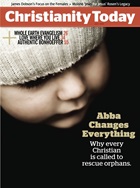
The creepiest sound I have ever heard was nothing at all. My wife, Maria, and I stood in the hallway of an orphanage somewhere in the former Soviet Union, on the first of two trips required for our petition to adopt. Orphanage staff led us down a hallway to greet the two 1-year-olds we hoped would become our sons. The horror wasn't the squalor and the stench, although we at times stifled the urge to vomit and weep. The horror was the quiet of it all. The place was more silent than a funeral home by night.
I stopped and pulled on Maria's elbow. "Why is it so quiet? The place is filled with babies." Both of us compared the stillness with the buzz and punctuated squeals that came from our church nursery back home. Here, if we listened carefully enough, we could hear babies rocking themselves back and forth, the crib slats gently bumping against the walls. These children did not cry, because infants eventually learn to stop crying if no one ever responds to their calls for food, for comfort, for love. No one ever responded to these children. So they stopped.
The silence continued as we entered the boys' room. Little Sergei (now Timothy) smiled at us, dancing up and down while holding the side of his crib. Little Maxim (now Benjamin) stood straight at attention, regal and czar-like. But neither boy made a sound. We read them books filled with words they couldn't understand, about saying goodnight to the moon and cows jumping over the same. But there were no cries, no squeals, no groans. Every day we left at the appointed time in the same way we had entered: in silence.
On the last day of the trip, Maria and I arrived at the moment we had dreaded since the minute we received our adoption referral. We had to tell the boys goodbye, as by law we had to return to the United States and wait for the legal paperwork to be completed before returning to pick them up for good. After hugging and kissing them, we walked out into the quiet hallway as Maria shook with tears.
And that's when we heard the scream.
Little Maxim fell back in his crib and let out a guttural yell. It seemed he knew, maybe for the first time, that he would be heard. On some primal level, he knew he had a father and mother now. I will never forget how the hairs on my arms stood up as I heard the yell. I was struck, maybe for the first time, by the force of the Abba cry passages in the New Testament, ones I had memorized in Vacation Bible School. And I was surprised by how little I had gotten it until now.
When someone learns that I'm going to speak at their church about adoption, typically the first question is, "So will you be talking about the doctrine of adoption or, you know, real adoption?" That's a hard question, because I cannot address one without addressing the other. We cannot master one aspect and then move to the other, from the vertical aspect of adoption to the horizontal aspect, or vice versa.
Families, the Bible tells us, reflect something eternally true about God. It is God's fatherhood after which every family in heaven and on earth is named (Eph. 3:14-15). We know what human parenting should look like based on our Father's behavior toward us.
The reverse is also true. We see something of God's fatherhood in our relationship with our human fathers. Jesus tells us that our fathers' provision and discipline show us God's active love toward us (Matt. 7:9-11; Heb. 12:5-17).
The same principle is at work in adoption. Adoption is, on one hand, gospel. Our identity and inheritance are grounded in our adoption in Christ. Adoption is also mission. In this, our adoption spurs us to join Christ in advocating for the poor, the marginalized, the abandoned, and the fatherless. Without the theological aspect, the growing Christian emphasis on orphan care too often seems like one more cause wristband for compassionate conservative evangelicals to wear until the trend dies down. Without the missional aspect, the doctrine of adoption too easily becomes mere metaphor, just another way to say "saved."
No Natural-born Children of God
Little Maxim's scream changed everything—more, I think, than did the judge's verdict and the notarized paperwork. It was the moment, in his recognizing that he would be heard, that he went from being an orphan to being a son. It was also the moment I became a father, in fact if not in law. We both recognized that something was wrong, because suddenly, life as it had been seemed terribly disordered.
Up to that time, I had read the Abba cry passages in Romans and Galatians the same way I had heard them preached: as a gurgle of familiarity, the spiritual equivalent of an infant cooing "Papa" or "Daddy." Relational intimacy is surely present in the texts—hence Paul's choice of such a personal word as Abba—but this definitely isn't sentimental. After all, Scripture tells us that Jesus' Spirit lets our hearts cry "Abba, Father!" (Gal. 4:6). Jesus cries "Abba, Father" as he screams "with loud cries and tears" for deliverance in the Garden of Gethsemane (Heb. 5:7; Mark 14:36, ESV, used throughout). Similarly, the doctrine of adoption shows us that we "groan" with the creation itself "as we wait eagerly for adoption as sons, the redemption of our bodies" (Rom. 8:23). It is the scream of the crucified.
Article continues below
The gospel of adoption challenges us, first of all, to recognize ourselves as spiritual orphans. The gospel compels us to see our fallen universe—and our own egocentric kingdoms therein—as not the way it's supposed to be.
With our evangelistic emphasis on the sinner's prayer, evangelicals ought to recognize this more than we often do. "Everyone who calls on the name of the Lord will be saved" (Rom. 10:13), we rightly insist. But we rarely feel how desperate—and how liberating—the call is. We assume it's a cry only at the beginning of the Christian walk, not through the ongoing work of the Spirit. We grow complacent in the present age, too comfortable to cry out for a Father we can sense only by faith.
The Abba cry of our adoption defines who we are and what family we belong to. That's why Scripture's witness to the doctrine of adoption has everything to do with church unity, away from the divisions of Jew and Gentile, slave and free, male and female, rich and poor (Gal. 3:28). None of us are natural-born children of God, entitled to all this grace, all this glory. It's not just the Gentiles—with their uncircumcised penises and pig-flesh-eating mouths—who were adopted into this family. The Jewish Christians, too, received adoption (Rom. 9:4). Yes, Abraham was the father of the Israelites, but he was an Iraqi Gentile before he joined the household of God. We Christians receive newcomers because, in Christ, we have been received. Our identity and our inheritance are found in Christ, or they are not found at all.
I was at first reluctant to adopt, because I assumed an adopted child would always be more distant than a child "of my own." I was wrong. And I should have known better. After all, there are no "adopted children" of God, as an ongoing category. Adoption tells us how we came into the family of God. And once we are here, no distinction is drawn between those at the dinner table. Love based on the preservation and protection of genetic material makes sense in a Darwinian—not a Christian—view of reality.
Article continues below
Thus, the adoption and orphan care movement teaches us something revolutionary about the evangel.
Orphan Care: Spiritual Warfare
We evangelicals often seem to identify more around corporate brands and political parties than with each other in our local churches. But our adoption in Christ makes us not warring partisans but loving siblings, whom the Spirit has taken from the babble of Babel to the oneness of Pentecost. The church's unity attests to the "manifold wisdom of God" (Eph. 3:10). Would our gospel be more credible if "church family" wasn't just a slogan, if "brothers and sisters" was more than metaphor? What would happen if the world saw fewer "white churches" and "black churches," fewer "blue-collar churches" and "white-collar churches," and fewer baby boomer and emerging churches, and saw more churches whose members have little in common except being saved by the gospel?
Our churches ought to be showing the families therein how love and belonging transcend categories of the flesh. Instead, though, it seems God is using families who adopt to teach the church. In fact, perhaps we so often wonder whether adopted children can really be brothers and sisters because we so rarely see it displayed in our pews. Some—maybe even you—might wonder how an African American family could love a white Ukrainian baby, how a Haitian teenager could call Swedish parents Mom and Dad. The adoption movement is challenging the impoverished hegemony of our carnal sameness, as more and more families in the church are starting to show fellow believers the meaning of unity in diversity.
That's why adoption and orphan care can ultimately make the church a counterculture. The demonic rulers of the age hate orphans because they hate babies—and have from Pharaoh to Moloch to Herod to the divorce culture to malaria to HIV/AIDS. They hate foster care and orphan advocacy because these actions are icons of the gospel's eternal reality. Our enemies would prefer that we find our identity and inheritance in what we can see and verify as ours—the flesh—rather than according to the veiled rhythms of the Spirit. Orphan care isn't charity; it's spiritual warfare.
A New Household Economy
After we learn more about our gospel identity, we start reflecting the economy and priorities of our new household. The God of Israel consistently urges his people to care for the orphan, the widow, and the immigrant (Deut. 24:17-22) by noting his adopting purposes as "Father of the fatherless" (Ps. 68:5). He announces, "If you do mistreat them, and they cry out to me, I will surely hear their cry" (Ex. 22:23). The Spirit drives us not just to cry Abba in the Christian gospel, but also to respond to the cries of the weak through Christian mission.
Article continues below
Orphan care is, by definition, missional. Paul's letter to the Romans, which includes perhaps the clearest explanation of the doctrine of adoption, isn't a systematic theology text; it's a missionary manifesto, calling the church in Rome to unify and to join Paul in making Christ known to the nations (Rom. 15:1-21). This is why James—the brother of Jesus—tells us that caring for widows and orphans is the essence of "pure and undefiled" religion (1:27). And Jesus himself—adopted by the righteous Joseph—identifies himself with the "least of these my brothers" (Matt. 25:40). And he tells us that the first time we hear his voice in person, he will be asking if we did the same.
Imagine, for a moment, the plight of an orphan somewhere out there. With every passing year, she will become less "cute," thus less adoptable. In a few years, on her eighteenth birthday, she will be expelled from the system. She might join the military or find job training. Maybe she'll stare at a tile on the ceiling above her as her body is violated—alone or before a camera crew of strangers—by a man who's willing to pay enough for her to eat for one day. Maybe she'll place a revolver in her mouth or tie a rope around her neck, knowing no one will notice except the ones who have to clean up afterward. This story could just as well describe a boy who is orphaned. Can you feel the desperation of what it means to be an orphan? Jesus can. Orphans are his little sisters and brothers. He hears them.
In saying that orphan care is missional, I do not mean that every Christian is called to adopt or foster a child. But every Christian is called to care for orphans. As with every aspect of Christ's mission, a diversity of gifts abounds. Some have room at their table and in their hearts for another stocking on the mantle by this coming Christmas. Others are gifted financially to help families who would like to adopt but cannot figure out how to make ends meet. Others can babysit while families with children make their court dates and complete home-study papers.
Article continues below
Still others can lead mission trips to rock and hug and sing to orphans who may never be adopted. Pastors can simply ask whether anyone in their congregation might be called to adopt or foster parent, or to empower someone who is. And all of us can pray—specifically and urgently—for orphans the world over.
Some would seek to contrast orphan care—and other so-called social ministries—with evangelism, perhaps even with the gospel itself. But such a dichotomy just does not stand up to biblical revelation. Genuine faith works through love, the Bible tells us (Gal. 5:6). The mission of Christ points us, as theologian Carl Henry reminded the last generation of evangelicals, to a God of both justice and justification.
Since genuine faith is always orphan-protecting, a culture of adoption and evangelism can work together. Indeed, they grow from the same root. Churches that are other-directed instead of self-obsessed in adopting unwanted children will be other-directed instead of self-obsessed in verbally witnessing to unwanted people. A conscience that's burdened for orphans, rather than seared over in the quest for more stuff, will be burdened for spiritual orphans. A church that learns to love beyond the borders of biology will learn to do mission outside the borders of geography.
A Kingdom of Rescued Children
As the Spirit draws more Christians to orphan care, we also must insist that adoption is not just a backdoor route to child evangelism. Of course, Christians who adopt will teach their children that what they believe is true and ultimately meaningful. Every parent does that and, to some degree, cannot do otherwise. A secular progressive parent would (rightly) correct racial bigotry or misogyny in his or her child. We wouldn't accuse that parent of having a child in order to export Western democratic values. In the same way, Christian parents will teach their child the message of Jesus, regardless of how the child arrived in their home.
But this doesn't mean that adoption is simply a means to evangelism, any more than biologically bearing children is reproductive evangelism. As those who have experienced gospel adoption, we know it is good for all children to have parents, even parents who do not yet know Christ. We advocate, then, for all orphans and rejoice when unbelievers adopt too, just as we encourage marriage between unbelievers, since marriage witnesses to the Christ-church union even when the married couple doesn't see it. The gospel is better understood in a culture that understands the one-flesh union. Likewise, the fatherhood of God is better understood in a culture where children know what it means to say "Daddy" and "Mommy."
Article continues below
Scripture characterizes the kingdom of Christ as a kingdom of rescued children. Solomon looks to the final reign of God's anointed and sings, "For he delivers the needy when he calls, the poor and him who has no helper. He has pity on the weak and the needy, and saves the lives of the needy. From oppression and violence he redeems their life, and precious is their blood in his sight" (Ps. 72:12-14). When we contend for orphans—born and unborn—we are doing more than cultural activism. A culture of adoption, orphan care, and ministry to mothers in distress announces what the kingdom of God looks like and to whom it belongs. We're contending for the faith once for all delivered to the saints (Jude 3).
While I was writing this article, my children came running through my study hyped up on Kool-Aid and Pop-Tarts (don't judge me). I heard myself saying, "Will all of you please be quiet so I can think?" But I remembered when our house was quiet, and I remembered the silence of the orphanage where we found Timothy and Benjamin. The kingdom of God isn't quiet. Instead it's like my house these days, "like a flock in its pasture, a noisy multitude of men" (Mic. 2:12).
The universe around us is creepily silent—like an orphanage in which the children no longer believe they will be heard. But if we listen with Galilean ears, we can hear the quiet desperation of thumbs being sucked, of cribs being rocked. As we welcome orphans into our homes, we can show the orphaned universe what it means to belong to a God who welcomes the fatherless.
Let's remember that we were orphans once, and that someone came looking for us, someone who taught us to call him "Abba." Let's be ambassadors for the One who loves the little children, all the children of the world. Like him, let's welcome children into our homes, our churches, and our lives, especially those we are not supposed to want.
Russell D. Moore is author of Adopted for Life: The Priority of Adoption for Christian Families and Churches (Crossway). He is senior vice president and dean of the School of Theology at the Southern Baptist Theological Seminary in Louisville, Kentucky. He is also a preaching pastor at Highview Baptist Church in Louisville. He and his wife, Maria, have four sons.

















 While we pray for peace, we need moral clarity about this war.
 As my doubts about his teachings grew, so did a secret fascination with Jesus.
 NIL deals in college athletics present new challenges—and opportunities—for colleges and students.






