Director John Curran made two perhaps inadvertently telling comments to the Toronto Film Festival audience last month following a screening of Stone. He said when Edward Norton first read the script, he passed on playing the title character because he (Norton) "just didn't see it." Later, after Robert De Niro agreed to play the title role, Norton reconsidered. Also, Curran mentioned that the film's near constant use of Christian talk-back radio as part of the soundtrack was a late addition because the director felt that De Niro is a very closed actor who didn't reveal much about his character's internal mental or emotional landscape, and Curran couldn't find music that would cue the audience into what Jack (De Niro's character) was thinking and feeling.
The line between subtle and muddled is a particularly thin one, and the film's defenders might think I'm on the wrong side of it. C. S. Lewis once opined that rhetorical nonsense doesn't become sense just by inserting the word "God" into a sentence. Likewise, just because Stone is asking questions that are essentially "religious" doesn't necessarily transform a muddled movie into something insightful. Sometimes it just results in muddled ideas about spiritual subjects.
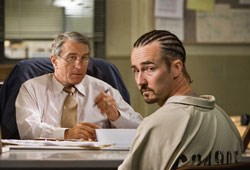
Robert De Niro as Jack Mabry
De Niro plays Jack Mabry, a parole instructor on the verge of retirement who once responded to his wife's threat to leave him by responding with a threat of his own—he'd kill their child if she ever tried to leave, or ever mention it again. It's unclear whether Curran intended to portray Jack as a Christian, though he's certainly shown as a church attender. If Christian faith is central to Jack's character, it's not evident in the film.
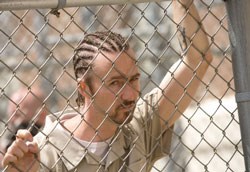
Edward Norton as Gerald 'Stone' Creeson
Norton plays Gerald "Stone" Creeson, one of the last inmates for whom Jack will have to write a report recommending for or against parole. Perhaps sensing a core of sexual frustration or perhaps just fishing for some sort of blackmail leverage, Stone encourages his wife, Lucetta (Milla Jovovich), to contact Jack outside of the prison and see if there's anything—including seduction—she might do to help Stone's chances at parole. While Jack is dealing with his own temptations and failings, Stone begins reading and parroting information about an alternative religion that claims focusing on small sounds is the first step toward becoming God's tuning forks. (Curran has said that he made up the "religion" for the film.)
Milla Jovovich as Lucetta
De Niro's acting credentials are unimpeachable, but the film seems to rely more on his persona than on his performance. None of the actors are bad, really, and Jovovich does probably her best work ever, but they don't seem to be in synch with each other or the script. You can have three great musicians, but if each of them and their conductor has a different piece of music the result isn't generally harmonious. It is one thing to keep the audience in suspense because we don't know which way a conflicted character is going to go; it is quite another to keep the audience in suspense by giving it conflicting sketches of who the characters are. Lucetta is a bit of a cipher—she has to cycle through multiple personalities to find what will push Jack's buttons, and so we get a sense of the game she is playing but no real sense of the woman who is playing it. Jack's wife will chastise him in one scene for using the Lord's name in vain—and then spout New Age babble about how we are all descended from rocks in the next. Jack himself is supposed to be a smoldering cauldron of anger capable of anything, but his demeanor is more sullen and defeated than lively or feisty.
The fact that Jack's two most overt acts of anger are both directed at women tends to make him come across as little more than a garden variety bully. To the extent the film works at all on a thematic level it is to the extent that it successfully manipulates the audience into complicity with Jack's hypocrisy by inviting us, with our own imperfections, not just to recognize another's flaws but to long for their punishment. Had the film ever invited or even allowed us to identify with anyone in it long enough to consider the danger inherent in judging another too legalistically, I might have admired it more. Instead, Stone seems to care more about keeping us guessing about what the characters are going to do than it does about making us care what is going to happen to them if and when they do it.
Talk About It
Discussion starters
Stone complains that he doesn't understand why Jack "gets" to judge him since Jack is not without faults himself for which he has never been held accountable. How would you respond to this challenge if you were in Jack's shoes?
Are any of the three main characters more or less culpable in your eyes for their actions? Do a person's circumstances ever mitigate his or her culpability for making bad moral choices?
Is the film's use of Christian talk-back radio meant to reflect negatively on Jack? Why or why not?
Taking into account not just Jack but also his wife and the inclusion of the Christian talk-back radio, what is the film's attitude toward institutional religion? What is the difference, if any, between portraying Christianity in a bad light and portraying individual characters who claim to be Christian in a bad light? Which, if either, does the film do?
Article continues below
The Family Corner
For parents to consider
Stone is rated R for violence, sexual situations, nudity, and language. Stone witnesses another inmate being killed, and the camera lingers over repeated stabbings with blood spurting over the witness's face. In an early scene, Jack holds a child out the window and threatens to drop it to death. The violence in this scene is not as explicit as in the prison murder scene, but its intensity, because of the threat of violence to a child, is particularly disturbing. Jovovich is shown nude from the waist up while on the phone and having sex with another character who is shown from the backside while on top of her. Stone speaks graphically and bluntly about his sexual desires and practices during his interviews with Jack. He also uses profane and obscene language.















 While we pray for peace, we need moral clarity about this war.
 We’ve got little information on Jesus’ appearance and personality. But that’s the way God designed it.españolFrançais
 C.S. Lewis recommended discernment over diatribes in exactly the moments we’re most eager to indulge in critique.