Oliver Stone has a penchant for tracking the winds of popular American sentiment. From his blistering account of the Vietnam War (Platoon, 1986) to his controversial presidential bio-pics (JFK, 1991; W., 2006), the larger-than-life director has taken on some of our deepest assumptions, exposing their cracks and flaws. Wall Street (1987) took one of our most cherished beliefs—that capitalism is the best economic system the world has known—to its logical conclusion, showing what happens when someone makes unfettered self-interest his gospel. (Hint: It ain't pretty.) The American Film Institute named reptilian corporate raider Gordon Gekko (Michael Douglas) among its top 50 movie villains, in part for his speech espousing that "greed … is good, greed is right, greed works." On a theoretical level, Americans understand that self-interest fuels the wheels of our economic system. But put Gekko's way, most of us sense something is horribly wrong.
Michael Douglas as Gordon Gekko
As it turns out, greed doesn't always work. If we have learned anything the past two years, watching the worst economic collapse since the Great Depression, it's that greed fails, sometimes miserably. News of sub-prime mortgage scandals, trillion-dollar government bailouts of "too big to fail" banks, and Ponzi schemes have primed many American moviegoers for a takedown of the bankers and investors who contributed to the mess. We are enraged at corruption throughout corporate America, and we're ready for an on-screen skewering of a Bernie Madoff—like character.
Enter Gekko—or reenter, that is. In Wall Street: Money Never Sleeps, Stone brings Douglas's Oscar-winning role back for a timely (some might say opportunist) story about an older, wiser Wall Street, and the bankers who've been humbled by its demise. Unlike the first film, which gave an insider's look at the soulless world of playing the market, Wall Street 2 is about the priceless value of investing in human relationships. Or at least it wants to be.
Shia LeBeouf as Jake Moore
Gekko has finished his jail sentence for securities fraud and racketeering, and is reentering society without a colleague or family member in sight. His only child, Winnie (Carey Mulligan), has cut all ties, blaming his "victimless crimes" for the suicide of her older brother, Rudy. Winnie is the girlfriend of—irony of ironies—a proprietary trader, the young, whip-smart Jake Moore (Shia LeBeouf), whose competitive drive is redeemed by his idealism and investment in green energy. Moore works for Louis Zabel, a hard-driving but honest investor, played by the luminous Frank Langella. When the Federal Reserve refuses to bail out Zabel's investment firm, rumored to have billions in toxic debt, tragedy strikes and another firm—led by Bretton James (Josh Brolin), clearly the villain here—swoops in to buy it for a fraction of its worth. Without telling Winnie, Moore contacts Gekko for clues as to why Zabel was betrayed by his fellow bankers. Gekko, always a businessman, wants something in return: his daughter.
Despite its potential for solid character development, Wall Street 2 is a plot-driven film that follows Moore's efforts to avenge Zabel and reconcile Winnie to her dad. It bends and twists, bouncing from scene to scene of men in suits talking quickly and slickly about money, but unfortunately the plot hits many dead ends. It also doesn't always let viewers in on the financial lingo. What the film lacks in decipherable dialogue, it tries to make up for in style. Stone uses split screens and colorful bar graphs throughout, winking at some of the visual gimmicks from his 1987 film. And Winnie and Jake zip through New York City on a motorbike, getting engaged in their loft apartment taken straight out of a Crate and Barrel catalog, attending a benefit dinner where Charlie Sheen makes a cameo—it's all fun to watch, if a bit vapid.
Jake and Winnie (Carey Mulligan)
So are scenes with Brolin as James, the villainous overlord of Churchill Schwartz who started the rumors about Zabel's firm and wants Moore as his protégé. James is Wall Street 2's Gekko, a man who worships wealth and will destroy people and institutions in its service. In one telling scene, Moore asks James about his "number": "the amount of money you would need to be able to walk away from it all and just live happily ever after." Smirking, James simply replies, "more." It's a stark reminder of Scripture's warnings about the consequences of the love of money: hatred of God and all kinds of evil. For this, Stone is to be commended for showing the high-stakes world of Wall Street without glamorizing it, even if his approach is at times heavy-handed.
The film also touches on another biblical theme: that earning money is never just about money, but also about achieving godlike power and gaining access into an elite social stratum—in other words, pride. After Winnie discovers that her father has stolen $100 million from the fund he once set aside for her, Moore lectures Gekko, "No matter how much money you make, you will never be rich." "You see, it's not about the money," Gekko says. "It's about winning the game between humans."
Article continues below
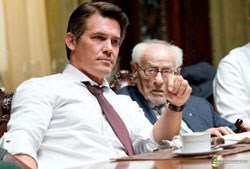
Josh Brolin as Bretton James
Gekko—and Stone, apparently—believes that relationships are always irreducibly a zero-sum game in which someone has to lose, even if the loser is family. "Whether it's greed or revenge or the compulsion to chase, it all amounts to the same thing … loss of control," Gekko says in one final scene. "And it's always going to be there and it's always going to be stronger than you, pal." Gekko does have tender moments, certainly more than in his debut, including a tear-inducing apology to Winnie. But viewers waiting for a radical change of heart will be disappointed. As will those hoping for a helpful explanation of why we are in the economic mess we're in. But if Wall Street 2 is accepted for what it is—a celebrated director's attempt to underline the moral dimensions of our nation's economic woes, and have fun in the process—this sequel is worth a shot.
Talk About It
Discussion starters
In one scene, Winnie asks Jake, "Are you interested in changing the world or making money?" According to Scripture, is making money bad? How might it relate to "changing the world"?
"Human beings—we gotta give them a break—they're all mixed bags," says Gekko. Do you agree with his assessment? Does Scripture portray us as "mixed bags"?
There's some truth to Gekko's final speech, that because greed is sin, it is always right there, waiting to pounce on us. How can followers of Christ keep greed from having control in our lives?
The Family Corner
For parents to consider
Wall Street: Money Never Sleeps is rated PG-13 for brief but strong language, including a few uses of the f-word and the Lord's name in vain. Unlike the original Wall Street, there are no sex scenes, though it's implied that Jake and Winnie are living and sleeping together. One scene depicts a man stepping in front of a train, but it is brief and not graphic.


















 While we pray for peace, we need moral clarity about this war.
 We’ve got little information on Jesus’ appearance and personality. But that’s the way God designed it.españolFrançais
 Eastern Orthodox poet Scott Cairns reflects on his new collection, his journey of faith, and poetry’s capacity to apprehend inexhaustible realities.