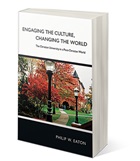
Pitzer College, a liberal arts school in California, will take secular education to the extreme this fall as it begins offering a major in secularism. Philip Eaton, president of Seattle Pacific University, seeks to counter the secular model of education with a model of life-giving learning in his new book, Engaging the Culture, Changing the World: The Christian University in a Post-Christian World (IVP Academic). Hunter Baker, associate dean of arts and sciences at Union University, spoke with Eaton about ways Christians can successfully engage the culture without necessarily blending in.
You say that the world needs the Christian university. How would you respond to secularists—or even some anti-intellectual Christians—who would disagree?
The demand at our schools has never been greater. This signals to me that there is something profoundly missing from the secular culture's commitment to education. We have something vitally important for the lives of students and for the health of our society. We have something more to offer them. I am convinced of this, despite the naysayers on both ends of the spectrum.
What about the drive toward seeing college as simply where we go to train for a job?
The university must be seen as a path toward productive lives. The Christian university must master, at the highest levels of excellence, the ability to equip our graduates with skills that matter in the world, abilities that allow them to contribute to society. At the same time, we want to equip them for both productive and meaningful lives. We want to provide them with a vision of human flourishing for their lives and for the world.
Several times you write about not giving students a "stone" instead of "bread." Is something like secularism, what Walker Percy calls "scientific humanism," the stone?
This metaphor is about our children, our students—the next generation. This is where Jesus puts the emphasis. He tells us that we have an enormous responsibility to teach children well, to equip them, to let them in on the secrets of the tribe, the teachings of our faith. All societies take education seriously. But in our time, we must take seriously both dimensions of this metaphor. There is education that is lifeless at the core: education that cares for skills to succeed in the world, but cares little about passing on a vision for human flourishing. Instead, we need an education that is life-giving, to our students and to the world—bread instead of a stone.
Secular thinking has hollowed out the soul of the educational enterprise. The masters of suspicion—Nietzsche, Freud, Foucault—have triumphed. Under their influence, we have an education based on suspicion about any story that seeks to participate in the true, the good, and the beautiful. The result is a life of suspicion, even cynicism.
You use the image of colliding maps of the world to illustrate the challenge of postmodernism. What is the key to finding a true map of reality?
Recovering the Resurrection is the key. As the Misfit says in Flannery O'Connor's short story "A Good Man Is Hard to Find," the Resurrection changed everything: If it is true, there is nothing to do but throw down everything and follow Jesus. If it is not, then why not live a life of meanness, selfishness, and destruction?
As we look at our surrounding culture, it is clear we have chosen a world without Easter. What would the world be like if Easter people once again asserted influence in the culture? That is the mission of the Christian university.
You place great value on community formation with regard to the study of Scripture and the pursuit of holiness. Is this a model for spiritual life at the university?
While I chose in the book not to focus on details of particular student programs, or how they relate spiritual life to academic life, I hope integration could be a new paradigm. At Seattle Pacific, we have tried to tap into deep roots of Christian history and teaching, by intentionally centering our reading, study, and worship on the Scriptures. History tells us this can have a profound shaping influence in the life of the community and the surrounding world.
Should the Christian university model holiness as a community?
Yes, I hope so. There is no more effective way to impact the world for good than by earnestly aspiring to be communities of trust, grace, hope, and holiness. People are watching. Universities are not the church. But we must continually draw from the deep and rich resources of our special tradition to create universities that truly matter to the world.
You talk about the divide in higher education in terms of two radio stations. One excludes God from consideration of public matters as a matter of course. The other nurtures a tribal type of Christian identity. You call for a work of translation.
Translation has to go both ways. As Scottish missionary Lesslie Newbigin argued so powerfully, we must learn the language of culture in order to translate the gospel into the culture. Our separatist tendencies encourage us to drop out of the culture altogether, skip the translation work, and rest on our clichés. Our accommodating tendencies make us shy about speaking the gospel at all. But we must find what I call the radical middle: to learn the culture through and through, and then to engage it boldly with the transforming gospel.

















 While we pray for peace, we need moral clarity about this war.
 A Christian reconciliation group in Israel and Palestine warned that war would come. Now the war threatens their relevance.العربيةFrançais
 We must always be people of the Word, but we’ll have to reimagine deep engagement with Scripture.






