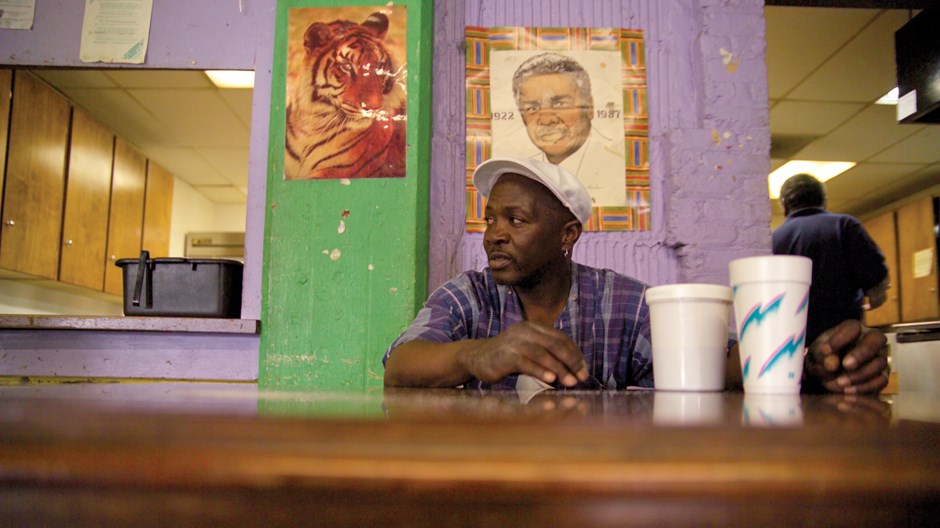
If you happen to be a homeless man on the South Side of Chicago, there are precious few places to go during the day to escape snow or rain or heat—the public library, the train station, and, until recently, Roseland Christian Ministries Center.
"For 20 years, we had a drop-in center," said Joe Huizenga, the ministry's director of development. "It was aimed at men in the Roseland community—homeless folks who have some sort of mental disability, maybe veterans who couldn't find services. Roseland had a high number of homeless and displaced men who had nowhere to go during the day."
Roseland Christian Ministries, which also runs an overnight shelter for about 80 women and children, worked with the Chicago Department of Human Services to staff the drop-in center. Doors were open from 9 A.M. to about 10 P.M. every day; about 80 to 100 men walked through them to find lunch, dinner, and a place to belong.
"It was just somewhere to go, something to do," Huizenga said. "It would give them a sense of community and belonging."
The benefit to the community was two-fold, he said. In addition to sheltering and feeding the men, the center worked for containment.
"The children and elderly folks who lived in the neighborhood didn't have 80 to 100 folks with drug addictions and mental illnesses on the street," he said.
The state paid Roseland $300,000 a year for staff and food supplies. Three years ago, the budget was slashed to $190,000. Huizenga cut the hours and number of meals. Doors were open just five days a week, from 9 A.M. to 5 P.M. Only one meal was served.
A year later, the state completely eliminated Roseland from its budget. A church in the suburbs stepped forward to help, giving enough money to staff the program for a few months. The hours were even shorter, from 2 P.M. to 5 P.M. each weekday. But it was not enough, and in June, Roseland had to shut the doors to the men's daytime shelter.
It is a story that's playing out in hundreds of places across the country this year. Since 2008, the recession has shrunk state budgets. At least 31 states have projected shortages for fiscal year 2012, a sum of more than $86 billion, according to the National Conference of State Legislatures.
Some of those shortages are enormous. Nineteen states report gaps of 10 percent or more of their general-fund budgets. Alabama and Nevada have shortages larger than 30 percent.
Thirty states have raised their taxes, while 46 have cut services, according to the Center on Budget and Policy Priorities. And assistance for the poor is not exempt from cutbacks—31 states have restricted health insurance eligibility or reduced access to health care for low-income children or families. Thirty states have cut expenses for medical or home care for poor elderly or disabled people, according to the Center on Budget and Policy Priorities.
"Human services isn't organized like, say, teachers," said Ron Baiman, director of budget and policy analysis for the Center for Tax and Budget Accountability. The services provided directly by the state and staffed by state workers can better maintain their funding than can community agencies and nonprofits, he said.
"Most of the actual services [in Illinois]—75 percent—are non-state-provided," Baiman said. "They're privatized, farmed out to nonprofits." This trend started in 2000 under the Bush administration, when many Christian charities and larger churches began signing government contracts to provide such services.
Since these faith-based groups are diverse and rely on multiple sources for financial support, it is harder for them to organize. They do not have a strong track record for moving legislation forward.
The same problem occurs on a federal level, said David Beckmann, president of Bread for the World. People who struggle to put food on the table and the groups that help them don't have a strong lobby in Congress, Beckmann said.
To raise awareness, Beckmann joined author-activist Jim Wallis (Sojourners) and Tony Hall (the Alliance to End Hunger) in a March 29 public fast that drew 15,000 participants as well as endorsements from top evangelical groups. Participants skipped at least one meal and committed to pray. In 1993, Hall raised public awareness when he undertook a 22-day water-only fast at a time of sharp government cuts in anti-poverty programs.
In addition, Bread for the World convened a small group of Christian leaders who wrote an open letter to Congress, calling its members to form a "circle of protection" around the hungry and the poor. More than 60 Catholic, mainline, and evangelical leaders have signed it.
In June, 300 Bread for the World members walked into the offices of their representatives in Washington, D.C., to ask that budget cuts exclude programs for the poor and hungry.
"We need to reduce the deficit, but shouldn't do it on the backs of the poor," Beckmann said. "It isn't necessary."
Article continues below
All the programs that help poor people add up to about 20 percent of the federal budget, he said. The House-approved budget cuts $4 trillion in taxes over 10 years, and a disproportionate amount of that (two-thirds) comes from programs focused on helping the poor, he said.
"It's just not right," Beckmann said. "Just the food stamp [program] … they're proposing to reduce by $130 billion over 10 years. Every church in the country is collecting and distributing food to hungry people. But it all amounts to about $5 billion in food. Five billion dollars in 10 years is $50 billion. Just the proposed cut to food stamps would take away from poor people more than twice of all the food that churches and charities can provide."
Instead, Beckmann said, cuts should be made in the other 80 percent of the budget. "There is nothing in the Bible that says you can't tax rich people, but there is a lot that says you shouldn't be hard on poor people."
Increasing Needs
At the same time budget cuts are squeezing relief agencies, more people are coming to them for help. "The tough times have really affected us," said Andy Bales, chief executive of Union Rescue Mission, which works to feed and house the homeless in Los Angeles. "We've tripled the number of families we serve since October 2008. We've doubled the number of people housed and doubled the meals we serve."
Other major Christian groups note the same worrisome trend. Salvation Army shelters and programs in the New York area have seen a 40 percent increase in clients since 2008, according to Major Evan Hickman.
Not only the poorest of the poor, but also "people who have never asked for help before" are coming for help, said Hickman. The "misery index"—the sum of the unemployment rate and the inflation rate—stands at 11.29, the highest it's been since the Reagan-era recession of 1984.
Cutbacks in city, state, and federal spending forced the Salvation Army to turn down contracts for adoption services and group homes in New York when the contracts came up for renewal. At the end of June, the Salvation Army expects to return one of the contracts to the Division of Juvenile Justice.
"[This program] has been about $600,000 in the hole each year, so we've had to make a critical decision," Hickman said. "We could not continue to operate with that severity of cutbacks."
Article continues below
The government's inability to pay for services is making Union Rescue Mission wary of doing business with the government, according to Bales. "We've not been paid yet" for the four winter shelters operated from December 2010 to March 2011, a loss of $305,000, Bales said.
"Not only will it not be paid in June, it looks like we may not be paid until after July. We don't know if we're going to be paid back at all for the work we did for the county and city."
Bales said the mission is actively considering how to increase private support, because there is greater risk that their seasonal shelters, which house up to 800 people each night, will be closed. "Our [break-even] margins are too small," he said. His organization is thinking of moving away from any dependence on government funding.
Emerging Partnerships
Moving away from that funding is not as easy as it might sound. Private charitable sources are also drying up. Total charitable giving in 2008 and 2009 fell a combined 13 percent from 2006 and 2007, the steepest decline in 40 years, according to Giving USA, a consulting firm for nonprofits. (Preliminary figures for 2010 show that giving rebounded 3.8 percent from 2009.)
'My church has significantly increased donations to the food pantry, because so many people are coming. At the same time, churches face the same economic pressures everyone else does, so there are of course limits.'—Galen Carey, National Association of Evangelicals
At Union Rescue Mission, it's the shrinking of gifts from individuals and corporations that is pinching day-to-day operations.
Some shelters are taking drastic measures, Bales said: charging for basic services. In April, the mission began charging $7 daily for a bed that used to be free. And, like Roseland in Chicago, the mission had to cut the number of meals served.
"It can be nearly a thousand people that we feed three times a day," Bales said. "We moved to one good lunch a day for everyone but families with children."
In addition to a private and public funding squeeze, the Salvation Army general fund, which pays for non-emergency services, loses momentum whenever donors switch the designation on their donations to "disaster relief."
"We did see a wonderful response to these disasters, the tornadoes and flooding, but those monies are separate," said Jeff Curnow of the Salvation Army in Chicago. "When they give to a disaster, that's all we'll use that for. We're hunkered down. There's no doubt about that."
Article continues below
A Salvation Army food bank that used to be open every morning is now open one day a week, Curnow said. A soup kitchen that provides hot meals to people in shelters or on the street had to reduce the number of meals served. Some Salvation Army offices are under a hiring freeze. Some ask employees to take a week of unpaid vacation. Travel is restricted, as are printing and supplies. Most offices have frozen pay increases, he said.
"We need to continue to keep things lean," Curnow said. "We're also convinced that God owns it all and that he will honor and bless ministries when we honor and bless him and do the right thing. So we always look at how we are doing our ministry—are we doing it in a God-honoring way, and do we trust him to provide for us?"
The hope seems to be that God will provide through other local agencies. Bales hopes other local missions will step up to provide the meals that Union Rescue Mission no longer can. "We know a couple other missions cut way back on services as the recession hit. Now that we're through the worst of [the recession], we're hoping they'll step up and do more meals."
Back in Chicago, Roseland is developing partnerships with three churches that will help provide more meals to the poor. Huizenga is also working informally with a neighborhood woman who provides two meals a week paid for out of her own pocket.
Another emerging model is to rotate services, where, for example, each church provides one meal per week. Huizenga said, "[It] becomes a pretty good opportunity for churches to come together around the least of these."
Asking churches and other charitable organizations to pick up the slack won't do the job of caring for the chronic poor completely, said Galen Carey, vice president of government relations for the Washington office of the National Association of Evangelicals.
"There is definitely more need," he said. "My church has significantly increased donations to the food pantry, because so many people are coming. At the same time, churches face the same economic pressures everyone else does, so there are of course limits."
Although some churches could give more, Carey said that all of a church's financial philanthropy represents a small response to poverty. "It doesn't in any way counteract the government budget cuts that—we believe—are not in keeping with the extensive biblical mandate to care for the poor."
Article continues below
Carey and other faith-based leaders believe the neighborhood church and local governments have very different responsibilities, but have at least one big goal in common—defeating poverty.
Sarah Eekhoff Zylstra is a freelance writer from the Chicago area.

















 While we pray for peace, we need moral clarity about this war.
 As my doubts about his teachings grew, so did a secret fascination with Jesus.
 NIL deals in college athletics present new challenges—and opportunities—for colleges and students.






