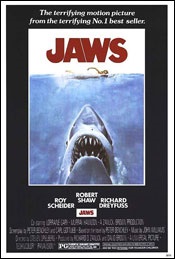
One morning when I was five, I opened the newspaper and suffered the most jarring fright of my childhood. It was 1975. An ad for the movie Jaws filled up a quarter of the page.
The infamous 'Jaws' poster
You know the poster: A razor-toothed predator rises like a missile toward the ocean's surface, where an oblivious woman is swimming.
The space between the beauty and the beast, that incredible unresolved tension—it set me to shaking. I was too young to see the movie, so I resolved my anxiety another way. I drew my own picture book, a series of sketches in which a fanged sea monster advances on a stick-man swimmer. At the last possible moment, the swimmer does what any good diver would do—he draws a sword and slays the shark. (Insert "x" for the dead creature's eye.)
That was my first encounter with the work of Steven Spielberg, who has two new films releasing this holiday season—The Adventures of Tintin, now in theaters, and War Horse, opening Christmas Day.
Little did I know in 1975 how influential Spielberg's films would become, or important his films would be to me. The shark was just the first of the scares that would shower the theatre floor with popcorn. But more importantly, he's inspired many of us to open-mouthed, wide-eyed wonder on more occasions than I have room to recount. And at his best, he's resisted his habit of happy endings and left us wrestling with hard questions and unresolved tensions.
Much has been written about Spielberg's directorial weaknesses. As a young fanboy, I defended him. But as I grew up and became a student of cinema's greatest artists, I eventually had to agree that Spielberg often soaks scenes in sentimentality until they're soggy (Hook); that his happy endings sometimes feel contrived, insufficient, even inappropriate (War of the Worlds, A.I. Artificial Intelligence); and that he has, at times, kept going when he should have called it quits (digitally revising E.T. for no good reason, or making Indiana Jones and the Kingdom of the Crystal Skull).
But let's not let that get in the way of acknowledging his strengths. I come to praise Spielberg, not to bury him.
Instilling a love of cinema
I could write about his influence as a producer, a studio executive, and a philanthropist. But I'd rather consider how he has instilled a love of cinema in generations of moviegoers, giving us many of the big screen's most wonderfully memorable sights and sounds.
Many directors have paid obvious tribute in their own films, most clearly in last summer's Super 8. J. J. Abrams' valentine to Spielberg's early blockbusters recreated the veteran's early '80s style even as it took inspiration from his childhood filmmaking adventures. (As a kid, Spielberg made a Super 8 movie that involved a simulated train crash using a model train.)
I suspect that most of us, like Abrams, could list many indelible images from the Spielberg films we've seen in theatres. Other than that shark fin breaking the surface of the water, what images come to your mind?
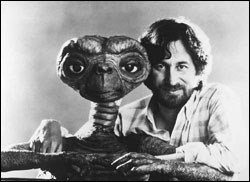
The director with his famous alien
Maybe you close your eyes and picture UFOs swooping over an awestruck community. A leathery extra-terrestrial lifting a luminous fingertip. Indiana Jones carrying a treasure like a tailback carries a football and sprinting one step ahead of a tumbling boulder. A furious Tyrannosaurus Rex seeking the chewy center of a tour-guide's truck.
Or maybe you recall more serious moments, those drawn from the shadows of the past. After all, Spielberg moved from visions of bloodthirsty monsters to far more fearsome revelations of humankind's own capacity for evil. You probably remember the little red-coated girl who caught Oskar Schindler's eye and broke his heart right open (Schindler's List), or the vision of American soldiers staggering through blood-clouded water, desperate to reach Normandy beach (Saving Private Ryan).
I'll never forget young Christian Bale's performance as a boy who delights in the sight of a fighter plane as it soars low over the prison camp in Empire of the Sun. And I'm haunted by Haley Joel Osment's turn as a suffering "mecha" in A.I.
But Spielberg's films are about more than just magical moments. There are powerful themes that bind all of these movies into a fascinating tapestry—a portrait of one man's fears, hopes, and questions.
Dreaming children, destructive adults
Spielberg's films convey a childlike spirit—and a severe distrust of adults.
His mother, a concert pianist and restaurateur, did not get along with his father, a computer engineer. Young Steven sought escape at the movies. He even crept around movie sets, determined to become a part of the process.
He did. And lo—he tells stories of characters who, betrayed by authorities, survive through cleverness until they surrender to the gravity of otherworldly wonders. Those wonders sometimes inspire reconciliation and healing. But when compromised by human pride, marvels turn destructive.
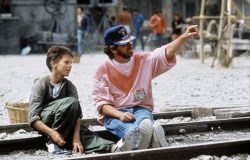
With Christian Bale on the set of 'Empire of the Sun'
Spielberg's big-screen children find easy access to enchantment (E.T.'s Elliott, Empire of the Sun's Jamie, Hook's lost boys). By contrast, his adult characters find illumination only when they humble themselves (Indiana and Henry Jones, or Close Encounters' Roy).
Article continues below
But none of his dreamers—whatever their ages—can save the world. In fact, some of them, following whimsy and adolescent recklessness, end up running into walls and learning that they have to grow up (Catch Me If You Can).
In Spielberg's world, redemption comes from mysterious sources—influences that restore us to a posture of humility and awe.
Sometimes it's the miracle of conscience. A German businessman (Schindler's List) and American soldiers (Saving Private Ryan) risk their lives to save others. Avner (Munich) strives for innocence in the corrupting business of covert operations.
Imagination itself can save the day too. The Terminal's Viktor sees an airport as a wonderland, turning tedium into opportunity. Catch Me If You Can's Frank Abagnale reinvents himself to escape the pain of his parents' disintegrating marriage.
Sometimes, it's an extra-terrestrial power. In E.T., a savior descends from heaven, delights children, suffers, dies, rises again, and ascends. In Crystal Skull and War of the Worlds, the aliens are not benevolent, but the marvels of their visitation help bring broken families together.
Healing can also come through a mysterious union of machinery and grace. In Close Encounters, hope comes—as James Lipton observed during an interview—in the form of a heavenly visitation, in which music (Spielberg's mother?) is reconciled with technology (his father?). In Empire of the Sun, a young prison camp survivor, betrayed by grownups, finds hope and joy in the spectacle of great American flying machines that scorch the air with gasoline and shake the heavens with their roaring engines.
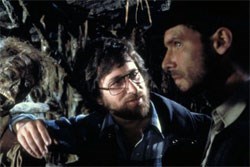
On the 'Raiders' set with Harrison Ford
And once in a while, it's divine intervention. In Raiders of the Lost Ark, an Old Testament Almighty judges evildoers, shows grace to a holy fool (of sorts), and restores order. In Amistad, the gospel gives hope to a battered slave.
Altars to an unknown god
While I stand with those who call Raiders of the Lost Ark the most enduring achievement of Spielberg's career, I think he is at his best when he is willing to give as much attention to human brokenness as he is to visions of magic and happiness.
Empire of the Sun is, in my opinion, an underrated masterpiece, transcendent in its sadness and longing. And I think Munich is his most mature work of storytelling. I also believe that the glory of Close Encounters' moving finale would be a much lesser thing without the film's portrayal of an irresponsible, conflicted dreamer (played by Richard Dreyfuss).
Article continues below
When Spielberg works at that level, his stories are something like prayers, or like extravagant altars to an unknown god. Regardless of their director's views, films like Close Encounters, E.T., Schindler's List, and Amistad—and even Catch Me If You Can with its "prodigal son" storyline—speak of our longing for healing, reconciliation, and redemption. They point us beyond the human sphere toward heavenly declarations, divine intervention, and acts of unnatural selflessness.
As Frederick Buechner wrote, "The world speaks of the holy in the only language it knows, which is a worldly language."
These films lead me to believe that Spielberg's best work may still be ahead of him.
He is now shooting his long-awaited film about Abraham Lincoln, with the great Daniel Day-Lewis playing "the great emancipator." And rumors are swirling that an epic about Moses might be next—a Ten Commandments for a new age of cinema. Can you imagine? Who knows what revelations may yet occur within and through his incredible—and unfinished—imagination?
But first, we this holiday season's double-feature.
The Adventures of Tintin marks Spielberg's first collaboration with Peter Jackson: a big-screen version of a comic book adventure they both loved when they were kids. Powered by lush animation and motion-capture technology, Tintin is about a boy carried away into wild adventures by unimaginable forces.
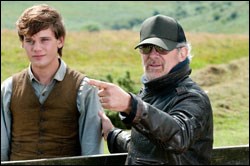
On the set of 'War Horse' with Jeremy Irvine
And then there's War Horse, an adaptation of a popular Broadway play, in which a young man bonds with a creature of majesty and mystery—a horse, this time—and their friendship carries them through literal battlefields.
Both look likely to be sentimental and heavy-handed. Both promise to reveal terrifying spectacles, as nightmarish forces bear down like hungry sharks upon vulnerable, childlike characters. They'll probably unite us again in a common longing for the reconciliation of the Machinery and Music—the contentious parental forces that struggle at the heart of every Spielberg endeavor. And they'll probably appeal to our longing for the restoration of a world where children of all ages can flourish.
But experts say it can offer opportunities for leaders and congregations to grow.
David Roach
The Fearsome and the Childlike in the Films of Steven Spielberg
1 of 5
The infamous 'Jaws' posterThe director with his famous alienWith Christian Bale on the set of 'Empire of the Sun'On the 'Raiders' set with Harrison FordOn the set of 'War Horse' with Jeremy Irvine












 While we pray for peace, we need moral clarity about this war.
 As my doubts about his teachings grew, so did a secret fascination with Jesus.
 But experts say it can offer opportunities for leaders and congregations to grow.