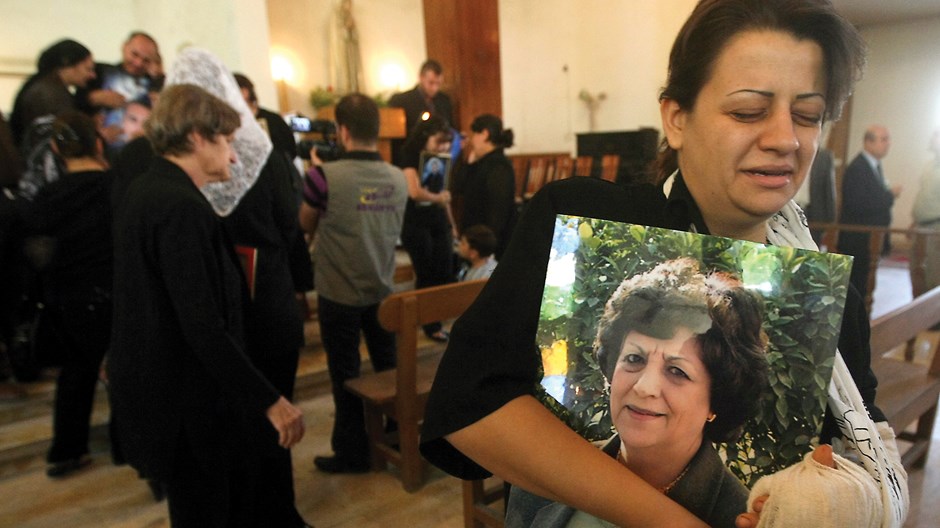
A ringing doorbell at the Baghdad home of an elderly Christian couple seemed innocent enough five days after Christmas. But when Fawzi Rahim, 76, and wife Janet Mekha, 78, opened their front door, a bomb exploded and took their lives.
The suspected militant attack was one of several on December 30, 2010, when 14 other Christians in Baghdad were seriously injured in their homes. The violence followed the October 31 attack on a Baghdad Syriac Catholic cathedral that killed 68 people, and a declaration by the Islamic State of Iraq, a terrorist group, that it was waging war on Christians.
The militant group claims that Egypt's Coptic Church is holding two women captive because they converted to Islam. Coptic leaders deny the allegations. Analysts believe the militants are using the "Egyptian women" as a pretext to attack Iraq's besieged Christian community.
Nina Shea, director of the Hudson Institute's Center for Religious Freedom, labeled the attacks a "ruthless cleansing campaign by Sunni, Shia, and Kurdish militants." U.S. State Department spokesman Mark Toner called on the government of Iraqi President Jalal Talabani and Prime Minister Nuri al-Maliki to swiftly "apprehend the terrorists behind these acts."
Pope Benedict XVI condemned the growing campaign against Christians in the Middle East in his New Year's Day homily: "In the face of the threatening tensions of the moment, especially in the face of discrimination, of abuse of power and religious intolerance that today particularly strikes Christians, I again direct a pressing invitation not to yield to discouragement and resignation." Benedict made these remarks hours after a car bomb outside a church in Alexandria, Egypt, killed 23 people.
The Vatican has repeatedly denounced the campaign against Christians in Iraq.
Departures Quicken
The United Nations agency for refugees in Iraq has recorded a significant increase in the number of Christians fleeing Baghdad and Mosul and heading for the northern Kurdistan Regional Government region and the northwestern Nineveh region. By the end of December 2010, more than 1,000 people had recently left these cities.
Although the Kurds are Muslims, they suffered severe discrimination under Saddam Hussein's regime. They now have an autonomous, Western-supported homeland in northern Iraq. Iraqi President Talabani, a Kurd, has gone so far as to suggest a similar homeland for Iraq's Christians. While many say the idea is a pipe dream, there remains a group of solidly Christian villages—including Banayeh, Telqais, Telleskof, and Merdi—some 25 miles outside of Mosul that are still considered safe; they are guarded by the Kurdish Peshmerga troops.
In Syria, Jordan, and Lebanon, the U.N. refugee agency's offices also report an increasing number of Iraqi Christians arriving and contacting the agency for registration and help. Updated numbers are not available.
Last year, Nellie, a 23-year-old Iraqi Christian, fled to neighboring Jordan from her native Baghdad after she was kidnapped and raped and then freed after her family paid a hefty ransom. Further traumatized after thieves tried to break into her tiny Amman apartment, Nellie (not her real name) can hardly count the days until she leaves for the United States, where she will be reunited with her mother and brother under a resettlement program.
Targeted by insurgents and Muslim militants since the 2003 war, a large percent-age of Iraq's ancient Christian population have fled their conflict-ridden country. Many fear that Iraq's centuries-old Christian community is on the verge of extinction.
"The 'religicide' of Christians holds disturbing parallels to a previous effort to eliminate Iraqi Jews in 1948," said Open Doors USA President Carl Moeller. "Many Jews fled and today virtually nothing remains of the once-vibrant community. People of all faiths must unite to prevent this from happening again. We must fight for freedom of religion for all imperiled faith groups in Iraq."
Breakup OF Historic Church
Some 196,000 Iraqi refugees are currently registered with the U.N. and are hosted in seven Middle Eastern nations. (Christians make up about a quarter of that figure.) However, that 196,000 figure comprises only refugees with active case files with the U.N. Not all refugees are registered, and some, faced with economic hardship, travel back and forth between Iraq and their places of refuge, where they cannot legally work.
Thousands of Iraqi refugees have also been resettled in the West by the U.N. More than one-third of the 53,700 Iraqis given asylum in the U.S. since 2007 are Christians.
In recent years, some 1.3 million Iraqis from differing religious backgrounds sought shelter in Syria, while more than 500,000 fled to Jordan. The Arab neighbor states opened their doors to the bulk of fleeing Iraqis, often taxing their own health and education infrastructures. Jordan already hosts hundreds of thousands of Palestinian refugees from successive wars with Israel. Smaller numbers of Iraqis have also gone to Egypt, Lebanon, and Turkey.
Article continues below
Iraqis are urban refugees. They do not live in refugee camps but must find their own accommodations. They often live off of savings or depend on relatives in the West to survive. Most are psychologically traumatized, having witnessed the killing, kidnapping, and rape of family members.
'The "religicide" of Christians holds disturbing parallels to a previous effort to eliminate Iraqi Jews in 1948.'—Carl Moeller, president of Open Doors USA
Barnabas Fund, an interdenominational Christian aid agency, estimates that Christians make up about 25 percent of the Iraqi refugee population in Syria. Archbishop Fouad Twal, the Latin Rite Patriarch of Jerusalem, says about 40,000 Iraqi Christians are in Jordan.
Despite talk of a dramatic decline in violence in Iraq after the U.S. poured in more troops in 2007 to quell civil war, Christians say their situation has not improved. Recent events support their claim.
Militants have kept up savage assaults with scores of roadside bombings and mortar attacks following a brutal massacre inside Baghdad's Our Lady of Salvation cathedral in late October.
Three days after the massacre, Uday Hikmat and his parents packed and left Iraq for Amman, the capital of Jordan. "We did not want to wait our turn to die," said the 33-year-old. They were joined by scores of other Iraqi Christians.
Baghdad and Mosul are the two Iraqi regions where a Christian population has resided since the first century A.D., when, according to tradition, the apostle Thomas introduced the gospel there. Most Iraqi Christians are Chaldean Eastern-rite Catholics who are autonomous from Rome but recognize the pope's authority. Also present are Assyrian, Roman, and Syrian Catholics; Greek, Syrian, and Armenian Orthodox; and Presbyterians, Anglicans, and many evangelicals.
Unacceptable Choices
The war against Christians began in 2003, when the U.S. invaded Iraq. The violence has included threats, kidnappings, bombings, murder—and now menacing cell-phone text messages. Militants accuse Iraqi Christians of collaborating with American and other Western troops—dubbed "invaders and occupiers"—despite the fact that the Iraqi Christians have lived in the region since the first century.
Article continues below
According to one church leader who spoke anonymously to Christianity Today, Muslim militants give Iraqi Christians three choices: One, they can pay money as jizya, an ancient tax imposed on non-Muslims. But experience has shown that militants just return for more when Christians pay the tax. Two, they can convert to Islam. Three, they can flee—which they must do within days of the ultimatum. The church leader said, "For people who have spent decades in an area and own a house, it's not easy for them to go. But if they hesitate, the militants will kill a family member, forcing them to leave."
That's what happened to one family with three children from Mosul, which has become a maelstrom of violence, said Margaret Holt, a Barnabas Fund worker. Holt said the family's 16-year-old son and 17-year-old daughter were kidnapped. The son was murdered, and the daughter was never seen again. The family left with their remaining son for Syria.
Just before the 2003 war, Christians made up some 1 million of Iraq's then-25 million citizens. Saddam Hussein viewed Christians as "peace-loving" and largely protected the historic community.
Although Iraq's Shiite-led government has voiced its support for the Christian minority, it has been powerless to offer protection. Unlike other communities, Christians are not part of Iraq's tribal social structure, nor do they have militias as do the Sunnis and Shiites. Thus they remain vulnerable targets.
In 2004 and again in 2009, a string of coordinated church bombings rocked the Christian community, already traumatized by the murder of several church leaders. In 2008, the body of Paulos Faraj Rahho, the Chaldean Catholic archbishop of Mosul, was found in a shallow grave after his kidnapping. A year earlier, his secretary and three other sub-deacons were murdered in what were clearly targeted attacks on Christians.
Most if not all Christian refugees believe returning to their ancestral homeland is impossible and see no other option than to resettle in the West.
Refugees At Risk
For those who do leave Iraq, life may be safer but not necessarily rosier in their adopted homes.
Arab countries, already suffering high unemployment rates, do not permit Iraqis to work legally. Those who do find jobs receive low to no pay for their services. Those who do not carry a U.N. card face possible deportation.
In conservative Mideast culture, young refugee women need to be under the protection of a male family member; when they aren't, they put themselves at considerable risk. Several cases are known in Syria of Iraqi Christian women who have turned to prostitution in order to make ends meet.
Article continues below
"We met a number of female refugees who have no protector because the father or brother was either dead or abroad. If there was one, they wouldn't be doing this," said Holt. "They are either completely alone or they have small children they need to support, and so they got into this lifestyle. It's tragic because it's not at all what they want."
The Barnabas Fund, working through local churches, helps these women and other vulnerable refugees. The U.K.-based Hope and Trust Fund helps resettle Iraqi refugees in Jordan and in the West. And Syrian and Jordanian churches, although not wealthy, distribute food and medicines to refugees and operate free clinics.
But an evangelical church that has distributed food monthly to 700 families in Amman for the past four years said it recently had to drastically limit its outreach. Because funding has run dry, the church can now offer aid to just 20 of the neediest families.
Education has been another obstacle for the refugees, who until recently were barred from attending public schools in Jordan. Some refugee children struggle to fit into similar age classes because of gaps in their school attendance. Others have been traumatized by events that took place at their schools in Iraq.
One father said his 7-year-old son's Baghdad school came under a grenade attack that killed two of his classmates. Though safely in Amman now, the son tells his father he refuses to attend school: "No, Daddy. I can't because it will be bombed." The man, a Christian convert from Islam who asked not to be identified, said his son has nightmares, unable to forget the blood he has seen.
Most if not all Christian refugees believe returning to their ancestral homeland is impossible and see no other option than to resettle in the West. For the most part, Christians are not given preferential treatment by countries taking in Iraqi refugees.
Two exceptions have been France and Germany. France received some 730 Christians following the death of Archbishop Rahho and scores more following the church attack in October 2010. Numbers for Germany are unavailable.
And at least one Iraqi Christian has vowed to stay and fight on. "These attacks express the contempt and hatred of terrorist organizations for Christians," said Yonadam Kanna, one of a handful of Christian lawmakers in Iraq's 325-member parliament. "Iraq is our country, and we won't leave."
Article continues below
Dale Gavlak is a journalist based in Jordan. John Stott Ministries has given a grant to Christianity Today to support reporting on international issues.
Recovering Church History: Exile from Babylon | The Iraqi Christian community, now nearly gone, was the church's center for a millennium. (December 31, 2008) Sins and Sorrows Grow in Mosul | For Iraq's Christians, a fearful Christmas amid shootings and a worsening humanitarian crisis. (December 15, 2008)
Have something to add about this? See something we missed? Share your feedback here.















 While we pray for peace, we need moral clarity about this war.
 As my doubts about his teachings grew, so did a secret fascination with Jesus.
 We must always be people of the Word, but we’ll have to reimagine deep engagement with Scripture.






