Hayden Christensen, Thandiwe Newton, John Leguizamo
Theatre Release
February 05, 2011 by Magnolia Pictures
One fateful day in Detroit, a news reporter named Luke (Hayden Christensen) awakens in an empty apartment. His girlfriend is missing and the power is out. Things become more disquieting when he reaches the lobby, piles of clothing and personal belongings the only mysterious evidence of people's existence. Things are just as desolate in the city street, where empty cars are strewn about in chaos after driverless accidents. Moments later, a jetliner interrupts the quiet, dropping from the sky just miles away.
The Rapture? If only.
Vanishing on 7th Street begins with a premise all too reminiscent of the first Left Behind book or Stephen King's The Langoliers. It prepares us for an intriguing movie steeped in mystery, creepy ambience, and deep moralizing among the characters about what they think is happening, all befitting of classic Twilight Zone or an M. Night Shyamalan movie. But Vanishing ultimately proves a hollow and frustrating experience—it's all setup with no payoff.
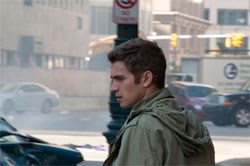
Hayden Christensen as Luke
Luke's introduction would have made a stronger opening to the film. The same might be said of Rosemary (Thandie Newton), a physical therapist working at the hospital when the lights go out and all hell breaks loose—her 9-month-old baby is missing, along with everyone else. Instead, things begin awkwardly in a movie theater with film projectionist Paul (John Leguizamo). Maybe the idea was to spook out the Vanishing filmgoers, but clunky dialogue and stilted acting keep the scene from working like it should, while revealing too much too soon.
Regardless, these three characters are eventually drawn to a bar on 7th Street—one of the few places left with working power thanks to a gas-powered generator—where they find 12-year-old James (Jacob Latimore). They seek refuge in the light away from growling, shadowy shapes in the dark (reminiscent of the evil spooks from 1990's Ghost) that whisk people away when the power goes out. This darkness grows stronger every day with increasingly less daylight, and battery powered flashlights will only get them so far.
Most of the film is spent in the bar with the four characters arguing about what they should do next and how to escape. One of them, of course, asks the obvious question: "Why are we the ones left behind?"
Thandie Newton as Rosemary
To reveal more would be a spoiler, but these questions arose during the film: Do these four characters share something in common that has brought them together? What are the whispering, Lost-like voices they hear in the dark? Is the widespread darkness confined to Detroit, or is the rest of the world affected? Does it matter that these four characters have biblical names? Is the darkness accidental or purposeful? Is the nearby church with light emanating from it important? Are the characters stuck in an alternate reality? Is their fate somehow related to what happened to the lost colony of Roanoke? And why do characters cannibalize electronics for batteries when they could simply loot the nearby convenience store?
Director Brad Anderson has done well with staging terror and suspense, from his creepy film debut Session 9 to several recent episodes from the TV series Fringe. To his credit, he does the same for Vanishing, preying on our inherent fear of the dark, the unknown, and death by playing with light and shadow while also creating a sense of claustrophobia among the characters in the bar.
Jacob Latimore as James
The actors also give it their all. But Christensen's character is highly unlikable, Leguizamo is unusually understated yet still annoying, and Newton alternates between a heart-wrenching and overacted performance.
Vanishing's potential, however, is primarily undermined by a half-baked story and script. The film is alarmingly inconsistent with the rules of its premise. No matter how fresh the batteries or how stable the generator may seem, the lights always seem to flicker at inopportune moments, only to restore when necessary. It all quickly becomes tiresome to watch.
For that matter, Christensen's character seems incapable of holding a flashlight for long periods of time. Most annoying is the way people seem to "outrun" the darkness in some scenes; in others, people disappear the instant they're outside the light.
John Leguizamo as Paul
It amounts to a movie that's more silly and dull than scary and provocative. Some critics have praised Vanishing for keeping things subtle without needing to answer questions. All well and good if the movie staged some truly frightening and suspenseful moments, but most of the scares are predictable and the situations rely on boneheaded decisions by the characters. If a movie is all about the journey, not the ending, then that journey needs to be compelling.
Leaving things left unexplained in this movie is like reading Agatha Christie's Ten Little Indians without reading the final chapter explaining whodunit and how—it nearly renders the story pointless. Though Vanishing on 7th Street may earn praise for Anderson's ability to stage a creepy scenario, most people looking for purpose to what they've seen will feel left behind.
Article continues below
Talk About It
Discussion starters
Why do so many of us fear the dark? Is it the absence of light or the fear of what might be concealed in the darkness—the fear of the unknown?
What struggles or sins are the four characters wrestling with? Do they experience a change in character before the end of the movie? What do you make of the film's last five minutes, particularly the shadowy people shown whispering?
Luke tells James that maybe this darkness is the start of a new beginning rather than the end of everything. Which do you think it is at the end of the movie, and why?
Compare and contrast this movie's scenario with a biblical understanding of the End Times. What does the Bible tell us the last days will be like? Should we fear the end or look forward to it with expectation?
The Family Corner
For parents to consider
Vanishing on 7th Street is rated R for language, including profaning God's name and the f-word. Characters are also seen smoking and drinking. The scares rely on creepy ambience and the threat of shadows rather than blood, gore, and violence. One character has blood on his forehead from a head injury and a hospital patient awakens from surgery in an empty operating room with a hole in his chest. Otherwise, people disappear in the darkness with barely a chance to cry out, leaving only their clothes behind.
















 While we pray for peace, we need moral clarity about this war.
 We’ve got little information on Jesus’ appearance and personality. But that’s the way God designed it.españolFrançais
 NIL deals in college athletics present new challenges—and opportunities—for colleges and students.