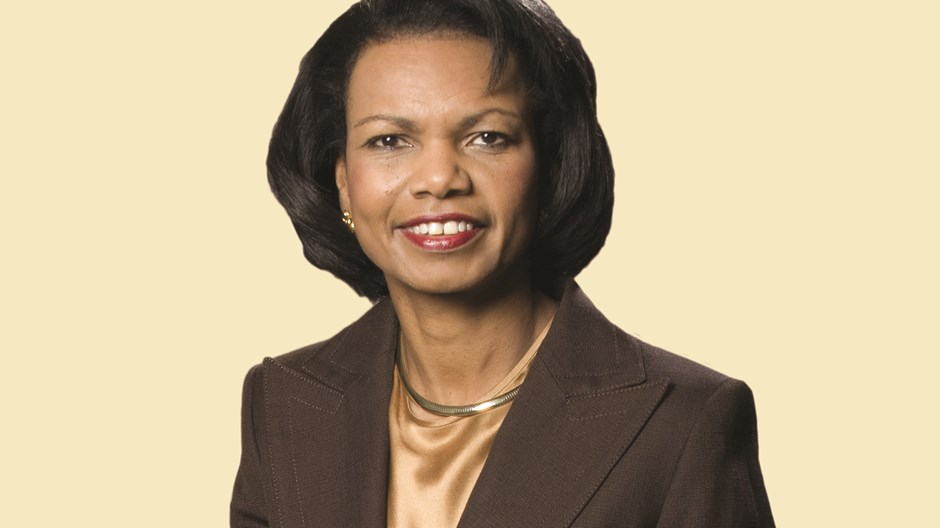
Condoleezza Rice was attending her father's church when a bomb exploded just a few blocks away at Sixteenth Street Baptist Church in 1963. Extraordinary, Ordinary People: A Memoir of Family (Crown), recounts the segregation the former secretary of state experienced, and her life as the daughter of a Presbyterian minister. She spoke with online editor Sarah Pulliam Bailey about faith and foreign policy during her book tour in New York City.
Did the racial tensions you experienced as a child have any impact on your faith?
The church was so much the center of our lives in Birmingham, the center on Sunday, the center on Tuesday, the center on Thursday. I don't know that any of us could have gotten through that period without tremendous faith.
As someone who never had a time when you didn't have faith in God, how do you think your spiritual journey is different from that of someone who had a more defined conversion experience?
Every spiritual journey is different in some sense. It's a matter of circumstances. My spiritual journey is one of trying to deepen that faith, trying to struggle with it, as my father taught me to do, not to become complacent.
You say in the book you never had a specific crisis of faith. But has your faith been challenged over the years?
Oh, sure. I've certainly felt like everyone does when something bad happens—"God, how could you let this happen to me?"—which is always our first response. But I always realize that maybe I had been prepared throughout my life to deal with these challenges from a position of faith.
Before you worked in government, did you feel like God was directing you toward public service?
I don't think somehow intellectually that God said, Okay, you're going to quit piano and become a Soviet specialist. It's a combination of circumstances and making choices, but I've always tried to seek guidance. I think I've been much more capable of dealing with ambiguity and what might come in the future as a result of faith.
Do you look to your faith for how you deal with foreign policy?
I just ask for guidance. I can remember in difficult times, like when things were really bad in Iraq, I would not say, "Lord, can you help me figure out this problem?" but, "Can you somehow show us a way out of this?" That's how I think about it, not specific answers to specific questions.
You have articulated a concern for international justice and peace. Do you feel like those values are an outgrowth of your faith?
It's also an outgrowth of my Americanism. But one that I am strongly attracted to, probably because of my faith, is religious freedom. That for me is a kind of test of whether or not a country's just.
In the past you said you worry about the government trying to legislate morality, and you know that evangelicals care very much about the issue of abortion.
I'm generally pretty libertarian in these matters, because Americans are quite good, actually, at finding a way to deal with these extremely divisive and difficult moral issues. And it's not that I'm a relativist. It's not that I believe everybody has their own morality. But I do understand that there are different ways of thinking about how these issues are going to play out in people's lives, and I tend to give people the benefit of the doubt in governing their own lives. Sometimes when things are out of whack the government has no choice but to step in. But I'm wary of the government stepping in to too many issues.
Was there a time when you came to a place on that issue, where your faith informed your position on abortion?
I'm still coming to terms with it. I don't like the government involved in these really hard moral decisions. While I don't think the country is ready for legislation to overturn Roe v. Wade, certainly I cannot imagine why one would be in favor of partial birth abortion. I also can't imagine why one would take these decisions out of the hands of the family. We all understand that this is not something to be taken lightly.
Same-sex marriage is another issue that has captured the country's attention in recent years.
I have lots of respect for people on both sides of this divide, because there are really hard issues. I don't ever want anybody to be denied rights within our country. I happen to think marriage is between a man and a woman. That's tradition, and I believe that that's the right answer. But perhaps we will decide that there needs to be some way for people to express their desire to live together through civil union. I think the country, if we can keep the volume down, will come to good answers.
When Hillary Clinton talks about her faith, she says, "I don't wear it on my sleeve." How do you talk about faith as a public figure?
There are very few people who don't know that I'm Christian. I don't have any desire to hide it or to say you don't need to know that about me. I also recognize that it's not something that one talks about in every sentence that you utter, because then people start to mischaracterize and start to caricature those of us who are Christian. You really want to know me? You need to know that I'm a devout Christian. But I'm not going to lecture you about it on a daily basis.
Article continues below
One of your friends read an article about you and said, "You're not an evangelical Christian," and you said "Yeah, but I am." How can evangelicals speak with conviction without alienating others?
It's extremely important not to assault people. I gave a sermon about the extraordinary variability in the way that Christ approached different people when he was giving a message. He kind of confronts the young ruler: "It's easier [for a camel] to pass through the eye of a [needle] than for a rich man to get into heaven." Even Christ tried to meet people where they were rather than just being harsh with everybody. He speaks to the woman at the well. Sometimes I think evangelicals come at people so hard and so fast and don't take time to listen to where somebody is. We can just try to have a lighter touch sometimes.
You said you had theological debates with your father: "We exchanged views on everything from the teachings of Paul, about which my father had some reservations, to the horrors of Revelation." Do you still wrestle with some of the Bible's teachings and its theological implications?
Sure. The Bible is at the core of our faith, and it's the core of my faith. Yet I can remember particularly wrestling with the relationship between the God of retribution, anger, and judgment in the Old Testament and the God of redemption and grace in the New Testament. Since I'm a Christian, the birth of Jesus Christ explains that link. We all struggle with some of the representations of women in the Bible, and yet I know and find remarkable that at the beginning of the faith, Christ's resurrection, it's women who are chosen to tell the first story.
Church has played an important role in your life. How does your current involvement impact your spiritual growth?
I want to get to a regular enough life that I could actually do Bible study, because Bible study is really essential. I've tried reading the daily passages, and I fall off or I don't really engage it. But whenever I've been in a group, it adds to my understanding.
Article continues below
A few years ago, you said you wanted "to figure out what the role in all of this is of profession and proselytizing [and] being a contagious Christian."
The contagious Christian is what I'm trying to understand better, but I think you do it through deeds not words. You try to live a life that makes people say, Oh, that's a life I'd like to emulate. Then they realize your faith is somehow linked to it.
How does your understanding of religion help you deal with the interplay between religion and foreign policy?
It helps to have both a historical and theological understanding of the children of Abraham and the relationships between Muslims, Jews, and Christians. I personally think that Israel is remarkable. It would not exist but for the toughness of the people and the grace of God. Yet Jerusalem is a place where the great religions don't so much come together; they clash there. You suddenly realize the extent to which man will go to use God for his own purposes rather than the other way around. That for me is the most terrifying thing about the combination of religion and politics, because that is really when man is trying to use God for his own purposes. That's why I don't see any conflict with being Christian and wanting to see a Jewish state, being Christian and believing there can be a Palestinian state, because the state is the state. When you start to try to infuse it with God's purpose you almost always get in trouble.
How do you distinguish between someone who's trying to use God for his purposes and when the person feels like God is speaking to him or her?
I'm always careful with people who assume God is speaking through them. It proves out over time, because essentially if God is speaking through you to put other people down I rather doubt it. That's not the God I know. And if God is speaking through you to hold yourself above others or your own kind above others then I doubt it.
Is there anything else you want to add about evangelicals or the interaction of faith and policy?
Let me be clear. I'm evangelical and I'm proud of it. I consider an evangelical to be someone who professes faith in a way that draws others to it. It's interesting because here we have separation of powers and separation of church and state, but we are the most religious people in the world. It serves us well, because when you're religious you at least know that you have to answer to some higher calling than your own whims or desires. When that's the case, you're also more cognizant of your responsibilities to care about those who have less. The United States has been served well by its religiosity, and I'm very, very unabashedly proud of how religious a people we are.















 While we pray for peace, we need moral clarity about this war.
 As my doubts about his teachings grew, so did a secret fascination with Jesus.
 C.S. Lewis recommended discernment over diatribes in exactly the moments we’re most eager to indulge in critique.






