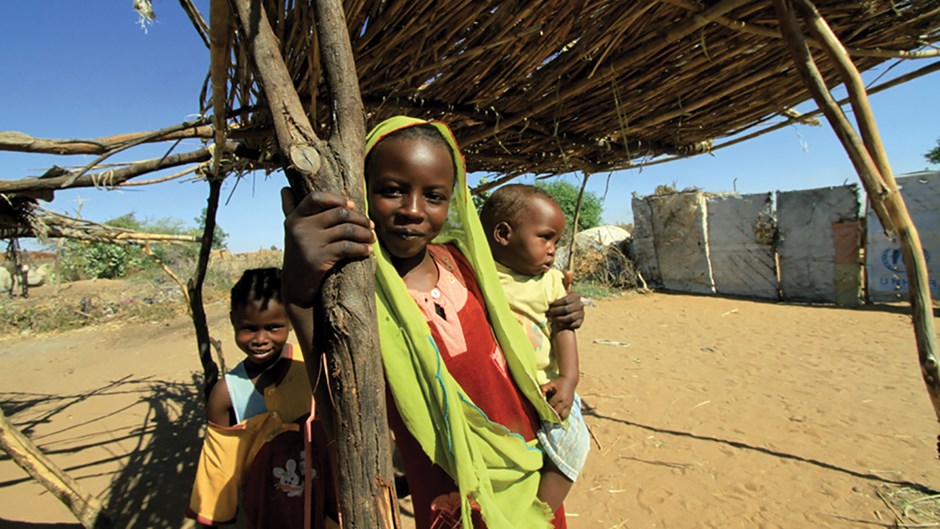
On October 23, I was one of 32 people crowded into the temporary office of the World Evangelical Alliance at Cape Town 2010. Twenty-eight of the people were representing the evangelical community of Sudan at what has been hailed as the most diverse gathering of the church ever. The rest of us were there to hear our Sudanese brothers and sisters' hopes and apprehensions as they approached the January 9 referendum on separate statehood for southern Sudan.
The Sudanese representatives said, "Pray, pray, pray." Pray for a fair and free election, without violent incidents or intimidation. As they took turns speaking, almost everyone earnestly repeated that phrase. They meant it.
After 50 years of civil war, southern Sudan has enjoyed a limited peace. The chance to vote for independence was guaranteed in the 2005 peace agreement, but these church leaders were worried.
Whether the southern Sudanese vote for independence from the North or for continued national unity, they have no control over reactions from the government or its proxies. One church leader who lives near the border later told me of a deadly October 31 border skirmish. As northern forces massed near the border, nervous southerners had begun digging defensive fortifications. Northern soldiers crossed the border and shot two southerners who had wielded only shovels. The incident highlights the sense of threat the southern Sudanese feel before this election. Major violence could erupt.
Given south Sudan's history, independence seems attractive. Until the mid-19th century, the South was largely isolated by the great Sudd Swamp. But then a route was opened through the swamp. Missionaries, slavers, and ivory hunters descended. All 46 missionaries died from disease. Then even northern pockets of Christianity disappeared after 1881, when a Muslim religious teacher proclaimed himself the divinely chosen leader Muslims expected to restore true religion in the last days. His followers carried out a purge.
Christian missionaries returned to Sudan after Britain and Egypt established a new colonial government in 1899. Fearing violence, however, the Brits forbade the missionaries to spread the gospel among Muslims. They allowed only educational and medical work. These restrictions encouraged missionaries to go south, where Islam was less dominant. There, British policy established English as the official language for education. The British also assigned territory to each denomination in the hopes that a Christian south would counterbalance a Muslim north.
When Sudan gained independence in 1956, Khartoum began to aggressively Islamize the South. The government nationalized mission schools, mandated Arabic rather than English in education, and changed the day of rest from Sunday to Friday.
The Sudanese representatives said, 'Pray, pray, pray.' They meant it.
In the 1960s, political turmoil and social dislocation combined with faith to produce explosive church growth. Regime change in the North brought new restrictions on missionaries and then outright expulsion. Massacres by out-of-control northern soldiers created massive migration. Nevertheless, in the absence of missionaries, youthful and evangelistic congregations began to flourish. As former missionary Andrew C. Wheeler wrote, "Christian faith and a southern identity became virtually synonymous."
Last summer, Duke Divinity School's Jason Byassee observed the vibrant churches around the southern capital of Juba. In an essay for Books & Culture, he wrote of southern Sudanese preachers who identified independence with God's will. "On January 9, we will be like the Israelites marching to freedom," one preacher said. "God put into motion his plan to free southern Sudan from the North …. [A]s we walk into freedom in January 2011, we recall that the plan for freedom is God's; yours is to be obedient."
This rhetoric promotes an idea the Sudanese leaders I heard are desperate to downplay. If Khartoum sees southern independence as a Christian issue, things will be much harder for Christians in northern Sudan. The government may take away Christians' access to social services, health care, and education, and could turn a blind eye to anti-Christian mob violence.
In our Cape Town conversations, church leaders repeatedly emphasized that they were only calling for a fair and free election. Unlike the preachers Byassee heard, they stressed church neutrality. If they told their people how to vote, they said, northern believers would risk being tagged as disloyal.
If the southerners vote for independence, it will be important for us to become advocates for Christians in the North. Northern Christian leaders say they fear they will be forgotten, and without international advocacy, they would be subject to Khartoum's deadly caprice.
Pray for the Peace of Sudan | The World Evangelical Alliance's Geoff Tunnicliffe talks about efforts to ensure a fair and peaceful election in Sudan and calls for a world day of prayer for the safety of believers there. (November 22, 2010)
Suffering in Sudan | Church leaders ask for prayer and advocacy at Cape Town 2010. (October 23, 2010)
Election Jitters | Sudanese Christians hope nation will hold together until 2011 referendum. (April 6, 2010)
Have something to add about this? See something we missed? Share your feedback here.
David Neff was editor in chief of Christianity Today, where he worked from 1985 until his retirement in 2013. He is also the former editor in chief of Christian History magazine, and continues to explore the intersection of history and current events in his bimonthly column, "Past Imperfect." His earlier column, "Editor's Bookshelf," ran from 2002 to 2004 and paired Neff's reviews of thought-provoking books and interviews with the authors.


















 While we pray for peace, we need moral clarity about this war.
 We’ve got little information on Jesus’ appearance and personality. But that’s the way God designed it.españolFrançais
 NIL deals in college athletics present new challenges—and opportunities—for colleges and students.






