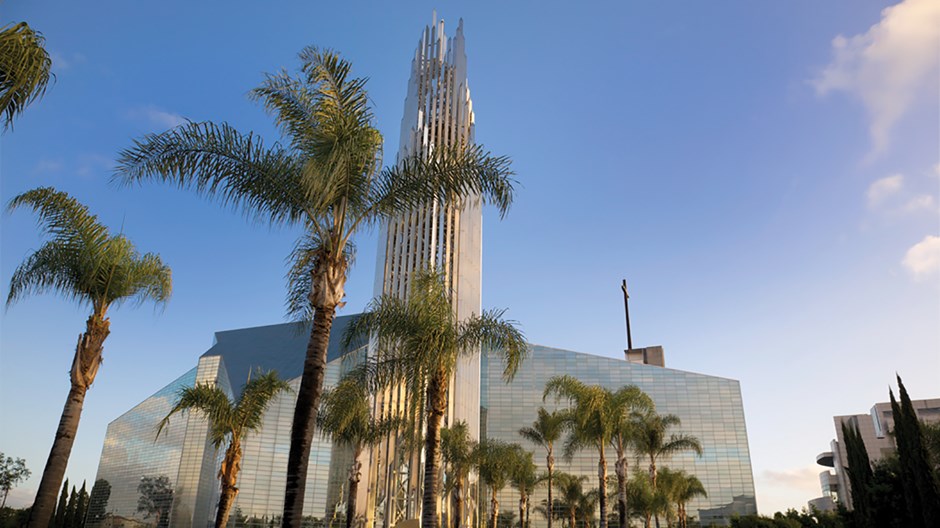
This past October, the megachurch prototype of the late 20th century filed for bankruptcy. A 24 percent drop in donations and a $50-$100 million debt owed to more than 550 creditors forced the Crystal Cathedral to file. It was a poignant moment in the history of modern evangelicalism.
Robert H. Schuller's famous Crystal Cathedral was built on a foundation of self-esteem. In a 1984 interview with Christianity Today, Schuller said that when he came to Garden Grove, California, in 1955, he asked himself, "What human condition exists here that I can have a mission to?" His answer was "emotional hunger." "Because of that," he said, "we have developed our present ministry."
That ministry increasingly was defined as the gospel of self-esteem, which for Schuller meant "the divine dignity that God intended to be our emotional birthright as children created in his image." It was lost in the Garden of Eden, he explained, but "we hunger for it until we regain it through faith in Christ."
Over the years, many people have caricatured Schuller's theology. Indeed, there has been much to criticize. To be fair, it was more nuanced than many critics imagine. Schuller's root concern from day one was emotional hunger, and the answer was helping people gain a positive self-image, albeit in Christ.
Schuller was tapping into themes of the human potential movement, the rage in the 1960s and '70s, when Abraham Maslow's theories deemed self-actualization the highest expression of human life. Schuller put a biblical and theological spin on it all and, as a result, attracted many to faith in Christ.
The mystery of why and how people come to faith is just that—a mystery.
But already in Schuller's day, there were concerns. The most scathing critique of this general cultural mood was from Christopher Lasch, who noted, particularly in The Culture of Narcissism, that the new therapeutic culture was leaving people trapped and isolated in the self.
It's like building a state-of-the-art structure. Technology moves at such a rapid pace that as soon as you move into the new building, you immediately find yourself stuck with an architecture that is already technologically dated, if only in small degrees at first. It isn't long before another developer announces plans for something even more state-of-the-art.
Today both the Crystal Cathedral and the theology that undergird it seem woefully inadequate buildings in which to house the gospel. In an age deeply sensitive to energy conservation, a glass house of worship is a sinful extravagance. In a culture increasingly addicted to the self, the gospel of self-esteem is clearly part of the problem. In short, the Schuller enterprise is filing for bankruptcy on more than one front.
Some are tempted to hit the man while he is down, but this is unwise. Robert Schuller is not the problem—contemporary evangelicalism is. Schuller was only leading the parade of those who believe they are responsible for making the gospel relevant. The lesson is not that Schuller got it wrong or that his theology is out-of-date; it is not that we just need to find a better, more current point of cultural contact. The lesson is that our attempts to find and exploit a point of cultural contact inevitably end in bankruptcy.
This does not deny the need to talk about the gospel in language and thought forms that a culture understands. In fact, we cannot avoid doing this—we are culturally and linguistically bound, ultimately unable to get out of our own skin and see the world in any other way. But we must repress every fearful thought that suggests that making the gospel relevant and meaningful rests on our shoulders. The mystery of why and how people come to faith is just that—ultimately a mystery. Spiritual directors long ago discovered what theologian Karl Barth noted: "As God awakens man to faith by his Holy Spirit, he himself posits the necessary point of contact." Or, as Peter put it, in describing the conversion of the Gentiles: "God, who knows the heart, bore witness to them, by giving them the Holy Spirit …" (Acts 15:8, ESV).
In fact, it is not only the listener who is deaf and blind to the gospel. The church is equally handicapped, especially regarding what will "work" to achieve genuine conversion. But—God be praised—we have a God who makes the deaf to hear and the blind to see! In every age and every culture, we are wise to trust the God who is rich in mercy and is able to accomplish through his Word that which he intends.
See the latest on the Crystal Cathedral in the Orange County Register.
Previous stories from the Crystal Cathedral include:
Crystal Cathedral Files for Bankruptcy | Crystal Cathedral Ministries, which owes about $7.5 million to unsecured creditors, filed for Chapter 11 bankruptcy this morning, according to the Orange County Register. (October 18, 2010)
Article continues below
Crystal Cathedral Apologizes for Debts | Crystal Cathedral leaders met with vendors and creditors on Friday to discuss debt payments after businesses filed lawsuits against the California megachurch, alleging that it owes $2 million in unpaid services. (April 12, 2010)
Q & A: Robert A. Schuller | The son of a famous evangelist tells CT why he left The Hour of Power. (June 19, 2009)
Schuller's Eldest Daughter to Lead Crystal Cathedral | The Orange County Register and the Los Angeles Times reported late yesterday that Sheila Schuller Coleman, eldest daughter of the Rev. Robert H. Schuller, will become "co-leader" with her father of the Garden Grove, California, church. (June 11, 2009)
Have something to add about this? See something we missed? Share your feedback here.















 While we pray for peace, we need moral clarity about this war.
 As my doubts about his teachings grew, so did a secret fascination with Jesus.
 After lobbying from fellow Southern Baptists and Christians affected by the war, the House speaker moves a package forward.






