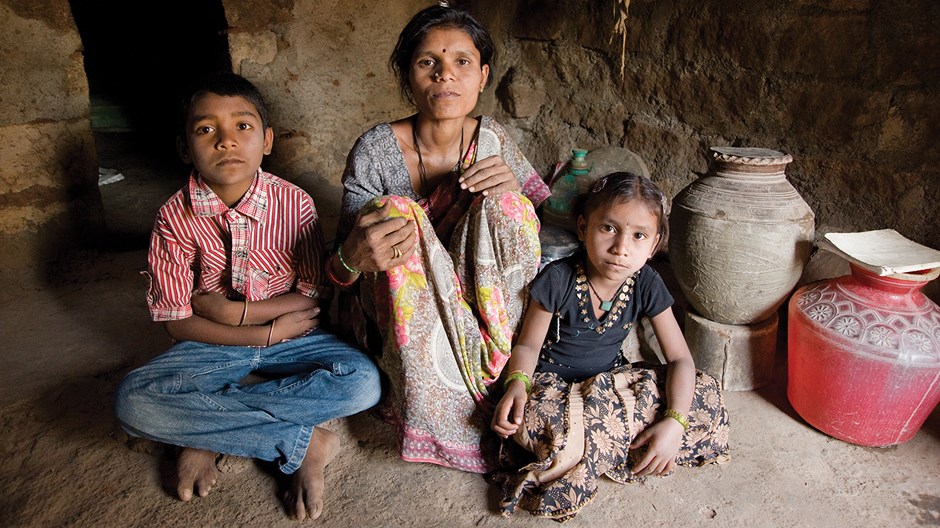
Shivamma stands in front of her house, braiding her little girl's hair. Her feet are bare, her sari is simple, and she is rail thin, but she speaks to visitors with boldness. She is the face of the new Christianity in India.
Shivamma's home is nestled inside a concrete storm sewer discarded by the factory where she and her husband work. The neighborhood, hidden in an overgrown back lot, consists of huge pipes lined up like mobile homes. Her family of four lives within 84 square feet.
For a Dalit and a woman, Shivamma is doing well. In traditional Hindu thinking, Dalits are not quite human, lacking the right to enter the temple, read, or eat with members of other castes. A person who touches a Dalit must immediately purify himself. (One church planter notes the awful exception: "When it comes to social life, they are untouchable. For rape, they are touchable.")
To be Dalit is much worse than being poor, for no matter how much education or wealth a Dalit accumulates, he or she remains polluted, a shame on the face of the earth. Dalits are like biblical lepers, except that in mainstream Indian culture, they cannot be healed. "Not even God can save them from pollution," the Catholic Dalit advocate A. Maria notes sarcastically.
But although Shivamma comes from generations of people accustomed to bowing and disappearing, she does not cringe any more. She came to the pipe village as a new bride 11 years ago, seeking to escape the jobless poverty of her home village. She and her husband together make $5 a day, more than most Dalits.
For three years she was barren.
Then, a young Dalit Christian named Bangarraju (most Dalits are known by a single name) came to Shivamma's home to pray for her. "I didn't know why he came or to whom he prayed. I thought Jesus was one of the gods." She conceived and gave birth to a son, and later had a second child, a girl. When her daughter was three months old, the girl became severely jaundiced, passing blood. Bangarraju came to them and prayed again, and the daughter was healed.
"I realized that Jesus is the living God," Shivamma told Christianity Today.
"We used to drink and every day we would fight, fight, fight. Jesus Christ brought peace to our family. I have no fear, because I have come to know the living God. I trust him."
An evangelist and church planter, Bangarraju began outreach in the pipe village in 1996. He taught illiterate children in an informal school that met under a tree. He arranged for weekly medical visits through his sponsoring organization, Operation Mobilization. For his first year visiting the village, Bangarraju said nothing about Jesus. It was three years before he baptized a convert. Now a large proportion of the pipe village follows Christ.
Over the years, Bangarraju did more than preach Jesus. He helped Shivamma and her husband learn the discipline of saving. The couple has managed to buy a house in their ancestral village. For the foreseeable future, Shivamma is happy to live in her pipe, rent free.
Yet for her children she dreams of much more: the education neither she nor her husband received. She is determined that they learn English and rise above the pipe village. "We don't want them to suffer as we have."
Opportunities Abound
With a new India rising up, a different kind of Indian Christianity is rising up with it. During a three-week journey across India, I discovered a vibrant, growing Christian community unfolding at the grassroots—a church thoroughly Indian, not Western.
The new-economy India is found in gleaming office towers where techsavvy Indians compete in a global market and climb the corporate ladder. The newly Christian India is found mostly at the bottom rung of society, among men and women like Shivamma, typically poor and illiterate "broken people" (the literal meaning of Dalit). Numbering 140 million or more, Dalits and Tribals (a grouping similar to the Dalits) have begun to shake the foundations of India's social order. They think in ways their ancestors never could have imagined. More of them are following Christ than at any other time in India's history, ministry leaders told CT.
India's church has grown and is getting larger. It now comprises over 70 million members, according to Operation World. That makes it the eighth largest Christian population in the world, just behind the Philippines and Nigeria, bigger than Germany and Ethiopia, and twice the size of the United Kingdom. Unlike believers in those countries, however, India's Christians live among one billion Hindus.
Opportunities for spreading the Good News seem to be everywhere. Operation World counts 2,223 unreached people groups in India, over five times as many as there are in China, the next most unreached nation. "India, Afghanistan, and Pakistan make up the largest concentration of unreached humanity in the world," says Operation World's Jason Mandryk.
Article continues below
Across the vast nation, a visitor hears of unprecedented numbers of people turning to Christ. Operation Mobilization, one of India's largest missionary groups, has grown to include 3,000 congregations in India, up from 300 in less than a decade.
A hospital-based ministry in north India has seen 8,000 baptisms over the past five years after a decade of only a handful. Operation World's detailed statistics show that the Indian church is growing at a rate three times that of India's Hindu population.
Many Indian Christians say that doors closed for centuries are swinging open.
The 2001 Indian census placed Christians at just over 2 percent of India's population. But currently, Operation World puts the figure near 6 percent and notes that "Christian researchers in India indicate much higher results, even up to 9 percent." Many Indian Christians say that doors closed for centuries are swinging open.
No one can be certain of such trends in this vast and complicated country. Religion statistics are poor, and enthusiastic reports from mission organizations may reflect only local conditions.
Todd Johnson, director of Gordon-Conwell Theological Seminary's Center for the Study of Global Christianity, says he has opted for more conservative estimates than Operation World's. The center's Atlas of Global Christianity estimates 58 million Indian Christians, not 70 million. Most of the difference lies in Operation World's "unaffiliated" category. The unaffiliated may be part of independent fellowships, or be "insider" Hindu or Muslim followers of Christ.
Nearly all reports of rapid growth come from independent mission and church groups. "I'm waiting to see how they settle," says Johnson. "It's a very volatile situation. Exciting things are happening. That's real. Our methodology is to wait and see, and do our best to track it. But it is remarkable. Everybody agrees with that. It is something new in the last ten years, especially in the north."
"Everybody knows about the massive scale of growth among Dalits," says Mandryk. "That was most of the growth for a few years. Now we see signs of growth in the middling castes and among the under-35s. There's a new dynamic for the urban, educated generation. There's growth happening in upper castes as well."
Though growth rates have not reached what they did in China during its peak growth period of the 1970s and '80s, "it could accelerate," Mandryk says. "It's shifting through the gears and starting to pick up speed. The diversity of castes, areas, and backgrounds is a big factor. Church growth is no longer locked in to Dalit and Tribal groups."
Article continues below
Pushed to Plant Churches
Whatever the growth rate of India's church, India is unquestionably in the midst of rapid social and economic changes. Such transformations contribute to the breakdown of religious traditions, especially India's caste system.
"Hinduism is a tool to keep us oppressed," says T.V. Joy, a church planter in north India. "The gospel is a message of deliverance, not just for heaven. It is a message of freedom. The truth is that God made man in his image." That claim, Joy asserts, undermines traditional conceptions of caste.
Caste, what scholar Kancha Ilaiah calls a "spiritually constructed social system," remains omnipresent in India. At the top are the Brahmins, the only people traditionally allowed to serve as priests. Below them are traditional castes for soldiers and businessmen. These "upper caste" groupings comprise only 15 percent of the population but their members dominate society.
Under them are the Other Backward Castes (OBCs), poor farmers and servants who make up almost half the population.
Below the OBCs are the Dalits, condemned to polluted occupations and lives. Dalits and Tribals make up almost a quarter of the population, and most remain destitute and illiterate. They, more than any other group, have found their way to Jesus.
Through community development, Indian missionaries demonstrate that Jesus is more than another god to worship.
Somewhere between 70 percent and 90 percent of Christians in India are Dalits. When Dalits become believers, they reinforce the stigma of Christianity as a Dalit religion, worthy of contempt from all other groups.
Caste discrimination exists among Christians too, even between Dalit sub-castes. "The Brahmins have a religion that has gone into the minds of the victims," says Y. Moses, a Dalit activist." 'All one in Christ' is theoretically correct, but practically it is not true. We are not all one in Christ."
Most Indian Christians indicate that their churches have great challenges. Materialism, discrimination, leadership quarrels, and lukewarm faith are all evident. When asked why Indians are coming to Christ in remarkable numbers, leaders point to the work of the Holy Spirit. Then they mention critical factors that undermine traditional Hindu beliefs while making more Indians open to change:
Article continues below
• Urban growth: India has 43 cities that are home to over 1 million people. (The U.S. has 9.) Two-thirds of Indians still live in rural villages, but even villagers are touched by cities, because their children migrate to cities to work. Cities have social fluidity. People of all castes mingle in new ways, and caste identity is less important. Prejudice endures, but it is subtler. Dalits, Tribals, and OBCs can and do rise to the top in urban areas.
• Globalization: Upper-caste Brahmins still dominate business. But multinational corporations hire Indian nationals based on their skill and education, not caste identity. The service sector is growing quickly. A Christian ministry in north India trains air conditioning technicians. Its graduates, nearly all from lower castes, land jobs with multinationals more interested in effectiveness than caste and family ties.
• Education: "Thanks to the missionaries, because they democratized education," says Dalit advocate A. Maria. Many of the best schools in India are private Christian institutions founded by missionaries. No surprise: wealthier (and thus high-caste) students often dominate these schools. Still, many Dalit, Tribal, and OBC students have profited from Christian institutions. Indian mission agencies are starting new schools, including English-medium schools, and students are flooding in. In the new India, mastery of English and high academic credentials trump caste. After the United States, India has the world's largest number of English speakers.
• Democracy: India has had more than 60 years of multi-party elections. In 2009, nearly 60 percent of the 714 million electorate cast ballots to elect a new parliament. Some Christian areas had huge turnouts. For example, northeast India's Nagaland, home to a high percentage of Christians, recorded a 90 percent turnout.
• New missions: India stopped giving visas for foreign missionaries in the 1950s. This decimated Christian hospitals and schools, which relied on foreign skills. But gradually the number of Indian mission agencies has grown. In 1971, there were fewer than 20 Indian mission agencies. Today there are at least 200. An Indian missionary often must learn a new language and an unfamiliar culture far from home—a task as daunting for an Indian as it would be for an American. Yet Operation World counts more than 80,000 Indian missionaries, most serving cross-culturally.
Article continues below
• Persecution: When Hindu fundamentalists won national elections in 1998, they brought an assertive Hinduism that fostered anti-conversion laws and persecution of Christians. Public evangelism became nearly impossible. Indian missionaries retreated from street preaching and public rallies, and instead settled in single locations to open schools, offer economic development and training, and plant house churches.
"God pushed us into church planting," says Operation Mobilization's Alfy Franks. But church planting often goes with other activities like microfinance, education, and medical care. India has thousands of gods and plenty of spirituality; a purely spiritual appeal does not necessarily communicate.
Through community development, Indian missionaries demonstrate that Jesus is more than another god to worship. He is the Lord who transforms life. For poverty-stricken and oppressed Indians—indeed, for Indians of all castes—that message of transformation appeals powerfully.
Health Plus
Newly formed indigenous Christian missions are turning fresh attention to traditional Hindus, many of whom live in the Hindi-speaking heartland of northern India. This north-central region of India has highly fertile land that supports a population of 340 million people.
In Uttar Pradesh, M. A. Raju, a Christian neurologist, heads the Mujwa Mission Hospital. Raju is convinced that this most densely populated region of India is the key to its future. His strategy for spreading the gospel is centered on providing quality health care and basic education for the poor.
Raju has a deep brown face fringed with an ice-white beard. Born in south India to a family of Christian doctors, Raju trained at Vellore, a well-known Christian hospital. Doubting his childhood faith, Raju spent years searching for a belief system that would sustain him. He pondered the great Hindu epics, practiced yoga, worked a stint with Mother Teresa in Kolkata, and studied Islam. His greatest influence turned out to be Francis Schaeffer, the late Christian author and apologist whom he first read in medical school and later spent a summer with at Schaeffer's retreat in L'Abri, Switzerland.
Raju carried his questions on to Israel, where he worked in a Christian hospital for Arabs. There he met a Scottish nurse who was struck by his kindly way. "He was the first really Christian doctor I had ever met," Rani says with a smile. Raju settled his remaining doubts, married Rani, and moved to England. He became a highly successful neurologist while working on the side to integrate psychology with Christian faith. He offered seminars on pastoral counseling to groups all over the United Kingdom.
Article continues below
He was pulled back to India, first raising money for missions, then becoming involved in planning and strategy. Finally in 1991, he and Rani moved to India with their four English-born children. Seven years ago, he took over Mujwa, a sprawling mission hospital that was about to shut down after a long decline. Raju could not bear to see it lost. "Wherever missionaries have gone, whatever their mistakes, the Holy Spirit is there. It's very difficult to get a beachhead. I didn't want to give it up."
The hospital's buildings were in disrepair, and local hostility was high. Several times fundamentalist mobs invaded the grounds, beating up staff. But Mujwa, while still ramshackle, is on the upswing. The hospital first concentrated its resources on basic medical care for the most poor. Soon, other ministry opportunities popped up. The grounds serve as a training center, preparing hundreds of primary school teachers and church planters, and offering vocational training—for electricians, air conditioning technicians, tailors, dental technicians, and others.
Holistic Model
Today, everything at Mujwa is geared to spiritual, social, medical, and economic transformation.
A visit to a nearby village takes me to one of Mujwa's informal primary schools. Traveling on narrow roads through lush fields, we reach an unpaved track that ends at narrow streets snaking between mud houses. On open land next to the village, boys play cricket with handcarved bats. Since this is a school day, their presence indicates how little the village values education.
'Jesus came in a dream and said to me, "Don't worry, I will make your people come up." '—Tissani, a Dalit teacher
But the government schools are terrible, everyone says. The teachers are often absent and show little interest in students' welfare. Mujwa offers to help villages start a school if they provide a teacher—a villager who has a high-school education and a good reputation.
Mujwa does not seek Christian teachers, because the few who identify as Christians are often alienated from the village. Rather, Mujwa offers two months of teacher training that includes immersion in Christian teaching and worship. Most of the time, they say, teachers begin to follow Christ during their training. The 220 teachers who have stuck to the job get tremendous respect in the village because of their role. And they begin to bring others to Christ.
Article continues below
Such inclusive approaches have met a tremendous spiritual openness. Evangelists saw only a handful of baptisms around Mujwa in the previous generation. They have seen 8,000 in the past five years.
The school meets in a mud-brick, tin-roof shed that cost $1,200 to build. Most of Mujwa's 100 schools meet under a tree. They all want a building like this one.
Outside the building, 50 ragged children sit on plastic mats, learning their alphabet by chanting out letters. Inside, two more classes are at work. They use simple paperback workbooks provided by the government.
The head teacher, Tissani, is a young woman who finished high school and is pursuing a bachelor's degree. Tissani is a Dalit who married into the village from another village three miles away. She has two boys under age 3, and has taught at the school for three years.
Tissani says many children in the village are not attending school. During teacher training at Mujwa, she developed a deep burden for them. "I had a dream," she says. "Jesus came in a dream and said to me, 'Don't worry, I will make your people come up.'?" She came to believe there is one God, Jesus, whom she seeks to follow.
Asked about her hopes for the school, she has a ready reply. "I want to see all the children become educated like me. And when the girls get married into every village in this area, I want them to start schools like this one."
A smaller village a few miles away is primarily Muslim. Local Muslims do not object to their school teaching Bible verses; they are pleased that their children receive a moral education.
The head teacher is a Brahmin widow who volunteered to help. "But we only work with Dalit children," Raju told her. She said she would be happy to teach Dalits, and started her school under a tree. The woman was baptized as a Christian and now leads the local house church. "This is the new India," Raju says.
Spirit of Change
According to Christian tradition, the apostle Thomas brought his faith to India in the first century, and an ancient church certainly existed in south India centuries before European missionaries arrived in the 1700s.
Article continues below
For generations, Roman Catholic and Protestant missionaries have witnessed to their faith. Yet despite much hard labor and many hopes, the Indian church has remained a tiny percentage of the population.
Sometimes, because of abuses, Western Christians shy away from social programs. They take for granted the possibility of economic progress and think it has little to do with faith. In India, however, such programs make the full implications of Christian faith visible. If God made every human being in his image, and if he loves the world, then humans are surely meant to thrive—just as they did in the Garden.
Today, broad economic and cultural reforms are sweeping Indian cities, and villages feel the spirit of change. Indians are choosing new ways of life—and many more are embracing the gospel and following Christ. Researchers agree that India has more Christians now than at any other time in its 4,000-year history.
Tim Stafford is a senior writer for Christianity Today based in northern California. John Stott Ministries has provided a grant to Christianity Today for reporting on international issues.
















 While we pray for peace, we need moral clarity about this war.
 We’ve got little information on Jesus’ appearance and personality. But that’s the way God designed it.españolFrançais
 After lobbying from fellow Southern Baptists and Christians affected by the war, the House speaker moves a package forward.






