On a recent Sunday, I found myself visiting a Protestant megachurch. Entering the "worship center" was eerily similar to being ushered down the aisle of a movie theater: floor lighting, padded chairs, visual effects shown on two large screens, and music over the speaker system.
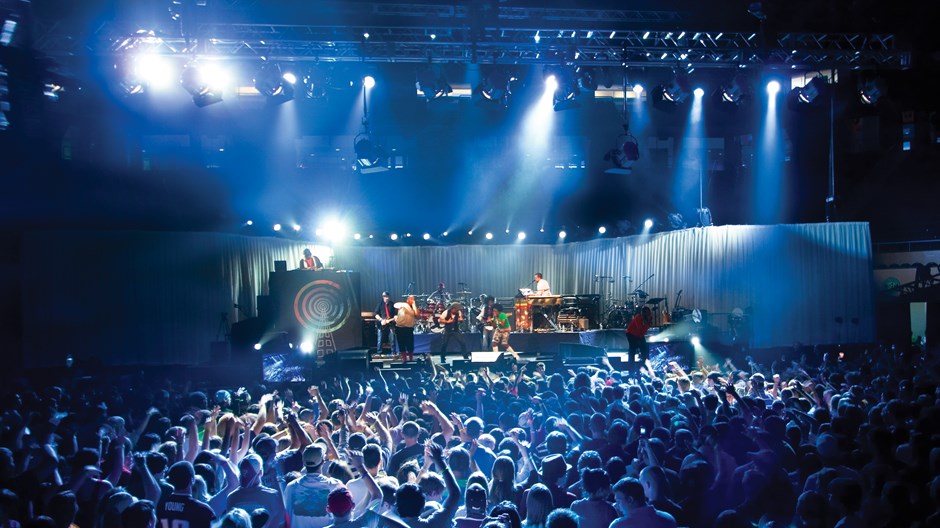
A band appeared on stage to begin the service with live music. It was dark, and I thought I heard the audience singing along, but it was impossible to tell. And although I was seated in the front row, I sensed that the congregation was almost superfluous to the activity on stage. As in most forms of entertainment, the audience functioned as passive onlookers, participating only in an unseen, intensely personal way.
While the band played, song lyrics flashed across the two big screens, with words like great, God, and high figuring prominently. The musical performance was outstanding, even if the vocabulary was extremely limited. If the songs aimed at an emotional response, they were probably successful, but like so much contemporary worship music, they lacked any element of substantive teaching.
Immediately after the singing, without any announcement, much less Paul's words of institution (1 Cor. 11:23-26), the elements of the Lord's Supper were hurriedly handed around. Again, I was amazed at the blandly efficient nature of this activity. We could have been passing pretzels and soda pop. No one offered any guidance whatsoever on the sharing of this critical ordinance or sacrament. It seemed a strictly vertical encounter between each individual and God.
Next came the sermon, offered by a capable person who worked very hard to relate while teaching some biblical content. A simple outline appeared on the screen so that we could follow the train of thought. So did the relevant Bible passages, lest anyone could not find them in an actual Bible. I noticed that the illustrations came almost solely from popular movies and television. Then the service ended as abruptly as it began, with a few announcements over the speakers and a cordial "thank you" to the congregation. No benediction or closing prayer—not even a person to give it. The house lights came on, and it was time to leave.
Protecting the Pearls
To say that the service was religiously "dumbed down" is not quite right. In fact, I wish that were the case, since the goal of comprehension sometimes demands that complex ideas be simplified. No, it seemed rather that the presentation aimed at finding a theological and cultural lowest common denominator in order to attract and engage the greatest number of people. As a result, there was no need to be a Christian to understand most everything that was said or sung.
While church leaders rightly want Sunday services to be accessible, they should also be asking about the limits of this strategy. Ironically, a common complaint 20 years ago was that churches alienated visiting nonbelievers with too much Christian jargon. This was a legitimate criticism. But now it seems the impulse toward accommodating the surrounding culture has pushed churches into making the opposite mistake. Has a passion for inclusiveness deluded churches into supposing that doctrinal or liturgical particularity threatens their mission to a religiously pluralized world?
The apostolic and post-apostolic churches—those nearest to the New Testament era—took a different approach. Modeled after the Old Testament tabernacle, the church was where believers encountered the "Holy of Holies." Thus worship could not be open to everyone. The churches of the third and fourth centuries observed what was called the disciplina arcana (the rule or practice of secrecy) with regard to worship gatherings. This was to ensure that only baptized Christians partook of the Lord's Supper and confessed the church's creed. Hippolytus, a third-century theologian, kept a list of vices and professions that would disqualify one from baptismal eligibility. In a great many churches, the un-baptized, even catechumens preparing for baptism, were dismissed before the church celebrated the Eucharist and confessed its creed.
I'm not suggesting that today's churches dismiss the un-baptized in the middle of worship, or prevent non-Christians from walking through the doors. Still, it is instructive to see how the church's "welcome" to the world was tempered by exclusionary safeguards to its identity and integrity, especially in the early centuries. If anything, the early church's example cautions against tossing around the pearls of the gospel promiscuously, lest these treasures fall into unprepared hands. On this score Jesus' words are stark: "Do not give dogs what is sacred; do not throw your pearls to pigs" (Matt. 7:6). Failure to preserve the uniqueness of Christian motives, insights, and commitments jeopardizes both the meaning and holiness of the church's life. I would argue that, far from snobbishness or spiritual elitism, this is a crucial part of the gospel message.
Article continues below
Gregory of Nyssa said it well: "Theology is not for just anyone" (Oratio 29). By "theology" he meant the creation of a unique, Christ-centered spirituality that gradually transforms the mind and heart, one in which "deep speaks to deep."
The Cost of Accommodation
Perhaps after witnessing this instance of contemporary worship, I should have simply thanked God for a church that was crowded and very active. Numerically speaking, this was the largest of the large churches in town. No doubt a great many seekers had been attracted for one reason or another: the youth program, the live music, the adult fellowship groups, or the emphasis on missions. But despite this obvious passion for involvement, I found myself struggling with an uncomfortable question: At what cost had this congregation—like others—purchased its sweeping adaptations to contemporary American society?
At some point, style of presentation affects the substance of Christian identity and teaching, often by blunting its sharper edges.
Of course, throughout history the church has immersed itself within its cultural surroundings in order to present an effective witness. Perhaps there's nothing new in the modern megachurch except elaborate methods of appealing to outsiders. Indeed, method has become very important for such congregations. I've been told that modern worship competes with the sound and visual effects of contemporary entertainment as a way of reaching modern audiences. The argument goes that churches should not be averse to using secular techniques showcased in popular entertainment. Artistry and drama in the presentation of the sacred are said to resonate with younger generations.
In this process, however, it seems to me that the church caters to short attention spans and relies heavily on stimulating emotional highs during the service. Instead of facilitating an encounter with the living God, the methods themselves become the overwhelming focus. In a recent Chronicle of Higher Education commentary, Timothy Beal observed that "a hallmark of American evangelicalism, at least since the 1940s, has been its ready willingness to adapt its theological content to new media technologies and popular trends in the entertainment industry. Implicit in that openness is an evangelical counterdeclaration to Marshall McLuhan's: The medium is not the message; the message, or the Word, transcends whatever media are used to convey it. But in the long run, is the constant evangelical adaptation of the Word unwittingly proving McLuhan right? I think so. That is partly why we find so little coherence within and among the various groups and movements and productions that pass as evangelical." At some point, style of presentation affects the substance of Christian identity and teaching, often by blunting its sharper edges. It is probably no accident that many contemporary churches offer a diet heavy in biblical images and metaphors, leaving actual biblical theology in short supply.
Article continues below
More than Aesthetics
Lest I sound like a grumpy old man complaining about the styles of the "new generation," let me say that the congregation I visited ranged in age from young to old. Fashions ran the gamut of formality, from suits to jeans. I myself dress casually most Sundays, and can appreciate a good bass guitar when I hear it. So I'm not just grumbling about matters of musical or sartorial style.
Yet aesthetics is never mere aesthetics; the medium may well override the message, or worse, become confused with the message. Tailoring the message to personal styles can easily result in adapting the faith to one's own needs. Instead of allowing the gospel to challenge us, we alter the historic faith to fit the trends of our age. Many contemporary worship leaders recognize this temptation.
How would the believer know when this process has gone too far? When is the Christian mission irretrievably compromised by a passion for making the gospel relevant? These are difficult questions. But given the anti-traditionalist posture of many contemporary churches—many of which have jettisoned confessional or theological resources in favor of relevance—it's hard to see what will help them preserve orthodox Christianity for the long haul.
Our consumerist culture has co-opted many churches, creating a mall-like environment marked by splashiness and simplistic messages. When the church becomes essentially a purveyor of religious goods and services, it reinforces the believer's own consumerist habits, allowing him to pick and choose according to taste or functionality. Inhaling from the cultural atmosphere a mania for unlimited choice, churches breathe out as many different programs as possible, looking to accommodate as many different believers as possible. Perhaps unintentionally, this approach treats personal liberty and the inalienable "right" to choose as the highest goods of life.
Article continues below
Ironically, the weight placed on personal experience and freedom from conventional beliefs is reminiscent of early-20th-century Protestant liberalism. Updating their theology for modern fashions, the heirs of Schleiermacher and Hegel emphasized the primacy of the individual's experience of God, setting aside complicating issues of doctrine as divisive, latently authoritarian, or just plain irrelevant. Despite many important differences between this sort of liberalism and the contemporary evangelical megachurch, there are striking similarities in their approaches to individual experience, popular culture, and socially uncomfortable doctrines.
But the big question remains: In what direction are such churches taking their members? What kind of Christianity will emerge from an overemphasis on appealing to anyone who might attend a church service for any reason? When the apostle Paul became "all things to all people so that by all possible means I might save some" (1 Cor. 9:22), he did not reinvent or re-orient the faith of which he said, "I delivered to you as of first importance what I also received" (1 Cor. 15:3, ESV). The kind of transformation Paul experienced and tried to ignite in the early church was grounded in a tradition that made Christian faith, hope, and love starting points for the believer's growth. If our post-denominational (or post-Protestant) era continues to elevate personal freedom of choice, the stability of the church's historical wisdom will be desperately needed.
At the very least, the mere entertainment techniques will never substitute the hard work of teaching believers to acquire the divine life of the Father by the Son through the Holy Spirit. This kind of life may well entail sacrificing certain pleasures of one's former life or rejecting certain elements of Western culture. And the church that would foster it must have goals that eclipse inclusiveness.
















 While we pray for peace, we need moral clarity about this war.
 As my doubts about his teachings grew, so did a secret fascination with Jesus.
 Christian artists work at the intersection of music and climate change.






