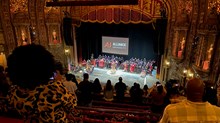
Evangelical, Mainline Protestant, and Roman Catholic leaders convened Tuesday in Geneva to announce the release of a historic document on the ethics of Christian evangelism. The World Evangelical Alliance (WEA) said Christian Witness in a Multi-Religious World: Recommendations for Conduct is the first document to receive unanimous endorsement from the WEA, the Pontifical Council for Interreligious Dialogue (PCID) of the Catholic Church, and the World Council of Churches (WCC).
The three-part document states that its intent is to "encourage churches, church councils, and mission agencies to reflect on their current practices … for their witness and mission among those of different religions and among those who do not profess any particular religion."
Jean-Louis Tauran, president of the PCID, said the text "will help us reduce unnecessary tensions and present the truth of God in a credible way to the world around us."
Geoff Tunnicliffe, secretary general for the WEA, said the document, which "covers very succinctly the essence of Christian mission," is the culmination of a five-year collaboration of theologians, practitioners, and Christian leaders.
"We might be surprised that the document does not say 'anything new,'" Tunnicliffe said. "After all, it states what many would consider to be obvious to the core of Christian mission. And yet, it has never been said before in this way! At least not so clearly and not within the context of collaboration between three Christian families of faith that jointly represent about 90 percent of all the Christians on the planet."
The organizations rarely meet together, let alone release joint documents. Documents released by Evangelicals and Catholics Together, for example, are endorsed by individuals on both sides but neither the WEA nor the PCID. But there has been an apparent thaw lately, especially between the WCC and WEA. In November the groups issued statements together on Sudan, and WCC general secretary Olav Fykse Tveit was invited to address October's gathering of global evangelical leaders in Cape Town, South Africa.
"It suggests that evangelicals are beginning to see their place as classic Christians in the broad scope of the Christian faith globally; we're seeing each other for who we are rather than who we're against," said Kevin Mannoia, professor of Ministry at Azusa Pacific University. As president of the National Association of Evangelicals (NAE, the U.S. body of the WEA) from 1999 to 2001, Mannoia attemped to work with the National Council of Churches (the U.S. body of the WCC). But his efforts, including allowing organizations to belong to both groups, led the National Religious Broadcasters to split from the NAE and were a factor in his resignation under pressure from the board.
Similarly, in 2001 NCC general secretary Bob Edgar signed a statement on marriage organized by Mannoia and endorsed by leaders of the National Conference of Catholic Bishops and the Southern Baptist Convention, then withdrew his support when his constituents complained that it excluded same-sex marriage.
"I think the fact that the WEA is engaging with the WCC and the Catholic Church here indicates that they are becoming more willing to embrace interreligious dialogue," Mannoia said. "On the other side, I think for the WCC and the Vatican to make the statement that witnessing is in the nature of the church marks a significant adjustment."
George Hunter, dean of the School of World Missions at Asbury Theological Seminary, sees an even more significant adjustment in what's not in the document. "A lot of times in these documents it's what they leave out that's really telling," he said. "Probably the Catholics engaged in the greatest concession by omission here: sacramental expression. Omitting sacramental rites from the 'essence' of evangelism is a huge statement from the Catholic Church, and an indication that they are willing to give up an important part of their tradition in order to meet evangelicals in the middle."
But Lon Allison, executive director of the Billy Graham Center at Wheaton College, said the document doesn't include everything evangelicals would have liked to see, either. "We wish that the verbal witness of the good news of Jesus was considered more central to how we express love to our world," he said. "While it was appropriate to teach how acts of service and justice, as well as Christian behavior, are witness, we desire to say that the most essential element of witness must be the verbal expression of the gospel adorned by love acts, respect, and gentleness."
Love, respect, and gentleness get a lot of attention in the "Christian Witness" document, which denounces "all forms of violence, even psychological or social, including the abuse of power" in Christian witness, along with "all arrogance, condescension, and disparagement." Allison said he appreciates it "as far as it goes. … It speaks eloquently to other world religions who, in many places, condemn the Christian Church for coercion. This brings needed correction to those claims." But he wonders if the document overemphasizes those issues as central problems in evangelism.
"The document operated from an assumption that Christians do witness, but do it badly or incompletely," Allison said. "At least in the Western world we argue that gospel witness is not done badly as much as it is not done."
Jerry Root, professor of evangelism and leadership at Wheaton College, said that he similarly fears the document's failure to make verbal proclamation explicit "leaves the door open for some to consider any proclamation at the time of service a coercive act." The document, he notes, says Christians "should not … violat[e] others' rights and religious sensibilities" and "never denigrate, vilify, or misrepresent them for the purpose of affirming superiority of our faith."
"This is ambiguous," said Root, author of The Sacrament of Evangelism. "If I said to another person, 'We need Jesus for the hope of heaven,' could this be considered a denigration of another's faith because of that faith's inability to provide a Cross-centered redemption? We never want to be offensive, but there are some features of the Cross that simply are offensive, by nature, to those outside the faith."
But Root said he likes the spirit of the document.
"I am amazed that careful work was done among groups who do not have a history of such good spirited cooperation; this is an encouraging sign. … The collective wisdom of Christian traditions is a valuable asset as well as an affirmation of the Gospel, 'They will know you are my disciples by the love you have for each other.'"
Craig Ott, professor of mission and intercultural studies at Trinity Evangelical Divinity School, said that while the omissions are significant, evangelical leaders are likely to be more uncomfortable with some of the language that's included than with what's left out.
"There's at least four mentions of the necessity of interreligious relationships and continuous commitment to engagement with other religions, and I'm not sure that this is realistic or theologically a major part of missions," he said. "This leans very heavily toward Catholic and WCC notions that the God of other religions is the God of Christianity, and that's something evangelicals are not willing to accept."
Similarly, Hunter notes one section that states, "Christians are to acknowledge that changing one's religion is a decisive step that must be accompanied by sufficient time for adequate reflection and preparation, through a process ensuring full personal freedom."
"That is not consistent with evangelical policy in the past," Hunter said. But he thinks it's worth questioning evangelical emphasis on the "moment of decision." "Faith is more like a gift—like falling in love—than a methodical, carefully discerned decision."
But is "changing one's religion" the same as "converting," or "having faith"? The terms faith, religion, and witness appear repeatedly in the document, but not evangelism.
"This document steps back from a lot of the activistic language we see in the Great Commission and throughout Matthew and favors the more Jesus-centric language of John—Jesus as the perfect witness to the gospel," said Dana Robert, co-director of the Center for Global Christianity and Mission at Boston University. "You don't see any language like convert or evangelize in the document because it would be perhaps perceived as too strong."
The interpretation of the rhetoric of the document, which is often ambiguous, will be essential to how it is used and perceived, Robert said.
"The use of the word witnessing here is important, because witnessing is a gentler word than converting," she said. "For the secular world and for proponents of other religions, conversion has often been seen as a coercive act. So to abandon that language is an important statement about the Christian intention to carry out evangelism with love, through relationships, with dependence on Christ."
Language may not be the only barrier to widespread acceptance of the document among the world's Christians, said Douglas McConnell, dean of Fuller Theological Seminary. "Different perceptions will arise depending on the context in which Christians are living and serving. For example, I can see a very different response from friends in places like northern Nigeria and Latin America."
Ott agreed. "It will inevitably be harder, perhaps even impossible, for Christians working in hostile locations to embrace the measures, specifically to embrace continuous religious 'dialogue,' as the document coins it."
Any disagreement among Christians will be limited to the language and context of the document, not its overall intent, said Ott. A 2009 draft of the text included a glossary of terms such as "conversion" and "dialogue" that was omitted in the final version.
"It's not difficult to figure out why, because that's where the rub is really going to come. You know, as soon as you start getting specific about these things, that's where you're going to have some differences," said Ott.
Ott said that while vague language may be problematic, and he takes issue with Tunnicliffe's depiction of it as describing "the essence of Christian mission," he generally likes the document.
"What's valuable about the document is that Christians are letting the world know that they are intending to be respectful, loving, and transparent in their approach to missions and that they do not intend to be seen as violent or coercive," he said. And he hopes it communicates to Christians, too. "If it causes some groups to give a little more pause to the way they consider others, especially a lot of the real nasty, uninformed rhetoric that is out there, if it somehow calls people to be tempered in their speech, then it is a good thing."
Editor's Note: This article has been updated for clarity.
Copyright © 2011 Christianity Today. Click for reprint information.
Related Elsewhere:
Christian Witness in a Multi-Religious World: Recommendations for Conduct is available in full on the WEA website.
Previous Christianity Today coverage of evangelism and missions includes:
Evangelism as Sacrament | Velcroed to a high-felt need: Jerry Root says evangelism is seeing how God is already working in someone's life. (April 28, 2011)
Q & A: Will Graham on Preaching Hell and Why He Doesn't Believe in Mass Evangelism | The son of Franklin Graham and the grandson of Billy Graham discusses his family and ministry. (Apr. 8, 2011)
Putting Evangelism on Hold | Will the Global Faith Forum's "evangelistic model" of engaging Muslims and Jews catch on? (November 16, 2010)
Additional articles on evangelism from Christianity Today's sister publication, Leadership Journal, include:
Is Jesus Welcome in Justice Efforts? | How to speak his name in a "serve but don't proselytize" world. (August 9, 2010)
The Faces of Graceful Justice | These churches are combining justice and evangelism. (July 12, 2010)
The Limits of Language | Communicating the gospel involves more than using the right words. (February 27, 2010)
For more on the World Evangelical Alliance (WEA), the World Council of Churches (WCC), and the Pontifical Council for Interreligious Dialogue (PCID), visit their websites.







Support Our Work
Subscribe to CT for less than $4.25/month