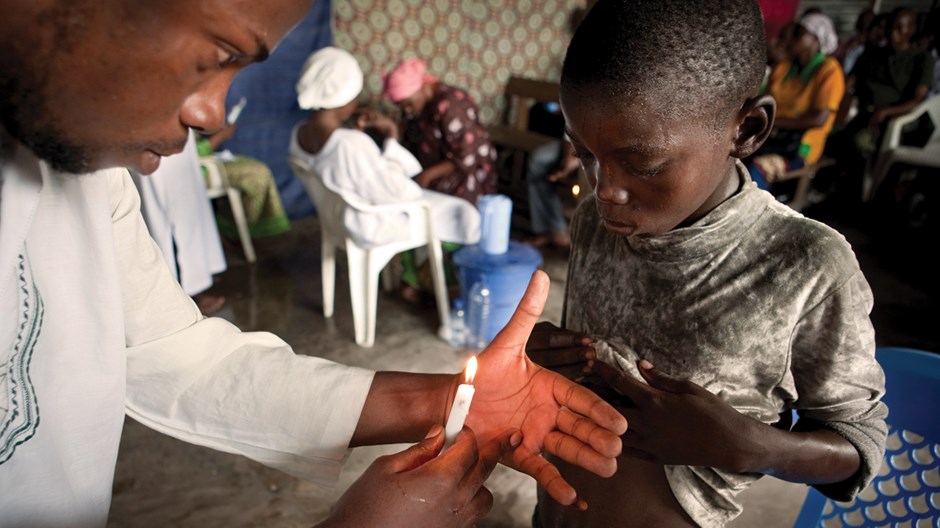
A recent rise in the number of people accused of witchcraft—particularly African children—isn't just an issue for missionaries to address, say scholars. It's also a problem they may be contributing to.
An entire track of the annual missiology conference at Trinity Evangelical Divinity School this February was devoted to witchcraft, a topic usually neglected by the field.
"We had thought this was a phenomenon that would die out," said Robert Priest, professor of missions and intercultural studies at Trinity. "Instead we are finding that the conditions of modernity—urbanization and social differentiation under capitalism—are contributing to accusations getting stronger and stronger."
Presenters hope the conference will prompt missionaries to focus more on the subject.
"Most missionaries go out knowing the answer—namely, Christ—without knowing the questions the local people are asking that the local religion answers," said Carol McKinney, an anthropologist who teaches at the Graduate Institute of Applied Linguistics. "Questions like, 'Why did something happen to John and not to Joe when John and Joe were at the same place?'?"
Witchcraft often provides answers, whether in traditional African cultures, India, or Papua New Guinea. Someone is accused of bringing evil on another, often because the "witch" is jealous of that person's good fortune.
Missionaries have commonly responded in two ways, said Priest. The power of witches to harm others is dismissed as superstition, but this seldom persuades local Christians to abandon the concept; or the reality of witchcraft is endorsed by missionaries not wanting to be "post-Enlightenment rationalists" with a non-biblical skepticism of spiritual warfare.
The result is that traditional witch ideas are fused with Christian theology, which obscures the social consequences: Accused witches are often destitute or outcast, and thus socially defenseless. Instead of seeing old women or children as scapegoats, said Priest, Christian leaders suggest that witchcraft participates in genuine spiritual evil and that the accusations are reasonable. "The church is providing the cognitive underpinnings for the past system in the contemporary world."
Priest says the approach is unbiblical. "Nowhere in Scripture do we find anyone attributing affliction or death to a human third party acting through evil occult means," he said. "We're not questioning Satan's power; we're questioning the diagnostic system that blames another person."
When witchcraft is Christianized—by placing it in the realm of the demonic—missionaries unintentionally change the gospel message, said Timothy Stabell, assistant professor of mission at Briercrest College and Seminary. The Holy Spirit then becomes just another source of witch-like power, albeit more potent than local witches or shamans.
"That doesn't work," Stabell said. "If you dig deeper, there's an undertone of darkness, of evil, even when people ostensibly use the same powers for supposedly good things. It becomes very ambiguous."
Cultural background matters. Stabell, who was raised in the Democratic Republic of the Congo and worked for 15 years there, sees witchcraft accusations as often rooted in psychological problems. His African Christian friends interpret them as evil spiritual powers.
"We need to develop a fuller understanding and theology of what sin has done in the world, whether in the West or in Africa," Stabell said.
"Missiologists have not yet done an adequate job of wisely engaging these realities," said Priest. "We have a solemn responsibility to mobilize the effort to rethink our role in this."















 While we pray for peace, we need moral clarity about this war.
 We’ve got little information on Jesus’ appearance and personality. But that’s the way God designed it.españolFrançais
 The Grammy-winning artist was found dead at her home in Nashville at age 47.






