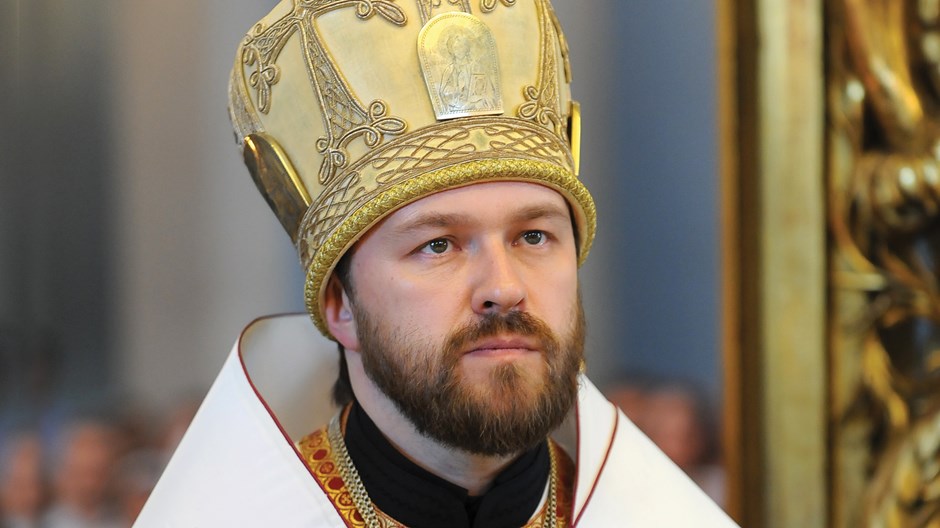
Hilarion Alfeyev, the Metropolitan of Volokolamsk, located 80 miles northwest of Moscow, has a very big job. As head of external relations for the Moscow Patriarchate of the Russian Orthodox Church, Hilarion is responsible for talking to global Christianity on behalf of the 150 million people in Russian Orthodoxy worldwide.
Given his gift for languages, Hilarion arose as an easy pick for the job by Russian Patriarch Kirill. This year, the Russian-American Institute, a faith-based educational and support organization (formerly the Russian-American Christian University), helped Hilarion interact with a cross-section of evangelicals around the United States for the first time. Christianity Today deputy managing editor Timothy C. Morgan interviewed Hilarion while he was in Washington, D.C.
What's the purpose of your trip?
To establish contacts and to find common positions. Often we are in circles in our own ecclesiastical environment and don't communicate with those who might be our allies.
With regard to evangelical leaders, until recently we didn't have any systematic collaboration or dialogue or conversation. Many evangelicals share conservative positions with us on such issues as abortion, the family, and marriage.
Do you want vigorous grassroots engagement between Orthodox and evangelicals?
Yes, on problems, for example, like the destruction of the family. Many marriages are split. Many families have either one child or no child.
There are many incomplete families, not to speak of various homosexual unions, which are equated with the family. This completely changes the whole picture of human relationships. It directly affects the future of many nations. The sign of a spiritually healthy nation is that it expands—it grows. If it shrinks, it is a very clear sign of unhealthiness.
There is a perception that religious freedom is declining in Russia. Is the perception true?
'Secularism is dangerous because it destroys human life. It destroys essential notions related to human life, such as the family.'— Metropolitan Hilarion
It's a completely wrong perception. We have to ask what we mean by religious freedom. If it's a freedom for the sects, including dangerous sects, to buy time on television and to propagate their ideas, then I think we no longer have the freedom that existed in the beginning of the 1990s. But I think freedom was sometimes not used in a proper way. For example, I remember how every morning Shoka Asahara would preach on Russian television. He was later condemned to death in Japan for organizing a terrorist attack in the Tokyo underground.
With regards to traditional churches and religions: They have complete freedom of action. There is the law on the freedom of conscience, which makes a subtle distinction between traditional churches and religions that never existed in Russia. Religious communities are given a 15-year probationary period precisely for the reasons I described. They can act freely during this period. They can organize services. They can publish literature. They can do missionary activities. But they are not registered with the juridical status. After 15 years, they can be registered.
Is it the government's role to regulate minority groups like Jehovah's Witnesses and the Church of Scientology? Or should the Russian Orthodox Church have influence there?
We should have some influence in this process, and we have a mechanism of dialogue within our government. For example, there is the interreligious advisory council to the Russian president. This includes representatives of the Russian Orthodox Church, the Roman Catholic Church, Protestants, Islamic leaders, Jews, Buddhists, and others, who gather on a regular basis. One of their tasks is to monitor the development of religious freedom. They can give advice, if asked, to the president or to the government about how to deal with various sectarian movements and so-called new religious movements. Of course, they have only advisory status.
What about the activity of Christian groups coming into Russia, setting up shop, and trying to reach people who have not heard the gospel?
In many cases, the activity of foreign missionaries in Russia might be profitable to people, because there are many social problems. But whoever comes with missionary purposes to our country must first learn our history, our tradition, and see how to correlate with the existing Christian churches. We distinguish between mission and proselytism. Mission, for example, is when you go to a foreign country where Christianity was not preached and you preach Christ. But when you come to a country where there is an established church that has existed for centuries, then you have to respect it. Ideally you have to come into contact with her and work together with her. Such work brings very positive fruits.
Generally after the election of Patriarch Kirill, the ecumenical climate and inter-Orthodox climate changed drastically. He made a direct appeal to the Patriarch of Constantinople to come to work together on various issues that are still dividing us, to come to a new type of relationship built on mutual trust rather than competition. And I think so far it's worked well.
Article continues below
How do you describe the model for church-state relations in Russia, and how could it be improved?
I don't represent the Russian Federation. I represent the Russian Orthodox Church, which includes other countries—Ukraine, Moldova, Belorussia, Kazakhstan. And in each of these states, the model of coexistence between the church and the state differs.
Our relations with the Russian political authorities are now based on two principles.
One principle is the separation of the church from the state, a mutual noninterference in internal affairs. This means that the government doesn't interfere with our life. And, we do not interfere with political processes. For example, we do not and cannot support one particular party against another party; we cannot say that this party is ours and this party is not ours, because we have to be inclusive. We are prepared to include members of all political orientations, except for extremists. And this is why, for example, some members of the Communist Party are Orthodox believers. This was not possible 20 or 30 years ago.
The other basic principle is collaboration. We build our relationship with the state to collaborate in those areas that are related to people's lives, and where such collaboration is necessary and welcome. For example, on all the issues I mentioned—family, demographics, education—we have a constant dialogue with the government in order to assist each other and people in their daily lives.
For example, the demographic crises cannot be addressed only from an economic or social point of view. They have to be addressed also from the spiritual point of view; we cannot change the declining demographic unless we address it from different angles, unless the whole society and all healthy forces of the society are involved. And this includes the government. If we succeed in creating an alliance between at least four pillars of society—politics, education, the church, and mass media—then we can change this tendency.
Do you believe the government is staying within the boundaries?
Yes. We don't feel any pressure coming from the political authorities.
Article continues below
How do you view Russia's Soviet period? Some say church leaders made the wrong choices in that difficult time.
Well, when I became a priest, the Soviet Union was still in existence. I didn't live in the time of the severe persecutions, when the church was being exterminated, when priests and bishops were killed or imprisoned or sent into exile, when churches were ruined, monasteries closed. But I started my ministry in the time when the church was still under very strict control by the state, and I remember how difficult it was for Christians to be Christians on a daily basis. Many were hidden Christians.
What insight do you draw from that period?
Some people say that the church made wrong choices. I don't think this was the case, because the church had to exist under the conditions that were set without consulting her.
This was the same situation that existed in the first centuries of Christianity. For example, we read how the early fathers tried to prove that they were loyal citizens of the Roman Empire in spite of its pagan character. Addressing the pagans, they said, "We do not bow to the emperor's statues, because this is not allowed by our tradition, but we pay honor to him in all other respects, and we are loyal citizens of the state." This is what the Russian Orthodox Church from the time of Patriarch Tikhon on tried to tell the Soviet authorities, that a person can be a believer and at the same time be a loyal citizen of the state. Of course, the situation of total control of church life by the Communist regime was a very unhealthy situation. But this was the only situation in which the church could live.
Sometimes official representatives of the church had to pay the price in order for the church to exist. For example, in the 1960s and '70s, the church was heavily involved in ecumenical activities, in what were called peacemaking activities. Representatives of the church went abroad. They engaged in various meetings, for example, dedicated to disarmament. If asked whether there were persecutions of the church in Russia, they strongly denied it. But in exchange, the church had the possibility to exist. Theological seminaries functioned. Monasteries functioned.
A choice between two evils—is that how you would describe it?
It was a choice between two evils.
What role can the Russian Orthodox Church play in world evangelization?
Christ created his church not just for private use but also for missionary purposes, and the church has a missionary imperative that must be embodied in the concrete forms of preaching and evangelizing.
Article continues below
Some say you can be a practicing Christian in your home and your family, but you should in no way exhibit your Christian commitments in your public life, especially if you are a politician. I believe that a Christian should be a Christian everywhere. And if he is a Christian and a politician at the same time, then his political agenda should be motivated by Christian values.
In our country, some people say the church exists in order to provide certain services to people when they need them: to baptize children, to marry couples, to organize funerals, and to do services in the church.
I believe that the role of the church is much more inclusive. For example, very often nowadays our church will publicly express positions on what's happening in the country.
Some people ask, "Why does the church interfere? It's not their business." We believe that the church can express its opinion on all aspects of human life. We do not impose our opinions on the people, but we should be free to express them. And people will have to choose whether to follow or not to follow, whether to listen to what we say or to ignore it.
Church leaders worldwide are challenged by secularism and Islam. Which do you see as a greater threat to global Christianity?
Secularism.
If we speak about Islam (and of course if we mean moderate Islam), then I believe there is the possibility of peaceful coexistence between Islam and Christianity. This is what we have had in Russia for centuries, because Russian Islam has a very long tradition. But we never had religious wars. Nowadays we have a good system of collaboration between Christian denominations and Islam.
The picture is different in many other countries, and recently, even the European Parliament publicly recognized that Christians are persecuted and discriminated against in many countries, including in Islamic countries. This is a problem we have to address. Yet I believe that on many essential points, especially in many aspects of moral teaching, Christianity and Islam are allies, and we can cooperate in those fields.
Secularism is dangerous because it destroys human life. It destroys essential notions related to human life, such as the family. One can argue about the role of the church. One can even argue about the existence of God; we cannot prove that God exists to those who don't want to believe that God exists. But when the difference in the world outlook touches very basic notions such as family, it no longer has to do with theological truths; it has to do with anthropological issues. And our debate with secularism is not about theology; it's about anthropology. It's about the present and the future of the human race. And here we disagree with atheist secularism in some areas very strongly, and we believe that it destroys something very essential about human life.
Article continues below
What is the way forward to address secularism?
We should be engaged in a very honest and direct conversation with representatives of secular ideology. And of course when I speak of secular ideology, I mean here primarily atheist ideology.
Of course, one has to distinguish between those representatives of secularism who are atheists and those who are believers, because some of them are believers. And here there is another problem: the influence of secularism on contemporary Christianity, the problem of liberalization of theological and moral standards within many Protestant communities.
But if we speak about atheist secularism, we must have a dialogue with these people, and we must say to them that of course you have the right to believe in what you believe, but we also have the right to believe in what we believe. And we have the right to teach people and to openly proclaim our system of values. There should be no ideological monopoly of secularism in contemporary society. This is one of the themes, maybe the main theme, of our dialogue with the European political structures.
Will the 21st Be the Orthodox Century? | Fascination with the Great Tradition may signal deep changes for both evangelicals and the Orthodox. (January 4, 2007)

















 While we pray for peace, we need moral clarity about this war.
 A Christian reconciliation group in Israel and Palestine warned that war would come. Now the war threatens their relevance.españolالعربيةFrançais
 After lobbying from fellow Southern Baptists and Christians affected by the war, the House speaker moves a package forward.






