Worship looks forward. Together we pray, "Thy kingdom come." In the earliest recorded post-Communion prayer, first-century Jesus-followers prayed, "Gather [your church] from the four winds, sanctified for your kingdom which you have prepared for it …. Let grace come, and let this world pass away …. Maranatha"—"O Lord, come."
Worship must also look back. Since early days, Christians gathered for worship have been, as Justin Martyr described it, reading "the memoirs of the apostles or the writings of the prophets," and afterward listening to the presider "instruct and exhort to the imitation of these good things."
Christian self-understanding has from the beginning been illumined both by what Jesus' closest followers wrote and by the Hebrew Scriptures that foreshadowed Jesus' work.
It is one of my pet peeves that orchestras at major Independence Day celebrations play only the final few minutes of Tchaikovsky's 1812 Overture. I understand the need to keep the program moving, but without the rest of Tchaikovsky's music, the finale is "sound and fury, signifying nothing." It is only the climax.
The same is true of the Christian message. Without paying attention to what has gone before, the great final act may be thrilling, but incomprehensible. We are actors in a great drama, but we don't know how to play our roles unless we study the earlier acts the Playwright has written.
A recent news item disturbed me. The Church of England Synod voted to simplify its baptismal service to make it more understandable to the unchurched friends who attend baptisms. The Diocese of Liverpool clergyman who proposed the revisions complained that people just didn't understand references like this: "Through water you led the children of Israel from slavery in Egypt to freedom in the Promised Land."
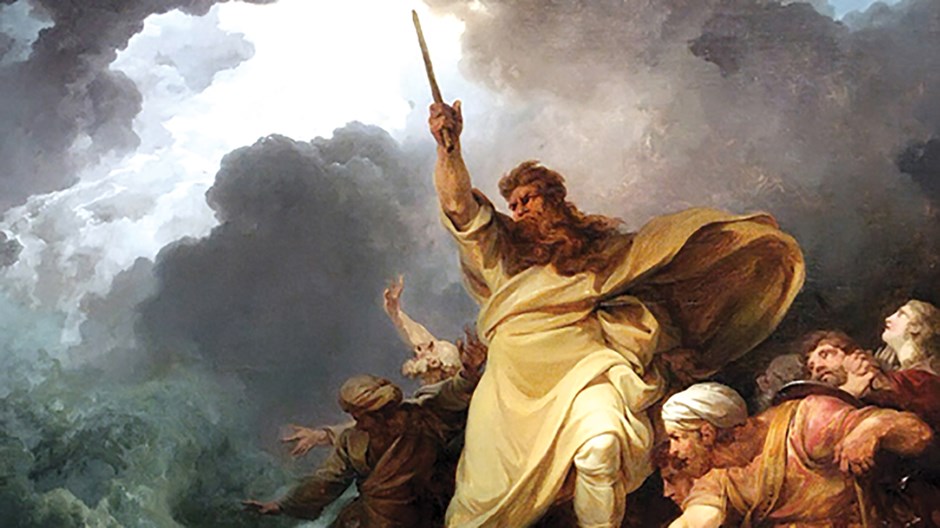
Some CT readers might wonder what that is doing in a baptismal service. But remember 1 Corinthians 10. Paul tells his readers that their ancestors "were all baptized into Moses in the cloud and in the [Red Sea]." Paul says these stories were written as an example to us, and for most of its history, the church has taken Israel's liberation via the Red Sea to foreshadow baptism. During the Reformation, Lutherans and English Protestants continued to connect the New Testament sacrament of baptism with the Old Testament story of deliverance from bondage through water. Luther's 1521 baptismal service put it this way: "You drowned hardhearted Pharaoh with all his army in the Red Sea, and you led your people Israel through it on dry ground, thereby prefiguring this washing of your baptism."
We are actors in a great drama, but we don't know how to play our roles unless we study the earlier acts the Playwright has written.
Calvinist Protestants also connected baptism and the Old Testament. Just as God marked the children of the Mosaic covenant by circumcision to show that they were part of his chosen people, he has now chosen baptism to set apart the children of the New Covenant. That is how the Scots Confession of 1560 explained it.
These Reformation Christians saw the importance of connecting the dots. The same God who saved Israel at the Red Sea and who commanded that a covenant people be marked by circumcision is at work in your baptism. If you know God's great works of mercy and his faithfulness to his promises, you can have even greater faith. So these Christians resisted the perennial temptation to marginalize the story of Israel.
But what about contemporary communication? That is what worried the clergy from Liverpool. Press reports singled out two items: the reference to the Red Sea and the necessity of being born again. Those things would confuse visitors who come to witness a relative's baptism. Perhaps, but what have we repeatedly heard about communication to postmoderns? That it must be pictorial? That it must use symbols and images? Are there more powerful images of rescue than the children of Israel passing through the Red Sea? Are there more powerful images of personal transformation than being born a second time?
I recently interviewed Metropolitan Kallistos Ware, a well-known spokesman for Eastern Orthodoxy. I asked how Orthodoxy was reaching out to the unchurched. Ware said Orthodoxy's "most important missionary witness" is its worship. "To those who show an interest in Orthodoxy, I say come and see …. We start from prayer, not from an abstract ideology, not from moral rules, but from a living link with Christ expressed through prayer."
Orthodoxy's sensory worship is far more difficult to penetrate than the Anglicans' modernized baptismal liturgy from the year 2000. Ware's "come and see" poses a challenge to the rest of us. Rather than strip our worship of ancient words and symbols, why not capitalize on their richness and mystery, and their ability to speak to the heart longings that secularism can never touch?
David Neff was editor in chief of Christianity Today, where he worked from 1985 until his retirement in 2013. He is also the former editor in chief of Christian History magazine, and continues to explore the intersection of history and current events in his bimonthly column, "Past Imperfect." His earlier column, "Editor's Bookshelf," ran from 2002 to 2004 and paired Neff's reviews of thought-provoking books and interviews with the authors.


















 While we pray for peace, we need moral clarity about this war.
 We’ve got little information on Jesus’ appearance and personality. But that’s the way God designed it.españolFrançais
 After lobbying from fellow Southern Baptists and Christians affected by the war, the House speaker moves a package forward.






