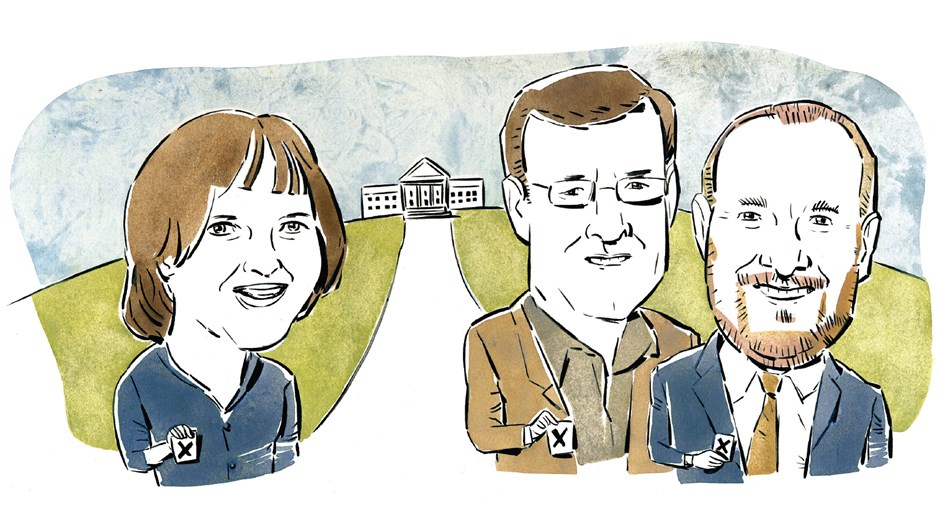
Amy E. Black is associate professor of political science and chair of the department of politics and international relations at Wheaton College in Illinois.
Forecasting election outcomes is dangerous business, but I can make one prediction with reasonable certainty: Whomever we elect President next year will face significant challenges on at least one political issue that affects millions of lives and costs billions of government dollars, yet no one will debate it in the course of the presidential campaign.
In the buildup to the 2000 election, who could have predicted that the person elected President would face three coordinated terrorist attacks on our own soil and lead the nation into its longest war? As we prepared to vote in 2008, few expected that uprisings across North Africa and the Middle East would topple autocratic regimes and threaten several others.
As we evaluate the 2012 presidential candidates, we should think first and foremost about choosing the person we trust most to make wise decisions on whatever broad range of issues will come his or her way. We should choose the candidate who demonstrates the best judgment.
Every official campaign publication, every public speech by the candidate and his or her representatives, every utterance, however scripted or off-the-cuff, is significant. All of these communications explicitly or implicitly receive the candidate's approval and reveal aspects of his or her character. We expect rhetoric will be hard-hitting and tough, but we should also expect it to be accurate and fair. Those who are quick to distort and skirt the edge of the truth publicly are even less likely to make wise choices when no one appears to be looking.
It is always a great challenge to discern the difference between genuine expression and calculated pandering. One way that may help minimize distortions is to consider the totality of the evidence. Evaluate the campaign as a whole by asking questions such as: What are the central themes? What kind of tone does the campaign set? What messages are repeated consistently?
Words are easy to script, but actions are not. Look to the candidates' actions over many years and see what patterns emerge. Is the candidate loyal and a person who engenders loyalty in followers? Do you see someone willing to admit mistakes and learn from them? After leaving jobs or positions, does the candidate appear to have left people and places better able to thrive, or do you see evidence of destruction in his or her wake?
After considering all of the evidence, ask one final question: If your life or the lives of those you love most were in peril, whom would you instinctively trust to respond with wisdom and grace?
We entrust the President with thousands of decisions over the next four years that will affect our lives and those of hundreds of millions of others. A wide range of domestic and international issues will enter and exit the spotlight during the President's term. For a decision of this significance, wise judgment is the issue that matters most.
Accountability
Chris Seiple is president of the Institute for Global Engagement and a member of the Council on Foreign Relations.
Standard & Poor's July downgrade of America's credit rating stated the simple and stark truth: The emperor is naked and can't afford clothes. The fact that Republicans and Democrats reacted to the downgrade by pointing fingers at each other again, rather than taking responsibility, confirmed that this country's government has been unaccountable to its citizens, the world, and God.
The number one issue of the 2012 presidential election is accountability. Accountability begins with vision, certainty, and decisive consensus building. Vision requires an exceptional sense of who we are as a people and the role we play in the world. Americans are constitutionally called to critique and correct ourselves civilly through government. Vision also demands a strategy that prioritizes goals and resources.
Certainty does not validate dogmatic solutions. Certainty is a confident assurance based on facts. Decisive consensus building requires the ability to listen, to form a vision and strategy that will do the most good for the most people. Americans, markets, and countries worldwide yearn for a humble and common vision of a governing system that is accountable.
The 2012 election will turn on the candidates' approach to some excruciatingly difficult decisions. Foremost, candidates should revisit the strategy, structure, and funding of our health and national security systems. "Reforming" organizational systems designed over 60 years ago for a completely different context will not guarantee future prosperity. Presidential candidates will need to boldly re-imagine the strategy, organizational structure, and budget for systems like health care and security.
Such vision and decisive consensus building should also suggest a way forward on permanent boundaries for congressional districts. The constant re-jiggering of boundaries for "safe" seats is the root of demonization politics. It encourages Americans to watch and read only those of the same opinion, even as Christians flirt with worshiping a God who always agrees with them.
Article continues below
For Christians who are Americans, it is useful to remember what the Bible teaches about accountability. Proverbs is clear: "Rebuke a wise man, and he will love you" (9:8, NKJV); for "he who regards a rebuke will be honored" (13:18) and will "get understanding" (15:32). Jesus taught his followers to "count the cost" (Luke 14:28), reminding them to always let their yes be yes, and their no, no (Matt. 5:37) while being "shrewd as snakes" and "innocent as doves" (Matt. 10:16, NIV).
People of good will and theological conviction will come to different conclusions about the application of these principles. But it should also be clear to Christians that, as Americans, we too have been part of the problem. Indeed, if we seek to reform government without renewing our godly principles, we will surely fail.
Therefore, no matter our political conclusions, let us contribute them in a manner that testifies to God's glory and grace. There should be no other gods before him—simply because there is no one else to whom we can turn (John 6:68).
Comprehensiveness
Galen Carey is vice president of government relations for the National Association of Evangelicals.
Every election should be an act of worship for Christians. We should proclaim through our voting that Jesus is Lord. Those we elect are God's servants, accountable for their stewardship to the people and ultimately to God. Government is a gift from God for the common good, to uphold justice and righteousness.
A comprehensive perspective saves us from single-issue politics. We do our nation a disservice and sell our faith short when we narrow our focus to one or a few concerns. With such tunnel vision, we abandon the implications of Christianity for many important areas of public life. We risk conforming our views to a political party or movement's ideology rather than to a biblical vision.
The National Association of Evangelicals' publication "For the Health of the Nation" provides a good starting point for reviewing candidate and party platforms. It offers a biblical and theological grounding for evangelical civic engagement, and then outlines seven broad areas of concern: religious freedom, marriage and family, sanctity of life, poverty, human rights, peace, and creation care.
Article continues below
The President faces daunting challenges and responsibilities at home and abroad. In our volatile world, the President must be a peacemaker who will deploy all dimensions of American power responsibly, with an emphasis on diplomacy over force.
The American economy can no longer guarantee ever-expanding prosperity. For too long we have lived beyond our means. The Bible counsels contentment with what we have and generosity to those in need. While the process is messy, it is good that we are finally seriously discussing the national debt. In this era, leaders will be called to carefully allocate scarce resources. Experience has shown that spending cuts and revenue increases can both contribute to deficit reduction.
Biblical justice requires special attention to the needs of the poor. We should not balance our budgets on the backs of the poor or blame our problems on immigrants. Indeed, fixing our broken immigration system will contribute to greater prosperity for all. Wisdom also suggests investing in future prosperity, even if that means deferring some current consumption. Our nation's moral foundations continue to erode as marriage and family are redefined, sex is debased, and life is unprotected. We need leaders who understand that marriage is more than a state-sanctioned sexual union of any two or more persons; it is fundamentally linked with the procreation, care, and nurture of children. We need leaders who understand that the well-being of mothers and their babies are intertwined, and that protecting the unborn is in everyone's interest.
Rhetoric should be evaluated against achievements. The issues are complex and interactive. Slogans often obscure more than clarify.
Let the debates begin! Let's do our homework and insist that the candidates do theirs. A thoughtful, intelligent campaign that addresses the full range of issues will itself be an important contribution to the health of the nation.















 While we pray for peace, we need moral clarity about this war.
 A Christian reconciliation group in Israel and Palestine warned that war would come. Now the war threatens their relevance.العربيةFrançais
 The Grammy-winning artist was found dead at her home in Nashville at age 47.






