Ever since I read, as a child, about Corrie ten Boom forgiving a Nazi guard in The Hiding Place, I've been a sucker for forgiveness stories—especially in the movies. The Green Mile, The Straight Story, The Spitfire Grill, The Mission, and even the end of Spider-Man 3, where Peter/Spidey forgives the Sandman/Flint Marko for killing his beloved Uncle Ben.
But the most powerful stories of forgiveness are the real ones as often depicted in documentaries. Martin Doblmeier's The Power of Forgiveness and Laura Waters Hinson's As We Forgive are both near the top of the list—especially the latter, which explores reconciliation in Rwanda in the wake of the 1994 genocide. I was in Rwanda two years ago and saw some of these stories myself.
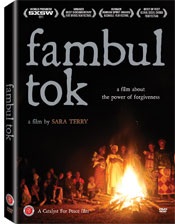
We can now add Fambul Tok (First Run Features), which just released to DVD, to the list of "forgiveness documentaries." The film features victims and perpetrators coming together in the wake of Sierra Leone's civil war, which featured some of the same types of atrocities as the Rwanda genocide and the horrific methods of Joseph Kony and the Lord's Resistance Army in other parts of Africa.
But such reconciliation doesn't come easily or naturally. It takes hard work on the part of peacemakers. While Sierra Leone had established a Truth & Reconciliation Commission (much like South Africa at the end of apartheid), and a number of warlords were tried and convicted in a special court, some folks believed that true reconciliation and forgiveness could not be court- or state-mandated, but had to occur at the grassroots level—in neighborhoods and villages, with perpetrators and victims meeting face-to-face.
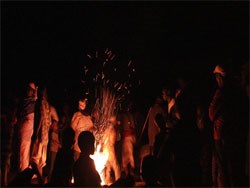
The film, directed by Sara Terry, focuses especially on John Caulker, a man who takes the role of peacemaker seriously. He travels around the country organizing "fambul tok" (which means "family talk")—gatherings around bonfires where victims have an opportunity to confront their perpetrators, and perpetrators have a chance to confess and apologize. It's moving to see so many perpetrators who are willing to stand before their victims (many of whom are the sole survivors of entire families that were murdered) and the whole community, confessing their crimes. The desired end is forgiveness, and sometimes that comes quickly, sometimes it does not. That's part of Caulker's hard work—to seek reconciliation between the parties, so that they can live together in peace and community. The meetings are similar to the gacaca court system of community justice that began 10 years ago in Rwanda.
It's a powerful thing to see two parties reconciled, especially after such heinous crimes as rape, torture, and beheadings of family members. But what the fambul tok model lacks (that was clear in both Doblmeier's and Hinson's films) is a thoroughly Christian model of forgiveness. Fambul tok claims to be nonpartisan process that aims to respect the traditions of the communities and cultures where it works, and Caulker is clearly doing a holy and spiritual work in encouraging reconciliation. But God or Jesus are never mentioned. There is never any talk of forgiving because we have been forgiven. There is no discussion of the idea that we're all sinners in need of forgiveness, victims as well as perpetrators. The only time someone mentions God is when one of the perpetrators says that "God has the final say" in such matters.
After reconciling with her perpetrator, one victim says forgiveness also means forgetting. No, it does not; it's asking far too much to ask a victim to forget being raped, or watching a man behead dozens of family members. Who can possibly forget such horrors? But forgiveness is possible.
Another concern is that forgiveness in some of the scenes seemed to come too quickly or flippantly—often as if the victim was being pressured to forgive before he/she was ready. When a perpetrator would confess and apologize, the leader and the group would often turn to the victim, putting him or her on the spot in front of the entire community and saying, "Will you forgive him now?" Some said yes, and as a viewer, I wondered if the forgiveness was real and lasting. Some said yes "for the sake of the community," but is that true forgiveness, if it doesn't come from your heart? And some said no—and those responses actually felt the most believable to me, as a viewer. If I confronted a man who had beheaded my family members and raped my wife, I don't know if I could forgive him on the spot.
Another element that was missing in this process was encouraging restitution—some kind of "payback" from perpetrator to victim. Restitution was a clear and intentional part of the reconciliation process in Rwanda; perpetrators would often be required to rebuild victims' homes, or work in their fields, or in some way repay their debt. But we don't see that in the "fambul tok" process in Sierra Leone. We hear a couple of stories of voluntary restitution occurring, but it didn't seem to be encouraged from Caulker or other peacemakers. (If it is part of the process, the filmmakers didn't depict it.)
Article continues below
The film's most interesting dialogue occurs between Caulker and a perpetrator named Mohamed Savage. Nicknamed "Mr. Die" by his victims, Savage initially denied his involvement in war crimes, but later fesses up, saying he'd been paralyzed by guilt for years. Caulker tells him, "The door to getting life is actually the truth. Once you acknowledge the truth, that is the opening of a new life."
Savage ponders these words for a moment and replies, "The truth is the weapon of everything. Without truth, you have no success in life, or anything. You must say the truth. God has the final say."
Fambul Tok—the movements, not the movie—has developed into an international peacemaking organization with the mission statement, "We are dedicated to advancing peace by mobilizing ordinary people—entire communities ravaged by war—in the hard work of reconciliation. Fambul Tok International originated in the realization that peace can't be imposed from the outside, or the top down. Nor does it need to be. The community led and owned peacebuilding we supported, witnessed and celebrated in Sierra Leone taught us that communities have within them the resources they need for their own healing. We believe this process has much to offer other post-conflict countries—and the world." Their website does acknowledge that peacemaking is not a one-time event, but ongoing, difficult work that requires much follow-up in rebuilding community.
God's hand is clearly at work in Sierra Leone with the reconciliation process, whether parties involved acknowledge him or not. Victims and perpetrators are now living side by side again, without fear, even becoming fast friends. Peace and unity are being restored. Blessed are the peacemakers.












 While we pray for peace, we need moral clarity about this war.
 A Christian reconciliation group in Israel and Palestine warned that war would come. Now the war threatens their relevance.españolالعربيةFrançais
 When I married into a Jewish family, antisemitism hit home. Now, the holy day reminds me of our future hope.