Blue Like Jazz is based on the 2003 bestselling Christian book of the same title—but you should probably take that with a grain of salt. I'm not entirely sure how comfortable author Donald Miller would be with the "Christian book" label, but it was released by a Christian publisher (Thomas Nelson), a lot of evangelicals bought it, and it is filed under the "Christian life" section at Barnes & Noble. But what both the book and the movie ultimately deliver are spelled out in the book's subtitle: "Non-religious thoughts on Christian spirituality."
For those who love Jesus and movies, the implications of that promise are decidedly mixed. On the plus side, much like the book it's based upon, Blue Like Jazz is anything but a typical "Christian movie." Besides, director Steve Taylor, a long-time rocker known for irreverent satire and his disdain of schmaltz, has rarely done anything typically "Christian." Taylor brings this movie the kind of grit (read: off-color humor, some brutal satirizations of evangelical subculture, and even some four-letter words) that you won't find in, say, Courageous. And he does a lot with a little, budget-wise; this film was financed largely via Kickstarter, and while the production values are not exactly high, it is nevertheless a quirky and genuinely funny indie. The acting is solid, if unremarkable, though Marshall Allman (who plays Don) deserves kudos for playing a character who is essentially a blank canvas, and making him someone we sympathize with and are engaged by.
Marshall Allman as Don, Claire Holt as Penny
The downside? Separating "Christian spirituality" from the fundamentals of the gospel message means, in the case of Miller's book, an emphasis on feelings and experience, on social justice and an individual search for truth. Little traction is given to the mortification of sin, to the atoning significance of the Cross, and so forth. In the movie, it means we get a vivid portrait of where evangelical culture has gone wrong, but the alternative we're given is a "Christian spirituality" that emphasizes all the wrong things (and pretty much excludes Christ himself).
Not that it falls on the film to lay out a full gospel presentation. Blue Like Jazz, the movie, does us a crucial service by illuminating some ways in which some churches—and churchgoers—have lost the plot. (That the film itself fumbles in vain to find that plot is lamentable, but, given the narrow focus of Miller's book, not surprising.)
Penny and Don have a chat on the bridge
Working from a screenplay that he adapted with Miller and Ben Pearson, Taylor translates the interior monologues of the book into a narrative about a young man—also called Don Miller—who flees the church culture of his youth in abject disillusionment. The hypocrisies of the faithful have grown too burdensome, and his own faith is too malnourished, for him to bear it any longer. He escapes into a secular university—Portland's Reed College—where he's bombarded with the anti-faith screeds of professors and classmates. Naturally, these add fuel to the fire of movie-Don's unbelief—but where the film works most sharply is in showing how the church itself failed him.
I'm thinking particularly of an early scene, set in a Baptist church in Texas. Young Don is standing in front of the whole congregation clad in the full "armor of God" regalia—helmet, shield, breastplate, sword, the works, all rendered in glorious plastic. There is an awkward Scripture recitation, and some beyond-cheesy organ music. Then comes the lethal blow: The congregation's youth pastor delivers a message about "how the Cross can make [one] happy," before bringing out a piñata to illustrate how Jesus basically just showers us with goodies. It's savage because it's true: How many of our churches basically take the approach that Jesus' sacrifice was all to make us happy, and we need only make a mad grab for his sweet blessings?
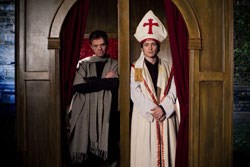
The Pope (Justin Welborn, left) joins Don int he confession booth
Don's leap from church to uber-secular university comes quickly, though, as he finds that his divorced mom is having an affair with the very same corny youth pastor. Since he was raised in a church where Jesus exists just to make him happy, it's only logical that he would abandon his faith the minute his happiness runs out. So he heads to school against his mom's wishes and plunges into drinking, partying, and atheism.
Don gives voice to a cynicism that many evangelicals, particularly of college age, will surely relate to, and the movie's knocks on some of the cultural trappings of Christianity are probably deserved. As a satire, it works; but again, to the extent that the film sketches a different vision of Christian faith, it falters, largely due to the weak foundation it's given by Miller's book.
While the movie raises valuable questions about Christianity, offering good answers is another matter entirely, and perhaps outside of what a movie like this should do. As Don undergoes a complete unraveling of his spiritual identity, we realize he's really never been given a good picture of what true Christian faith looks like. That the church is full of hypocrites, like his mom and the youth pastor, is no great revelation; that Don was weaned on a version of the gospel that seemingly has more to do with therapy than with Truth is horrifying.
Article continues below
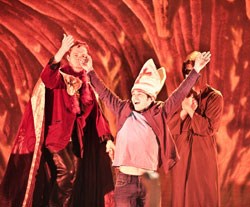
Don and the Pope whoop it up at Ren Fayre
What the film offers as a resolution, though, is really no resolution at all. Don spends a lot of time with a girl named Penny, clearly depicted as a Christ follower in the book but somewhat less explicitly in the film. In the movie, Penny mentions "liking" Jesus in one scene, but most of her piety is wrapped up in the good work she does—like serving needy people in India, for example. Don himself lands on a spiritual identity that is characterized by the apologies he offers on behalf of Christianity's history of hypocrisy.
But Christ and the Cross don't much factor into the story, making it seem like a big swing of the pendulum, from the legalism of the Christian Right to the social causes of the Christian Left. It's a problem in Miller's book that is amplified here, where the entire film builds toward a spiritual epiphany that is anything but satisfying. Christian moviegoers will find much to challenge them, to be sure—but those hoping Don's journey leads him to a clear understanding of the gospel might find Blue Like Jazz a bit unsatisfying.
(Blue Like Jazz is opening in limited release, and expanding wider in the coming weeks. Click here for a complete list.)
Talk About It
Discussion starters
Blue Like Jazz pokes fun at evangelical culture and satirizes academia. Do you think any of these satires are truthful and deserved, or are they inappropriate? Do you think the movie ultimately has love and affection for the church, or just cynicism?
How would you characterize the film's attitude toward being judgmental? By contrast, how would you characterize its view of sin in general? Of Christ?
How would you describe Don's motivations for choosing to go to a secular university, and for behaving the way he does once he gets there?
The movie's climactic scene involves a conversation between Don and "The Pope" inside a mock confessional booth. How would you evaluate Don's presentation of Christianity?
The Family Corner
For parents to consider
Blue Like Jazz is rated PG-13 for mature thematic material, sexuality, drug and alcohol content, and some language. There is a fair amount of foul language, though no misuses of the Lord's name; in keeping with the movie's collegiate setting, there is also plenty of talk about drugs, drinking, sex, and homosexuality. In one scene, students place what is basically a giant condom on top of a church steeple as an act of protest. There is much honest dialogue about the existence of God and the nature of the church—excellent discussion fodder for discerning moviegoers, but it's not suited for pre-teens.
But experts say it can offer opportunities for leaders and congregations to grow.
David Roach
Blue Like Jazz
1 of 4
Marshall Allman as Don, Claire Holt as PennyPenny and Don have a chat on the bridgeThe Pope (Justin Welborn, left) joins Don int he confession boothDon and the Pope whoop it up at Ren Fayre


















 While we pray for peace, we need moral clarity about this war.
 A Christian reconciliation group in Israel and Palestine warned that war would come. Now the war threatens their relevance.العربيةFrançais
 But experts say it can offer opportunities for leaders and congregations to grow.